shipwreck

CC Image Courtesy of jim68000 on Flickr

A week ago the anchor handling tug Jacson 4 sank in heavy weather off the coast of Escravos, Nigeria. Divers were able to recover 10 bodies from the wreck, however, the ship’s cook Okene Harrison remained missing. Two days after the vessel’s sinking, divers located Mr. Harrison alive and well in one of the ship’s compartments. Miraculously, Mr. Harrison had survived nearly 48 hours on the oxygen trapped within the compartment.

Complicating his rescue, though, was the fact that his body had normalized to the pressures of the environment 90 feet beneath the surface and a return to the surface without equalizing the pressure would result in death from the bends. Donning a diving helmet, Mr. Harrison moved to the safety of a diving bell (similar to the one shown above) where it took a further two days underwater for him to decompress and return to the surface. As of May 31st, Mr. Harrison was recuperating and responding well to treatment after his providential recovery.

Death in the Baltic

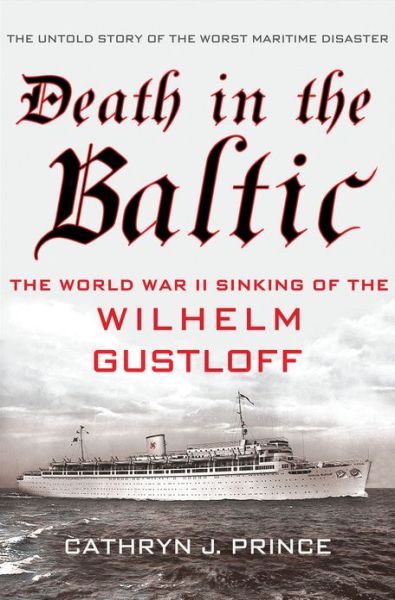
In Death in the Baltic, Cathryn Prince relates the tragic tale of the greatest maritime disaster in recorded human history – the sinking of the Wilhelm Gustloff. Prince has written previously about World War Two as well as the American Civil War and her latest volume is an excellent work of vernacular history. The Wilhelm Gustloff was among the numerous vessels pressed into service for Operation Hannibal – the Nazi seaborne evacuation of East Prussia in early 1945. Prince’s work especially shines in her weaving together various first-hand survivor accounts to paint a picture of what civilian life was like in the waning days of the Third Reich. Her description of the sinking as well as the story of the Soviet sub commander who led the attack are superb and make for highly engaging reading.

The only hiccup in Death in the Balticis Prince’s misuse of some nautical and military terms throughout the book. This is a minor quibble though and on the whole the work is a compact and very readable account of an often forgotten story. For several reasons which Prince highlights in the closing chapters of the book, the sinking of the Wilhelm Gustloff has largely been overlooked in pop history even though its death toll was several orders of magnitude than even the RMS Titanic. Death in the Baltic is a wonderful blend of vernacular, maritime and military history and as such will appeal to a broad cross-section of readers.

voyage of the damned

SS St. Louis in Havana Harbor
Photo: US Holocaust Memorial Museum

On May 13, 1939, the Hamburg-Amerika Line ocean liner SS St. Louis departed Hamburg, Germany for Havana, Cuba. Aboard the St. Louis were more than 930 Jewish refugees seeking refuge in Cuba from Nazi oppression. The refugees had secured legitimate landing certificates for Cuba, however, upon their arrival the refugees learned that the pro-fascist Cuban government had invalidated the visas and all but 27 of the refugees were denied entry. Much like White Russians after the 1917 Revolution, the refugees were now a people without a country. The refugees sought entry into the United States, but in a shameful and cowardly act, the US government denied them access.

Thus, on June 6 the St. Louis was forced to return to Europe where the refugees were eventually divvied up among several European countries – 287 to the United Kingdom, 214 to Belgium, 224 to France and 181 to the Netherlands. As the Nazi juggernaut flattened Europe over the next 18 months many of the refugees once again found themselves under the heel of the Nazi jackboot. Many of the refugees perished in the Holocaust, however, a majority were able to survive the war.

In the subsequent years, the plight of the refugees aboard the St. Louis has been highlighted in print (Refuge Denied & Voyage of the Damned) and the big screen (Voyage of the Damned). As the great statesman Edmund Burke once said, “The only thing necessary for the triumph of evil is for good men to do nothing.” Sadly, good men chose to do nothing when the refugees aboard the St. Louis came calling in Cuba and the United States.

Scotch

Today, two bottles of scotch from the wreck of the 8,000 ton SS Politician went up for auction on Scotch Whisky Auctions’ website. Politican departed Liverpool in February 1941 with a general cargo bound for Kingston, Jamaica and New Orleans. Stuffed within the ship’s holds were 28,000 case of malt whisky. While sailing around the Outer Hebrides, the Politician wrecked off the island of Eriska and the local islanders moved quickly to salvage the cargo and quench their war-deprived thirst.

Forty six years later, in 1987, professional diver Donald MacPhee discovered 8 bottles of whisky on the wreck which were subsequently auctioned by Christie’s for £4,000. As of this writing the winning bid for just 2 of the bottles at the Scotch Whisky Auctions site is £2,400 – a tidy profit for the previous owner.

civil war steamboat

Sultana Ablaze
Photo: Library of Congress

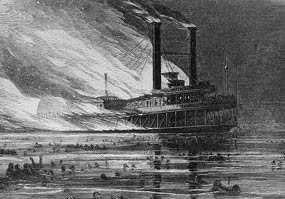
In the waning weeks of the Civil War, the riverboat Sultana departed New Orleans with a load of livestock and passengers bound for St. Louis. Having developed a leak in one of its boilers, the ship stopped in at Vicksburg, Mississippi for some makeshift repairs to replace the leaking boiler plates. Following this stopover, the ship proceeded upriver against the strong spring currents of the Mississippi. Aboard the ship were hundreds of recently released Yankee POWs making their way home from Confederate prison camps. On the evening of April 27, 1865, as the ship’s crew piled on steam to overcome the Mississippi’s currents, a massive explosion ripped through the wooden bowels of the ship and set the entire vessel aflame.

Ablaze and adrift, the Sultana ran aground on the west bank of the Mississippi near present-day Marion, Arkansas. Despite the efforts of several rescue ships, hundreds perished in the frigid waters of the Mississippi from hypothermia or drowning. Dozens more were killed by the initial explosion and subsequent fire. Most of the survivors were taken ~9 miles downriver to Memphis where another ~300 died from their burns. The official death tolleventually reached 1,547, however, estimates have ranged as high as 1,900. Regardless of which figure is correct, the sinking is to this day the deadliest maritime disaster in US history. Despite its high body count, the Sultana’s sinking, both in 1865 and in a historical context, has often been overshadowed by President Lincoln’s assassination and the conclusion of the Civil War.

japanese submarines

Operation Storm by John J. Geoghegan relates the obscure story of Japan’s last ditch effort to launch an attack on American soil in the closing days of World War II. Geoghegan, the executive director of The SILOE Research Institute’s Archival Division, devotes much of his writing to white elephant technology and thus his choice of subject matter is quite apropos. Over the course of ~400 pages, Geoghegan introduces the reader to the Japanese naval officers and designers who helped craft a Hail Mary strategy of launching an airstrike on the Panama Canal from the largest submarines of the war. Each submarine was designed as an underwater aircraft carrier to carry two or three specially developed strike aircraft and the path of their development makes for incredible reading.
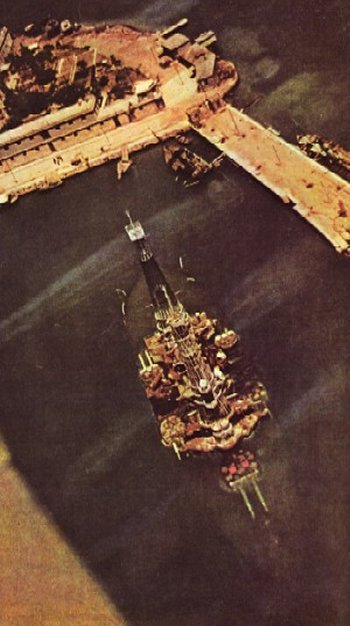
Geoghegan also tells the backstory of the USS Segundo (a sub that often operated in conjunction with USS Razorback) which captured one of the subs in the uneasy days following the capitulation of Japan. Relying on extensive archival research as well as interviews with survivors of the Japanese program, Geoghegan provides readers with a highly readable account of this overlooked aspect of World War II history. In addition to the strength of his research, Geoghegan integrates the story into the continued development of America’s submarine program in the years following World War II. Finally, readers are brought full circle to the present day via two modern points of reference. First, one of the subs (I-401) was re-discovered in 2005 off the coast of Hawaii where it had been used for torpedo practice by the US Navy after the war. Second, the Smithsonian Institution displays the only surviving example of the subs’ Seiran attack planes at its spectacular Steven F. Udvar-Hazy Center in northern Virginia near Dulles Airport. Operation Storm is highly recommended for anyone interested in obscure technology, warfare or a non-traditional history of World War II.

Greek Battleship

Greek Battleship Kilkis Sunk at Anchor
Photo: Wrecksite

On April 6, 1941, the Axis powers launched Operation Marita – an all out invasion of Greece. Two weeks later, on April 23rd, the Luftwaffe dispatched a swarm of Ju-87 dive bombers to strike Greece’s principal naval facilities at Salamis. Caught in port during the raid were the obsolete Greek battleships Limnos and Kilkis. The ships had originally been built for the US Navy in the early 1900s and were sold to Greece in 1914. At the time of the raid, Limnos was merely serving as a floating barracks; however, Kilkis had found more gainful employment as a floating battery to support Greek ground units. The Luftwaffe strike force made quick work of the battleships and by the end of the raid both were resting on the port’s shallow bottom. Following the war, both ships were salvaged for scrap.

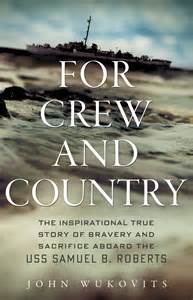
USS Samuel B. RobertsIn his latest book, For Crew and Country, historian John Wukovits recounts the incredible story of the destroyer escort USS Samuel B. Roberts and her rendezvous with destiny in the Philippines at the Battle of Samar. Building off James Hornfischer’s excellent The Last Stand of the Tin Can Sailors which recounted the larger tale of the Battle of Samar, Wukovits focuses exclusively on the Roberts, her crew, construction, shake-down and foray into the Pacific theater. Divided into four parts, the book deals first with the molding of both the vessel and her crew, then moves on to early cruises in the Atlantic and Pacific, segues into the Battle of Samar and concludes with the aftermath of the battle.

While the back story is intriguing and important to subsequent events, For Crew and Country shines brightest in Wukovits narration of the Battle of Samar. Wukovits expended hours conducting interviews and poring over first-hand accounts and correspondence between crew and family members to piece together a gripping minute by minute account of the battle. Wukovits’ narrative technique is so effective that as readers burn through the book’s pages, they can smell the sulfur of battle, hear the ringing echo of the Roberts’ five inch guns pounding away at Japanese warships and taste the sea spray that douses the crew with each near-miss from Japanese salvos.

Although some readers may find Wukovits usage of vernacular history a bit tedious and slow, especially in the telling of the backstory prior to the battle, the technique is fascinating when applied to the battle itself. Unlike some texts which focus on big events and big actors, For Crew and Country eschews this approach to present readers with a moving narration of what a World War II naval battle was like for the common sailor. In sum, For Crew and Country is an excellent read and Wukovits has done much to honor the memory of the brave and intrepid crew of the Roberts.

Raleigh, NC

Sir Walter Raleigh
CC Image Courtesy of Jeffrey L. Cohen on Flickr

The UK’s Western Morning News is reporting that divers believe they may have found the wreck of a ship from Sir Walter Raleigh’s fleet lost in 1617. Local divers Todd Stevens and Robin Burrows discovered the wreck last summer and have worked to identify its remains in the interim period. Stevens is no stranger to wreck diving as he located the HMS Colossus (the captured French 74 Courageux) in 2001. Evidence at the site has led Stevens to believe the wreck could be from the Flying Joan, an armed pinnace which was one of two ships lost during Sir Walter Raleigh’s expedition to modern day Venezuela. Among the artifacts located at the site are two cannon, a swivel gun, a red clay pipe, a bronze pulley sheave and a complete bung hole – all dating from the period during which the Flying Joan was lost.

Sir Walter Raleigh’s role in exploring the New World, handing Spain well-deserved defeats, and helping popularize the use of tobacco made him one of the UK’s most important historical figures. If the wreck site is indeed the Flying Joan, then its recovery and conservation will be a significant addition to the corpus of knowledge about Sir Walter Raleigh, his fleet and maritime practices during the early 17th century.

norway naval battle

Wreck of German Destroyer in Narvik Fjord
CC Image Courtesy of Eugene van Grinsven on Flickr

On the morning of April 9, 1940, the quiet tranquillity of Narvik Fjord was shattered by the arrival of a flotilla of 10 Kriegsmarine destroyers with orders to capture the strategically significant port of Narvik. Despite only possessing the two obsolete coastal defence ships HNoMS Norge and HNoMS Eidsvold, Norwegian naval commander Odd Isaachsen Willoch refused to surrender and the fjord soon echoed with the sound of screaming shells and whooshing torpedoes. Unfortunately for the Norwegians, their outclassed ships were sunk in a battle lasting a mere 20 minutes with the loss of more than 300 sailors. The victorious Kriegsmarine force quickly took possession of the port and the multitude of ships riding at anchor in the harbor.

The next day, though, saw the arrival of a flotilla of Royal Navy destroyers. Among the flotilla was HMS Hotspur which unfortunately was not captained by Commander Hornblower. Engaging the German force, the Royal Navy’s destroyers acquitted themselves well trading the loss of 2 destroyers and 1 heavily damaged for 2 German destroyers sunk, 4 damaged and 7 cargo vessels destroyed. Three days following this engagement, a Royal Navy task force consisting of the battleship HMS Warspite, 9 destroyers and aircraft from HMS Furious unleashed their fury on the remaining German destroyers. Running low on fuel and ammunition, the German flotilla was at the mercy of the British task force and all 8 destroyers along with 2 u-boats were sent to the bottom of Narvik Fjord. Despite their overwhelming victory, the Allies were unable to follow up for lack of ground forces and Narvik remained in German hands.

battle of narvik

Battle of Narvik
CC Image Courtesy of Arkiv i Nordland on Flickr