Archives For November 30, 1999

Battle of the Nile

August 1, 2013 — 3 Comments
Aboukir Bay

Battle of the Nile by Thomas George Webster
CC Image Courtesy of Black County Museums on Flickr

The boy stood on the burning deck

Whence all but he had fled;

The flame that lit the battle’s wreck

Shone round him o’er the dead.

Two hundred fifteen years ago today, Admiral Horatio Nelson pounced upon the French fleet in Aboukir Bay, Egypt. By early morning the next day, Nelson and his fleet had captured or destroyed nearly every French ship and ended Napoleon Bonaparte’s dreams of a French Egypt and the destruction of Britain’s colonial holdings in India. Alternatively called the Battle of the Nile or the Battle of Aboukir Bay, the action would later be immortalized in the poem Casabiana by Felicia Dorothea Hemans, the first stanza of which is above.

For two months in the summer of 1798, Nelson fruitlessly tracked the French fleet across the Mediterranean. Meanwhile, the French used the time to capture the island of Malta and land an army of troops and scholars in Egypt. Although the French troops eventually were defeated, the scholars scored a victory for the ages when they discovered the Rosetta Stone.

After finally catching up with the French fleet in Egypt, Nelson wasted no time in daringly dividing his forces and launching an attack on the French fleet. Dividing his forces allowed the British fleet to engulf the French in a deadly crossfire and after three hours much of the French fleet had been destroyed. Capping the battle was the violent destruction of the French flagship L’Orient caused by a fire reaching one of the ship’s magazines.

kickstarter

Kickstarter, the wildly successful crowdfunding website, is currently hosting two nautical themed projects. The first is “Twice Forgotten,” a documentary about the USS R-12, a training submarine that sank off the coast of Key West, Florida seventy years ago today. Forty US sailors and officers as well as two Brazilian officers went down with the sub and it was not until 2010 that she was re-discovered. Funding will allow the team to return to the site and conduct filming this summer to complete the documentary.

kickstarter

Instead of seeking to tell a true story from the past, the second project aims to produce a fictional film about a World War II submarine and its mysterious disappearance during the war. The film team has partnered with Battleship Cove, the home of the battleship USS Massachusetts and submarine USS Lionfish, to provide a filming location. If the project is funded, then the remaining half of the project’s expenses will be covered and the filming will be able to proceed as planned.

The Hunt for Hitler's Warship

Regnery History, a relatively new imprint of Regnery Publishing, has brought readers yet another fantastic offering in Patrick Bishop’s The Hunt for Hitler’s Warship. Previous books from Regnery History reviewed here include Ships of Oak, Guns of Iron and Fatal Dive. Over the span of ~400 pages, Bishop familiarizes readers with the epic saga of the Nazi battleship Tirpitz from her gestation in Wilhelmshaven to her cataclysmic death at the hands of British bombers in November 1944.

Bishop brings to life the tireless efforts of the Royal Navy, Fleet Air Arm, Royal Air Force and Norwegian Resistance to reduce Nazi Germany’s last remaining battleship Tirpitz to a worthless heap of scrap iron. The reader is also introduced to life aboard the Tirpitz through Bishop’s interviews with surviving crew and archival research. This aspect helps round out the work and present readers with a better understanding of both the dread struck in British military planners’ minds by the Tirpitz as well as the fear and trepidation experienced within the ranks of the Kriegsmarine at the prospect of the loss of the Tirpitz in a surface action.  Unlike Hunting Tirpitz, which I reviewed earlier last year and is essentially a compendium of after-action reports by the British Admiralty, The Hunt for Hitler’s Warship, is an engaging work designed to bring the story of the sacrifices of British and Norwegian sailors and airmen to life for modern audiences.

Scotch

Today, two bottles of scotch from the wreck of the 8,000 ton SS Politician went up for auction on Scotch Whisky Auctions’ website. Politican departed Liverpool in February 1941 with a general cargo bound for Kingston, Jamaica and New Orleans. Stuffed within the ship’s holds were 28,000 case of malt whisky. While sailing around the Outer Hebrides, the Politician wrecked off the island of Eriska and the local islanders moved quickly to salvage the cargo and quench their war-deprived thirst.

Forty six years later, in 1987, professional diver Donald MacPhee discovered 8 bottles of whisky on the wreck which were subsequently auctioned by Christie’s for £4,000. As of this writing the winning bid for just 2 of the bottles at the Scotch Whisky Auctions site is £2,400 – a tidy profit for the previous owner.

Raleigh, NC

Sir Walter Raleigh
CC Image Courtesy of Jeffrey L. Cohen on Flickr

The UK’s Western Morning News is reporting that divers believe they may have found the wreck of a ship from Sir Walter Raleigh’s fleet lost in 1617. Local divers Todd Stevens and Robin Burrows discovered the wreck last summer and have worked to identify its remains in the interim period. Stevens is no stranger to wreck diving as he located the HMS Colossus (the captured French 74 Courageux) in 2001. Evidence at the site has led Stevens to believe the wreck could be from the Flying Joan, an armed pinnace which was one of two ships lost during Sir Walter Raleigh’s expedition to modern day Venezuela. Among the artifacts located at the site are two cannon, a swivel gun, a red clay pipe, a bronze pulley sheave and a complete bung hole – all dating from the period during which the Flying Joan was lost.

Sir Walter Raleigh’s role in exploring the New World, handing Spain well-deserved defeats, and helping popularize the use of tobacco made him one of the UK’s most important historical figures. If the wreck site is indeed the Flying Joan, then its recovery and conservation will be a significant addition to the corpus of knowledge about Sir Walter Raleigh, his fleet and maritime practices during the early 17th century.

battle of the atlantic

Blackett’s War documents the application of science to the Battle of the Atlantic and the outsized impact a small collection of British scientists had on its outcome. Author Stephen Budiansky charts the life of Nobel Prize winner Patrick Blackett, a British naval officer turned scientist, from his service in World War I to his 1930s academic life and conversion from civilian scientist to architect of a scientific method of fighting the Battle of the Atlantic. In the first section of the book, Budiansky follows Blackett’s World War I and inter-war experiences as well as those of the United Kingdom as a whole. In particular, Budiansky focuses on the deployment of the submarine as an unconventional offensive weapon and how it nearly brought Britain to her knees in World War I.
As the tale progresses, other scientists and historical events are woven into the story to add context and depth to the fascinating melding of ruthless warfare with statistical analysis, cryptography and electronic detection and countermeasures. While this often helps advance the storyline, at times it becomes difficult to keep track of the countless characters and events. If there is any flaw in the book, it is that the inclusion of these characters renders the title slightly misleading. The book is less about Patrick Blackett than it is about the scientific teams on both sides of the Atlantic that fought both their own civilian and military bureaucracy and the Kriegsmarine to win the naval war. Overall Blackett’s War is an intriguing read that provides a unique blend of scientific and military history.

royal navy painting

Battle of Santo Domingo
Nicholas Pocock, National Maritime Museum

After the defeat of the French fleet at Trafalgar on October 20, 1805, the British Admiralty pulled back its close blockade of the primary French naval base at Brest. Sensing an opportunity to wage war on the British merchant fleet, Napoleon dispatched two naval squadrons to the West Indies. Ordered to prey on merchant shipping and avoid engaging naval forces of equal or greater strength, the two squadrons weighed anchor for the West Indies and escaped initial detection by the Royal Navy.

After discovering the escape of the French, the Royal Navy dispatched a force of six ships of the line under the command of Vice-Admiral Sir John Duckworth to destroy the French. Admiral Duckworth’s force detected a French squadron of five ships of the line and two frigates near Santo Domingo in the West Indies on February 1, 1806 and Admiral Duckworth quickly gathered additional ships to his command. Early on the morning of February 6, Admiral Duckworth made the decision to engage the French and his squadron set upon the French squadron in Santo Domingo’s harbor. By end of the afternoon, all five of the French ships of the line had been captured or destroyed. The Royal Navy lost no ships and suffered less than a hundred killed while the French lost approximately 1,500 men. Only the two frigates and some lesser ships of the French squadron were able to escape.

The victory at Santo Domingo made Admiral Duckworth a hero in Britain and signaled the end of any effective offensive capability by the French Navy. As a random historical side note, author Jane Austen’s brother Captain Francis Austen, served at the Battle of Santo Domingo as captain of the 80-gun ship of the line HMS Canopus. Austen weaved the battle into the background of a character in her book Persuasion. Canopus’ successor would later fight farther south during World War I at the Battle of the Falklands when another belligerent raiding squadron was annihilated by a Royal Navy squadron.

royal navy submarine

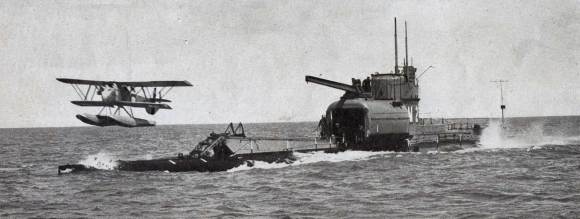
HMS M2

While the submarine has existed for centuries, it was not until World War I that the weapon performed to a level that made it an effective weapon. The German Imperial Navy’s submarine blockade nearly brought Great Britain to her knees and as a result the victorious navies continued the refinement of the submarine as an offensive weapon during the inter-war years. The Royal Navy pushed the envelope of innovation with the creation of the first ever aircraft carrying submarine, HMS M2.

Laid down during World War I, the M2 was originally designed to carry a single 12-in. gun and act as a submersible cruiser. Nearly a decade after her commissioning, the British Admiralty decided to remove the 12-in. gun and use the M2 as a test bed for developing a submarine capable of carrying a small reconnaissance biplane. The tactical concept was that the M2 would screen the battle fleet and use her biplane to extend her effective observational range. To do this, a watertight hangar, crane and launch ramp were added aft of the submarine’s conning tower.

Sadly, the M2 was lost with all hands while conducting exercises on January 26, 1932 in Lyme Bay off Dorset. It is believed the crew opened the hangar door while still submerged thus sinking the ship. A subsequent 11 month salvage attempt failed to bring her and she now lies in 90 feet of water where it has become a popular dive site. The Royal Navy abandoned the aircraft carrying submersible concept shortly thereafter.

The period video below demonstrates the M2 deploying, launching and recovering its single biplane.

For All the Tea in China

January 17, 2013 — 1 Comment
clipper ship

Tea Clipper Hallowe’en Aground
Photo: http://www.wrecksite.eu

The ghostly image above resulted from the wreck of the record breaking clipper ship Hallowe’en on January 17, 1887. The Hallowe’en was loaded with 1600 tons of tea from Shanghai, China and she ran aground in a storm off Soar Mill Cove in the United Kingdom. Tea clippers were designed to quickly bring the latest crop of tea leaves from China to western markets. The Hallowe’en briefly held the record for fastest voyage from Shanghai to London in 1874 when she made the voyage in a mere 91 days. The ship eventually sank and can now be visited by divers.

wrecked ship

SS Knud Aground
Photo: Wrecksite

Some of the most impressive maritime images are derived from ships being found in places where they are completely out of their element. Blogger gCaptain compiled a grouping of photos the top ten maritime incidents of 2012 and many of them are ship’s aground in spectacular locations or angles. More than a century ago, the Danish steamer SS Knud created a similar image when it ran aground in Robin Hood’s Bay on January 2, 1900. The steamer had been launched on October 19, 1871 and was a Clyde built merchant steamship of 1,185 tons. When she ran aground she was loaded with a cargo of ballast, but thankfully none of her crew were lost in the debacle. The cargo was later salvaged and the ship sold for scrap.