Archives For November 30, 1999

Royal Navy

HMS Exeter Sinking

In the months following the Japanese bombing of Pearl Harbor on December 7, 1941, the Japanese juggernaut swept through the Pacific in an all out quest to secure natural resources and eliminate its opponents. A prime target in the Japanese crosshairs was the Dutch East Indies – modern-day Indonesia. In February 1942, the Imperial Japanese Navy dispatched a task force consisting of two heavy cruisers, two light cruisers and 14 destroyers to escort an invasion force of ten transports. Opposing the IJN task force was a motley assortment of Dutch, US, British and Australian naval assets including two heavy cruisers, three light cruisers and nine destroyers.

The Allied force was outmatched in numbers and firepower as the Japanese heavy cruisers possessed more heavy caliber guns than their Allied equivalents. Additionally, they were also hampered by communication and coordination issues stemming from trying to integrate ships from four navies into a single task force. In a desperate attempt to destroy the Japanese invasion force before it offloaded its troops, the Allied force sailed into the teeth of the Japanese task force late in the afternoon on February 27, 1942.

The Allied force tried vainly to close within gunfire range of the Japanese transports, but each time they were rebuffed by a hellish rain of gunfire from the Japanese escorts. As the afternoon progressed the Japanese advantages began to tell with Allied ships succumbing to torpedo attacks, gunfire and even mines. By midnight, three destroyers and two cruisers, HNLMS De Ruyter and HNLMS Java, had been lost along with the Dutch admiral in charge of the Allied task force.

Later the next day, two of the surviving three cruisers were annihilated in a follow-on battle in Sunda Strait. Only a day later, on March 1, in the Second Battle of the Java Sea, the remaining Allied cruiser, HMS Exeter, and her two destroyer escorts were sunk. In just three days, the Allies had lost five cruisers and another six destroyers while the IJN had suffered the loss of only a few escort vessels and transports sunk or damaged.

With Allied naval power in the region either destroyed or driven off to Australia, the Japanese conquest of the Dutch East Indies was virtually assured. Not only did the battles of the Java Sea and Sunda Strait represent a stinging defeat for the Allies, but it also signaled the beginning of the end of Dutch colonial power in Indonesia.

SS Gairsoppa

February 16, 2014 — Leave a comment
sunken silver

SS Gairsoppa

At 10:30pm on February 16, 1941, U-101, captained by Korvetten-Kapitan Ernst Mengersen took up a firing position off the starboard midsection of a lone British freighter slowly making her way through heavy North Atlantic seas. Despite his first spread missing, Mengersen persisted with the attack and fired another torpedo which struck the freighter’s number two hold and caused a massive explosion to rip through the vessel. Less than 20 minutes later the ship slipped beneath the frigid waves of the North Atlantic. Unbeknownst to Mengersen or any of the crew of the U-101, the freighter they had sunk, the SS Gairsoppa, was laden with an incredibly valuable cargo of silver ingots bound from India to the United Kingdom.

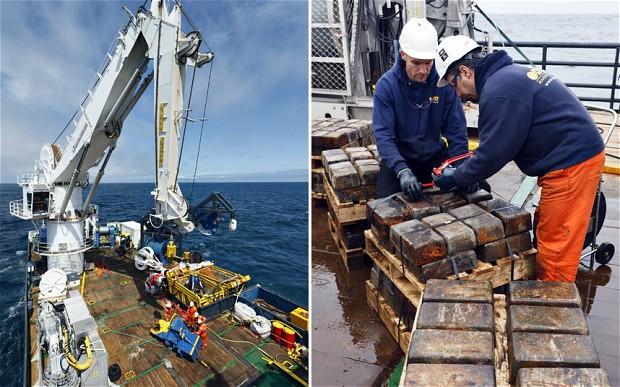
Seventy years after the Gairsoppa sinking, an American company, Odyssey Marine Exploration, through a competitive bid was awarded the exclusive salvage contract by the UK government to recover the Gairsoppa’s silver cargo . The UK government’s Ministry of War Transport had paid out a war insurance claim on the silver during World War II and as a result was the legal owner of the silver. Under the contract, which followed standard commercial practices, Odyssey assumed the risk of search and recovery and retained 80% of the net salved value of Gairsoppa silver cargo. During 2012-2013 operations, Odyssey went to work discovering, mapping and recovering the Gairsoppa’s cargo. Over the course of two summers, Odyssey recovered more than 99% of the insured silver bars equaling more than 3.5 million ounces of silver. Although most of the silver was  sent to a UK refinery, investors and shipwreck enthusiasts can purchase 10oz silver ingots and 1/4oz silver Britannias struck by the Royal Mint from silver recovered from the Gairsoppa.

Odyssey Marine

Photo: Odyssey Marine Exploration, Inc.

Royal Navy

HMS Liverpool
CC Image Courtesy of Jonathan Jordan on Flickr

On Friday, the UK Ministry of Defence announced the solicitation of bids for the scrapping of two of its Type 42 destroyers, HMS Liverpool and HMS Manchester. Both ships were launched in 1978, commissioned in 1982 and saw service the First Gulf War. The scrapping of their sister ship HMS Edinburgh was announced last year and drew record crowds when she was open for tours in Liverpool for the 70th Anniversary of the Battle of the Atlantic in May 2013.

Today the Type 42s have been replaced by the Type 45s in their fleet air defense role. Unfortunately for the United Kingdom, NATO, the US and all who rely on the US, the UK and their allies to ensure the freedom of the seas, the vessels are being replaced at a ratio of 2:1 with only six joining the fleet. While only two of the six Type 45s have officially joined the Royal Navy’s fleet, one, HMS Dauntless has already been deployed to the Falklands to ensure the continued liberty of the Falkland Islands. While the Type 45s are vastly more capable than the Type 42s they replace, the Royal Navy will lose the quality that comes with quantity and be forced to further rely on allies and “hope” as a strategic defense policy. All the while, many of the Royal Navy’s vessels, including the carrier HMS Ark Royal, face transformation from mighty vessels of war to lowly razor blades.

u-boat pastor

Martin Niemoller

First they came for the Socialists, and I did not speak out – Because I was not a Socialist.

Then they came for the Trade Unionists, and I did not speak out – Because I was not a Trade Unionist.

Then they came for the Jews, and I did not speak out – Because I was not a Jew.

Then they came for me – and there was no one left to speak for me.

These famous words were composed by German theologian, Confessional Church pastor and anti-Nazi Martin Niemoller. Notably, Niemoller was no academic unfamiliar with the hardships of armed conflict for he had served with distinction in the Imperial German Navy in World War I as a U-boat captain. During his time as second officer aboard U-39, the U-boat and her crew sank 35 ships for over 90,000 tons of shipping. Additionally, while aboard U-73, the boat deployed the mine that sank the RMS Titanic’s sister ship HMHS Brittanic. Niemoller was awarded the Iron Cross First Class for his contributions to the Imperial war effort and ended the war with command of his own U-boat, UC-67.

Like fellow theologian and Confessing Church pastor Dietrich Bonhoeffer, Niemoller spoke out against the Nazi regime and was arrested in 1937 by Nazi authorities. Niemoller spent the remainder of the Nazi years in various prisons and concentration camps including Sachenhausen and Dachau for his “crimes.” Later in life Niemoller became an ardent pacifist, campaigned for nuclear disarmament, won the Lenin Peace Prize and even visited North Vietnam’s communist dictator Ho Chi Minh during the Vietnam War. Sadly, Niemoller’s eight years in Nazi prisons had not completely inoculated him to the dangers of authoritarian government or the ugly necessity of war in certain instances.

Chernobyl Ghost Ships

Photo: Timm Suess

The past week has seen a slew of articles making their way around the internet about the USSR/Russian “ghost ship” Lyubov Orlova drifting toward the British coast infested with a cargo of cannibal rats. Although the vessel is most likely at the bottom of the ocean, there exists almost an entire fleet of ghost ships rusting away within the confines of the former USSR.

Nearly thirty years ago, on April 26, 1986, the city of Prypiat became ground zero for the most devastating nuclear disaster to date. With the meltdown of the Chernobyl nuclear reactor, the Soviet government was forced to evacuate the city and leave behind personal belongings, vehicles, vessels, factories and homes. In the years since the disaster, photographers and urban explorers have ventured to Prypiat and brought back incredible photos of an abandoned modern society slowly sinking into the irradiated landscape.

Chernobyl Ghost Ship

On the night of December 19, 1941, a half dozen Italian frogmen slipped into the British naval anchorage at Alexandria, Egypt. Sitting astride human torpedos, the frogmen quietly went to work placing explosive charges under British warships including the battleships HMS Valiant and Queen Elizabeth. Although all six of the frogmen were captured as they tried to make their escape, their charges successfully detonated around 0600. The Valiant and Queen Elizabeth both settled quickly on the shallow bottom of Alexandria’s harbor while a Norwegian oiler, M/V Sagona and the Royal Navy destroyer, HMS Jervis, she was refueling were also severely damaged.

Despite these successes, the raid was not nearly as successful as the Italians had hoped for two reasons. First, the original assault plan had called for the initial charges to sink the tankers in the harbor and spread fuel oil across the surface of the anchorage’s water. Secondary incendiary devices were then to ignite the fuel oil and turn the harbor into a blazing inferno. The Sagona’s oil tanks, though, miraculously failed to rupture and the incendiary devices, despite exploding as planned, had nothing to ignite. Second, because the two battleships sank on an even keel, post-raid aerial reconnaissance mistakenly thought the ships had not been damaged at all. As a result, the Italians failed to take advantage of a vastly changed strategic situation in the Mediterranean with the British battle fleet seriously weakened.

The Valiant and Queen Elizabeth both underwent repairs in South Africa and the US respectively and returned to the war effort in 1943. Both served in the Pacific Theater before returning to the UK where the Valiant was scrapped in 1945 and the Queen Elizabeth in 1948. A new Queen Elizabeth is set to join the Royal Navy in 2017 for sea trials and the ship will mark the return of carrier borne fixed wing aviation to the Royal Navy.

Mississippi

The Mississippi River is the fourth longest river in the world with a watershed encompassing all or parts of 31 states and 2 Canadian provinces – 1.2 million square miles worth. 1,200,000 square miles is a lot of territory to cover and yet in his latest book, Old Man River, Paul Schneider provides readers with a sweeping overview of the river from its geological origins to the taming of the river by the modern US Army Corps of Engineers. Schneider serves up a veritable feast with an appetizer of geology, a second course of pre-historic and Indian tales, a main course of 19th and 20th century stories spiced with liberal helpings of Mike Fink, Ulysses S. Grant and Mark Twain and finished off with a dessert of modern events.

Interspersed throughout historical tales of floods, Indian raids and keelboats, Schneider weaves in his own odyssey on the Mississippi and her tributaries. From kayaking the Ohio alone to drifting down the Mississippi with his son, Schneider brings to life the various locales he visits. For those who have spent any amount of time living on the River, Schneider’s book will especially resonate as he perfectly captures the feelings and color of the River’s varying culture. Although a couple passages inadvertently come across as elitist and preachy, overall Old Man River is a beautiful ode to one of America’s defining geographic landmarks. For those looking to lazily drift from the breadbasket plains states past Mark Twain’s Hannibal, St. Louis’s Gateway Arch and Busch Stadium, the antebellum homes of Natchez, the bluffs of Vicksburg where the blood of men in blue and gray flowed and down to the Cajun culture of the Delta, Old Man River is a highly recommended read.

khukri

Today marks the thirty-second anniversary of the first, and thus far, only sinking of an Indian naval vessel. On December 3, 1971, tensions between India and Pakistan reached a fever pitch and the countries began a thirteen day shooting war. On December 9, Indian early warning posts detected a submarine patrolling close to the harbor of Diu and a squadron of frigates was dispatched to dispense with the trespasser.

The submarine in question was the Pakistani Hangor, a sub completed by the French in 1970 for Pakistan’s Navy. Sallying forth against the Hangor were the two British built frigates, Khukri and Kirpan. The Hangor launched two (although some sources claim three) homing torpedoes which struck the Khukri and sent her to the bottom in short order. Despite being attacked with depth charges, the Hangor successfully returned to Pakistan where she served until 2006 when she was transformed into a museum ship. The Khukri was the first ship sunk by a submarine since World War Two and would remain so until the HMS Conqueror sank the ANA General Belgrano during the Falklands War. All told 194 Indian sailors lost their lives and hostilities ceased just 7 days later.

China submarine

In his new book, Poseidon, expat journalist and diver Steven Schwankert brings alive the unfortunate sinking and mysterious salvage of the Royal Navy submarine HMS Poseidon. Over the course of several years, Schwankert meticulously researched the history of the Poseidon via trips to UK archives, Chinese museums and libraries and even a dive on the wreck of her sister ship in the Ionian Sea. Schwankert’s research shows in the compelling manner in which he unfolds the story of the Poseidon, her crew and their fate, and the subsequent history of the vessel in the context of greater Chinese/world history.

The book especially shines in Schwankert’s dogged determination to get to the bottom of the story. His investigative efforts bear fruit in the later pages of the book as he brings to life the terrestrial surroundings of Poseidon’s sinking on Liu Gong Island. Readers will be engrossed by the dramatic escape of some of Poseidon’s trapped crew members and the mysterious disappearance of the wreck from the sea floor. Poseidon helped make a trans-Pacific flight pass by in almost no time at all and is well worth the read. China history buffs, maritime historians, lovers of detective novels and any fan of Dirk Pitt will enjoy the tale told by Schwankert in Poseidon.

Robert Holland

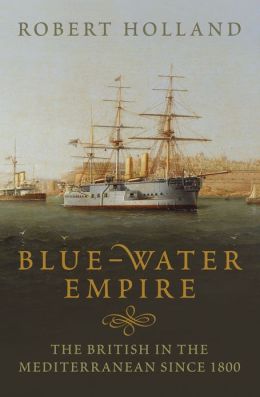
Robert Holland’s Blue-Water Empire is a phenomenal history of British engagement in the Mediterranean world from 1800 to the present. Holland takes the reader around the entire circumference of the Mediterranean from Gibraltar to Malta to the Ionian Islands to Cyprus to Suez and leaves the reader struck by the influence the United Kingdom exerted in places many could not even locate on a map. Instead of focusing explicitly on social, political, military, diplomatic or economic history, Blue-Water Empire masterfully weaves them all together to present a comprehensive account of Great Britain’s strategy (or lack thereof) in colonizing and policing the Mediterranean over the course of three centuries.

Perhaps the most interesting aspect of the book is how Great Britain’s actions in the Mediterranean continue to echo today. For example, Holland carefully analyzes the trajectory of Cyprus under British rule and the air fields retained by the United Kingdom after her political withdrawal from the island. Those same air fields at Akrotiri and Dhekelia have been used as staging grounds for any action against Syria in 2013 or 2014. Also addressed in the book is the perennial question of how best to deal with the flood of refugees that accompanies unrest in North Africa or the Middle/Near East. Not only has the Arab Spring resulted in the destabilization of the region, but it also has driven refugees to seek asylum in places like Malta and Italy. Tragically, many of those refugees have died en route as their vessels are overcroweded and unseaworthy and subsequently sink.

Overall, Blue-Water Empire will not only entertain the casual reader, but will also inform the curious as to some of the origins of today’s headlines.