The Spratlys

March 14, 2014 — Leave a comment
Spratlys

Boomerang Island in the Spratlys
CC Image Courtesy of Storm Crypt on Flickr

As relations continue to deteriorate between China and Japan over the Senkaku/Diaoyu Islands, it is easy to forget that China has had previous conflicts over other island chains that exist in close proximity to its borders. One such conflict occurred on March 14, 1988 between Vietnamese forces and elements of the People’s Liberation Army Navy (PLAN).

Taiwan, the PRC, Vietnam, the Philippines, Malaysia and Brunei have all laid claim to the Spratly Islands, an uninhabited collection of 750 islands, reefs and atolls in the South China Sea. Apart from rich fishing grounds and possible oil and gas deposits, the islands have no economic value; their primary value being geopolitical in nature. In early 1988, Vietnamese forces began landing forces and construction supplies at one of the reefs in order to further their claim to the area. A short skirmish erupted when the Vietnamese forces encountered a PLAN squadron.

Despite this confrontation, the two countries continued to operate in the area until March 14 when PLAN and Vietnamese forces again collided. This time the firefight was more intense and by the time it was over two Vietnamese transports had been sunk and another heavily damaged. While the Chinese suffered no casualties, the Vietnamese lost more than 70 sailors in the short and sharp encounter.

The Chinese victory, now known as the Johnson South Reef Skirmish, allowed the PLA to occupy several more reefs in the area and expand their area of influence at the expense of Vietnam. A resolution to the issue between the multitude of sparring countries has yet to occur and provides simply one more smoldering match to the growing powder keg that is the South and East China Seas.

Royal Navy

HMS Exeter Sinking

In the months following the Japanese bombing of Pearl Harbor on December 7, 1941, the Japanese juggernaut swept through the Pacific in an all out quest to secure natural resources and eliminate its opponents. A prime target in the Japanese crosshairs was the Dutch East Indies – modern-day Indonesia. In February 1942, the Imperial Japanese Navy dispatched a task force consisting of two heavy cruisers, two light cruisers and 14 destroyers to escort an invasion force of ten transports. Opposing the IJN task force was a motley assortment of Dutch, US, British and Australian naval assets including two heavy cruisers, three light cruisers and nine destroyers.

The Allied force was outmatched in numbers and firepower as the Japanese heavy cruisers possessed more heavy caliber guns than their Allied equivalents. Additionally, they were also hampered by communication and coordination issues stemming from trying to integrate ships from four navies into a single task force. In a desperate attempt to destroy the Japanese invasion force before it offloaded its troops, the Allied force sailed into the teeth of the Japanese task force late in the afternoon on February 27, 1942.

The Allied force tried vainly to close within gunfire range of the Japanese transports, but each time they were rebuffed by a hellish rain of gunfire from the Japanese escorts. As the afternoon progressed the Japanese advantages began to tell with Allied ships succumbing to torpedo attacks, gunfire and even mines. By midnight, three destroyers and two cruisers, HNLMS De Ruyter and HNLMS Java, had been lost along with the Dutch admiral in charge of the Allied task force.

Later the next day, two of the surviving three cruisers were annihilated in a follow-on battle in Sunda Strait. Only a day later, on March 1, in the Second Battle of the Java Sea, the remaining Allied cruiser, HMS Exeter, and her two destroyer escorts were sunk. In just three days, the Allies had lost five cruisers and another six destroyers while the IJN had suffered the loss of only a few escort vessels and transports sunk or damaged.

With Allied naval power in the region either destroyed or driven off to Australia, the Japanese conquest of the Dutch East Indies was virtually assured. Not only did the battles of the Java Sea and Sunda Strait represent a stinging defeat for the Allies, but it also signaled the beginning of the end of Dutch colonial power in Indonesia.

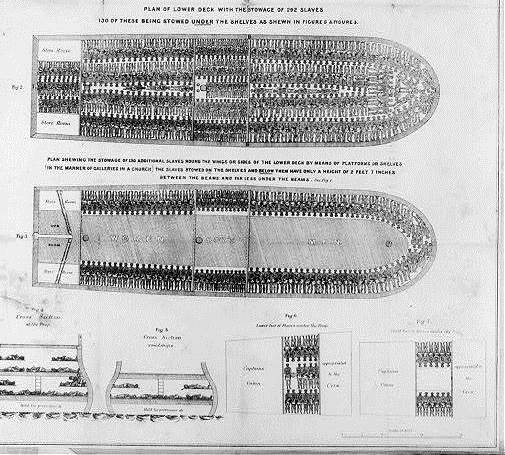
slaveryThe Telegraph is reporting that a combined British and Dutch group of explorers are mobilizing for an expedition to South America to locate the wreck of the Dutch slave ship Leusden. Widely believed to be the deadliest disaster to befall a slave ship, the Leusden ran aground on January 1, 1738 with a “cargo” of nearly 700 African captives. Prior to the early 19th century crusade of William Wilberforce and his fellow abolitionists to outlaw the slave trade, slave ships regularly plied the waters between Africa and the New World exchanging human cargos for sugarcane, molasses, silver, gold and other valuables. Although the trade was outlawed in 1807, it was only the iron fist of Royal Navy enforcement that prevented the horrific trade from continuing to occur.

The Leusden, a Dutch West Indiaman, departed Ghana on November 19, 1737 after having waited six months to collect a full cargo. The ship had an uneventful passage until she was dragged ashore by a strong tidal current. Tragically, while the ship was aground, the rudder broke off and water flooded into the crowded confines of the hold. Abandoning ship, the crew left the 664 Africans trapped below-deck where they all perished as the sea clawed the Leusden and her 664 souls into her dark depths.

In less than two months, the British and Dutch team hope to return to the site of the sinking off the coast of Suriname and conduct an in-depth survey of the wreck. The team has narrowed their search area and intend to use side-scan sonar to locate and survey the wreck. Not only would the discovery be archaeologically important, but it would also serve to highlight the heroism of men like William Wilberforce, Lord Grenville and Foreign Secretary Charles James Fox who passionately fought to end the disgusting and repugnant trade in human flesh.

george washington

Portrait of George Washington by Charles Willson Peale
Washington & Lee University

Today marks the official celebration of Washington’s Birthday (aka Presidents’ Day). Lighthorse Harry Lee described George Washington as “first in war, first in peace and first in the hearts of his countrymen,” a fitting description for a man who personally shaped many of America’s first martial and political traditions. While George Washington and tales of cherry trees, providential safety in battle and his wooden false teeth are typical textbook fare, less well known is the story behind the Washington family’s emigration to the colonies.

Born around 1633 in England, George Washington’s great-great grandfather Lawrence Washington embarked aboard the Seahorse in 1656 to trade tobacco with Virginian colonists. As the Seahorse neared the Virginia coastline, the ship was caught in a storm and wrecked near The Clifts, a plantation owned by one Nathanael Pope (part of the plantation later became the Lee family home of Stratford Hall). Instead of returning to England, young Lawrence grew enamored with Nathanael’s daughter Anne and married her in 1658. Lawrence served his adopted colony of Virginia in her militia as well a the House of Burgesses and died with 8,500 acres to his name. Thus, if it weren’t for a shipwreck and a beguiling Southern belle, an English born George Washington may very well have been leading British and Hessian troops against the colonists in 1776.

SS Gairsoppa

February 16, 2014 — Leave a comment
sunken silver

SS Gairsoppa

At 10:30pm on February 16, 1941, U-101, captained by Korvetten-Kapitan Ernst Mengersen took up a firing position off the starboard midsection of a lone British freighter slowly making her way through heavy North Atlantic seas. Despite his first spread missing, Mengersen persisted with the attack and fired another torpedo which struck the freighter’s number two hold and caused a massive explosion to rip through the vessel. Less than 20 minutes later the ship slipped beneath the frigid waves of the North Atlantic. Unbeknownst to Mengersen or any of the crew of the U-101, the freighter they had sunk, the SS Gairsoppa, was laden with an incredibly valuable cargo of silver ingots bound from India to the United Kingdom.

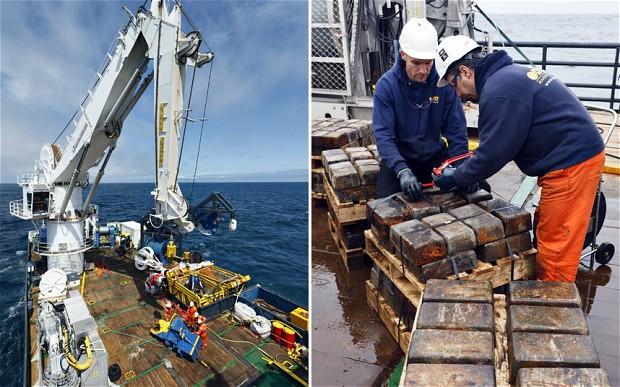
Seventy years after the Gairsoppa sinking, an American company, Odyssey Marine Exploration, through a competitive bid was awarded the exclusive salvage contract by the UK government to recover the Gairsoppa’s silver cargo . The UK government’s Ministry of War Transport had paid out a war insurance claim on the silver during World War II and as a result was the legal owner of the silver. Under the contract, which followed standard commercial practices, Odyssey assumed the risk of search and recovery and retained 80% of the net salved value of Gairsoppa silver cargo. During 2012-2013 operations, Odyssey went to work discovering, mapping and recovering the Gairsoppa’s cargo. Over the course of two summers, Odyssey recovered more than 99% of the insured silver bars equaling more than 3.5 million ounces of silver. Although most of the silver was  sent to a UK refinery, investors and shipwreck enthusiasts can purchase 10oz silver ingots and 1/4oz silver Britannias struck by the Royal Mint from silver recovered from the Gairsoppa.

Odyssey Marine

Photo: Odyssey Marine Exploration, Inc.

message in a bottle

Sister Ship of SS Naronic

“Feb.  19, 1893- Naronic sinking. All hands praying. God have mercy on us.”  ~L. Winsel

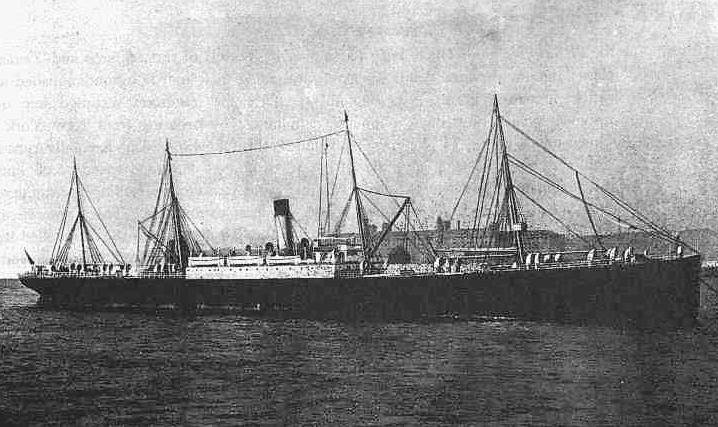
On February 11, 1893, the White Star Line steamer SS Naronic departed Liverpool for New York with 74 crew as well as 3,600 tons of general cargo. Built in 1892 by Harland and Wolff, the same company that would build the ill-fated Titanic, the Naronic measured 470 feet in length and had twin coal fired reciprocating engines capable of propelling her through the waves at a steady 13 knots. Although the ship had been built as a cattle vessel, additional passenger accommodations were added to permit her to earn extra revenue on non-New York routes.

After landing her pilot at Point Lynas, Wales, the Naronic sailed for New York and entered the mists of history as neither she nor any of her crew members were ever seen again. On March 3, a bottle washed ashore in Bay Ridge, New York with the contents “Feb. 19, 1893 – Naronic sinking. All hands praying. God have mercy on us.” The note was signed by a L. Winsel, but there was no L. Winsel on the Naronic’s manifest – the closest name being John L. Watson. Three more bottles were found over the next six months – one in Virginia, another in the Irish Channel and a fourth in the Mersey River. None were signed by identifiable members of the ship’s crew, but two contained generally the same story – the ship had struck an iceberg in a storm and sunk over the course of a few hours.

A subsequent British Board of Trade inquiry dismissed the iceberg theory as not fitting the weather patterns, but local reports in New York placed icebergs in the general vicinity of where the Naronic was sailing. Two separate reports were made of ships sighting lifeboats from the Naronic but the exact location or cause of her sinking has never been determined – it was even speculated that the ship was the casualty of a terrorist bombing.

Royal Navy

HMS Liverpool
CC Image Courtesy of Jonathan Jordan on Flickr

On Friday, the UK Ministry of Defence announced the solicitation of bids for the scrapping of two of its Type 42 destroyers, HMS Liverpool and HMS Manchester. Both ships were launched in 1978, commissioned in 1982 and saw service the First Gulf War. The scrapping of their sister ship HMS Edinburgh was announced last year and drew record crowds when she was open for tours in Liverpool for the 70th Anniversary of the Battle of the Atlantic in May 2013.

Today the Type 42s have been replaced by the Type 45s in their fleet air defense role. Unfortunately for the United Kingdom, NATO, the US and all who rely on the US, the UK and their allies to ensure the freedom of the seas, the vessels are being replaced at a ratio of 2:1 with only six joining the fleet. While only two of the six Type 45s have officially joined the Royal Navy’s fleet, one, HMS Dauntless has already been deployed to the Falklands to ensure the continued liberty of the Falkland Islands. While the Type 45s are vastly more capable than the Type 42s they replace, the Royal Navy will lose the quality that comes with quantity and be forced to further rely on allies and “hope” as a strategic defense policy. All the while, many of the Royal Navy’s vessels, including the carrier HMS Ark Royal, face transformation from mighty vessels of war to lowly razor blades.

L'Insurgente

USS Constellation Defeats L’Insurgente

Though largely forgotten today, in the closing years of the 18th century, the newly formed United States Navy fought an unofficial war with the French Navy. Dubbed the Quasi-War, the conflict gave the fledgling US Navy the opportunity to cut its teeth in preparation for later conflicts with the Barbary Pirates and the Royal Navy. Fittingly, the US Navy’s first victory also belonged to its first warship, USS Constellation.

While sailing off the coast of Nevis in the Caribbean on February 9, the Constellation came upon an unidentified frigate and immediately gave chase. Over the course of the next hour and a half the two vessels danced across the sea in a deadly waltz. As the vessels attempted to outmaneuver one another, a gale came up and damaged the L’Insurgente’s main topmast which enabled the undamaged Constellation to gain on the French ship. In an engagement lasting less than an hour and a half, the Constellation made quick work of the French and the L’Insurgente struck her colors. Marking the first victory of the US Navy, the French vessel was commissioned the USS Insurgent and the Constellation’s commander, Commodore Thomas Truxton, and her crew were celebrated as heroes upon their return.

u-boat pastor

Martin Niemoller

First they came for the Socialists, and I did not speak out – Because I was not a Socialist.

Then they came for the Trade Unionists, and I did not speak out – Because I was not a Trade Unionist.

Then they came for the Jews, and I did not speak out – Because I was not a Jew.

Then they came for me – and there was no one left to speak for me.

These famous words were composed by German theologian, Confessional Church pastor and anti-Nazi Martin Niemoller. Notably, Niemoller was no academic unfamiliar with the hardships of armed conflict for he had served with distinction in the Imperial German Navy in World War I as a U-boat captain. During his time as second officer aboard U-39, the U-boat and her crew sank 35 ships for over 90,000 tons of shipping. Additionally, while aboard U-73, the boat deployed the mine that sank the RMS Titanic’s sister ship HMHS Brittanic. Niemoller was awarded the Iron Cross First Class for his contributions to the Imperial war effort and ended the war with command of his own U-boat, UC-67.

Like fellow theologian and Confessing Church pastor Dietrich Bonhoeffer, Niemoller spoke out against the Nazi regime and was arrested in 1937 by Nazi authorities. Niemoller spent the remainder of the Nazi years in various prisons and concentration camps including Sachenhausen and Dachau for his “crimes.” Later in life Niemoller became an ardent pacifist, campaigned for nuclear disarmament, won the Lenin Peace Prize and even visited North Vietnam’s communist dictator Ho Chi Minh during the Vietnam War. Sadly, Niemoller’s eight years in Nazi prisons had not completely inoculated him to the dangers of authoritarian government or the ugly necessity of war in certain instances.

The UK Telegraph is reporting that a fisherman from El Salvador, Jose Salvador Alvarenga, has landed in the Marshall Islands, ~8,000 miles from his starting point in Mexico. Supposedly, Mr. Alvarenga and a 15 year old, Ezekiel, departed for a day long fishing trip 13 months ago and only just now reached land. Alvarenga survived by eating birds, sharks, turtles, fish and other wildlife while Ezekiel perished only four months into the trip as he refused to eat. While tales such as this exist, it is still yet to be proved whether Alvarenga’s account is true. It is also still unconfirmed whether Gilligan or the Skipper were aboard at any point during his epic voyage.