chinese porcelain

Blue & White Yuan Dynasty Porcelain
Photo: history.cultural-china.com

Earlier this year Vietnamese fishermen in the province of Quang Ngai came across a shipwreck full of Chinese porcelain. The fishermen recovered several artifacts and later tried to illegally sell them, but the items were intercepted by Vietnamese authorities. After examination by archaeologists and porcelain experts, the porcelain bowls and incense burners have been determined to be from the 14th century Yuan Dynasty. The porcelain is among the oldest artifacts found in Vietnam and the find is believed to be relatively well preserved beneath sand and silt. Recovery operations have not been announced, but the wreck would undoubtedly yield increased knowledge about trading patterns from the period along with priceless porcelain.

Porcelain has long been an important export for the Chinese economy. The Pacific Ocean, South China Sea and even the Atlantic Ocean are littered with porcelain carrying shipwrecks from every Chinese dynasty. During the American Colonial Period, Chinese porcelain from Jingdezhen in Jiangxi province was considered one of the highest forms of conspicuous consumption. New England merchants made fortunes importing porcelain from China and one item in especial demand was porcelain decorated with the owner’s coat of arms – “armorial porcelain.” Even President George Washington owned a dinner service set of the trendy armorial porcelain. Pieces of Washington’s porcelain are now housed at Washington & Lee’s Reeves Center – one of the largest collections of Chinese export porcelain in the world.

submarine

Photo: US Navy

One wouldn’t expect to find a museum ship in Oklahoma, much less an American World War 2 submarine, but the USS Batfish has made its final resting place in Muskogee, Oklahoma just southeast of Tulsa. The Batfish, a Balao class submarine, was commissioned on August 21, 1943 and made 7 war patrols during the course of World War 2. She is officially credited with sinking 6 Japanese ships, however, her ship’s crew claimed 15 ships sunk and such discrepancies are not uncommon. Among those 6 ships were 3 Japanese submarinesgranting Batfish entry into the exclusive fraternity of submarines that have sent other submarines to the bottom. The Batfish and her crew earned a Presidential Unit Citation, 10 Bronze Stars, 4 Silver Stars and a Navy Cross for their actions in World War 2.

Following World War 2, the Batfish served as a training vessel in the Pacific Fleet and was decommissioned in 1969. In 1973, after much political wrangling by various parties, the Batfish made her final voyage up the Arkansas River to Muskogee where she now continues her service, this time as a museum and memorial to the valiant submariners who perished defending liberty and freedom in World War 2. The ship is open to visitors from March to November. 

Merchant submarine

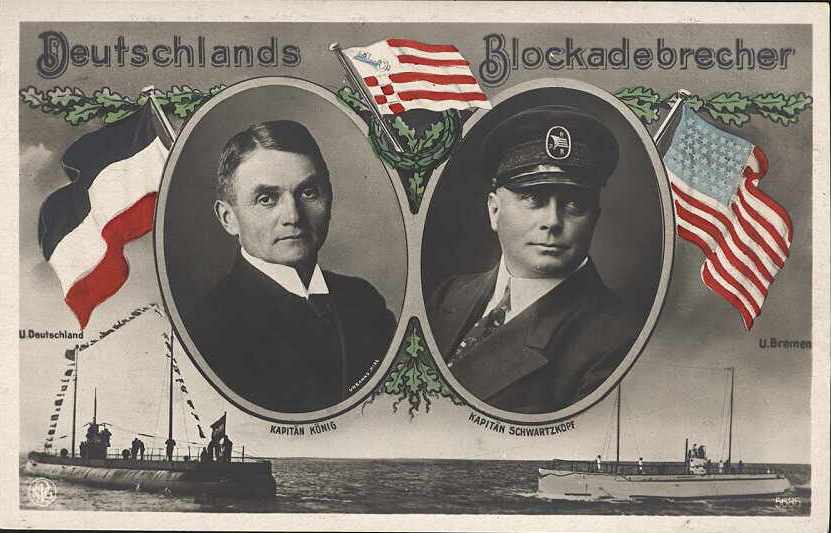
German Merchant Submarines Deutschland & Bremen
Photo: Kevin Heath

During World War I, the Royal Navy blockaded Germany’s North Sea ports and cut off all imports into the country. Desperate for imports of rubber, tin, nickel and other resources unavailable within their borders, the German merchant marine took a page from Jules Verne’s 20,000 Leagues Under the Sea and developed blockade running merchant submarines. The subs were built for the North German Lloyd Line and were designed to maximize cargo carrying capacity – unusual for vessels normally viewed as tools of war and not of trade.

The first sub, Deutschland, made her maiden voyage in June of 1916 and arrived in Baltimore, Maryland a month later carrying dyes, gemstones and pharmaceuticals. Deutschland had successfully threaded the needle of the Royal Navy blockade without even being detected. Returning with a load of valuable nickel, tin and rubber, the Deutschland’s maiden voyage not only paid for itself, but it netted a massive profit for her North German Lloyd Line owners.

The Deutschland made one more voyage to the United States before deteriorating relations between the US and Germany precluded further trade. Deutschland was later converted to u-boat use by the Imperial German Navy, sank 42 vessels and was turned over to the Royal Navy after the Armistice. The Deutschland’s sister ship, Bremen, sailed for the US in September of 1916, however, she never arrived and was presumed lost at sea. One of Bremen’s oil stained life preservers was discovered near Cape Elizabeth, Maine indicating the ship may have made its way as far the American coast. The ship’s disappearance, though, remains a mystery. Various reports indicate she might have been depth charged or mined by Royal Navy vessels, but perhaps Bremen felt drawn to her Jules Verne origins and fell prey, like Captain Nemo and the Nautilus, to the Moskstraumen.

helicopter carrier

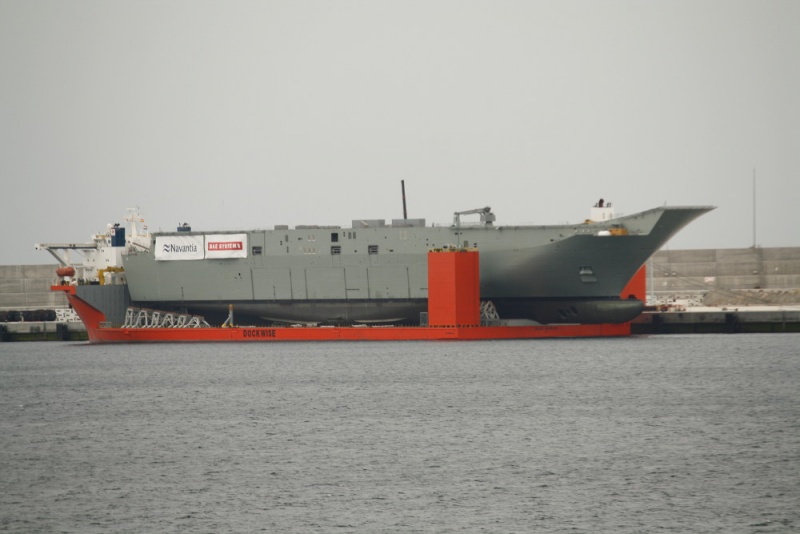
Hull of LHD Canberra aboard heavy lift ship MV Blue Marlin
Photo: Royal Australian Navy

The first of the Royal Australian Navy’s new Landing Helicopter Dock ships is ~1/3 of its way to Australia. Launched in February 2011, the LHD Canberra is the first of two Canberra class Landing Helicopter Dock ships being built for the Royal Australian Navy. The ships are based on the design of Spain’s SPS Juan Carlos I which entered service in the Spanish Navy in 2010. The hull and flight deck were built in a Spanish shipyard and are being transported to Australia via heavy lift ship. The same lift ship was used to transport the USS Cole back to the United States after it was bombed by Islamic fundamentalists on October 12, 2000. Upon arrival in Australia in November, the Canberra’s final fitting out will be performed by BAE Systems. Once commissioned in 2014, the Canberra will be the largest warship to ever serve in the Royal Australian Navy.

Australian helicopter carrier

LHD Canberra Cutaway
Photo: Royal Australian Navy

Depending upon mission needs, the Canberra class LHDs can accomodate up to 1,000 troops and 110 vehicles in its multiple decks. The Canberra’s welldeck can hold and launch 4 landing craft and RHIBs. Air capabilities include 6 medium helicopter launch spaces and room for 26 medium-helicopters (up to CH-47 Chinook size) in its hanger and light vehicle deck. The ship is approximately the same size as the United States’ Wasp class amphibious assault ships and as such could most likely operate V-22 Ospreys as well as the F-35B if/when it becomes available. Additionally, the ship was designed with the lightest draft possible so as to be able to operate in the littorals and secondary ports. The addition of the Canberra and her sister ship Adelaide in 2015 will give the Royal Australian Navy further power projection capabilities and help maintain the balance of power in a region increasingly under the influence of Chinese autocracy.

One of the most unusual clashes in naval history occurred on September 14, 1914 when two former passenger liners fought one another off the coast of Brazil’s Trinidada Island. At the outbreak of World War 1, both the British and German navies put into effect plans calling for the arming of certain ships as auxiliary cruisers to act as wartime supplements to their naval forces. Two such ships were the SS Cap Trafalgar and RMS Carmania.

The SS Cap Trafalgar had been built in 1913 and operated between Hamburg, Germany and South American ports. Following the declaration of war, her civilian crew was replaced by officers and seaman of the German Imperial Navy and she was armed with 2 4.1in. guns. Thus she became SMS Cap Trafalgar and was charged with hunting down and sinking Allied shipping in the South Atlantic. SMS Cap Trafalgar’s opponent, RMS Carmania, was a British mail liner built in 1905 for the Cunard line’s Liverpool to New York route. Similar to SMS Cap TrafalgarRMS Carmania was commandeered by the British Admiralty and became HMS Carmania on August 8, 1914 when she was armed with 8 4.7 in. guns. Unlike Germany’s auxiliary cruisers, Britain utilized its cruisers to protect merchantmen or assist in the hunt for Germany’s merchant raiders.

The two ships were destined to come across one another after each were given orders to proceed to Trindade Island – the Germans were to rendezvous with colliers and the British suspected the island was being used by the Germans as a supply point. Caught with two colliers in broad daylight, the Cap Trafalgar at first fled from the pursuit of the Carmania, however, the Germans reversed course and turned to engage the Carmania. After a brisk 70 minute battle, with both ships ablaze and holed below the waterline the Cap Trafalgar capsized and sank with the loss of 51 officers and crew. While the Cap Trafalgar had been sunk, it had inflicted serious damage on the Carmania and she required extensive repairs at Gibraltar’s dry dock. The Carmania finished out the war in British service and was eventually scrapped in 1932. Even though it involved two of the largest, fastest and most expensive ships in the world, the engagement was of little strategic consequence and is now merely a strange footnote in naval history.

Me-323

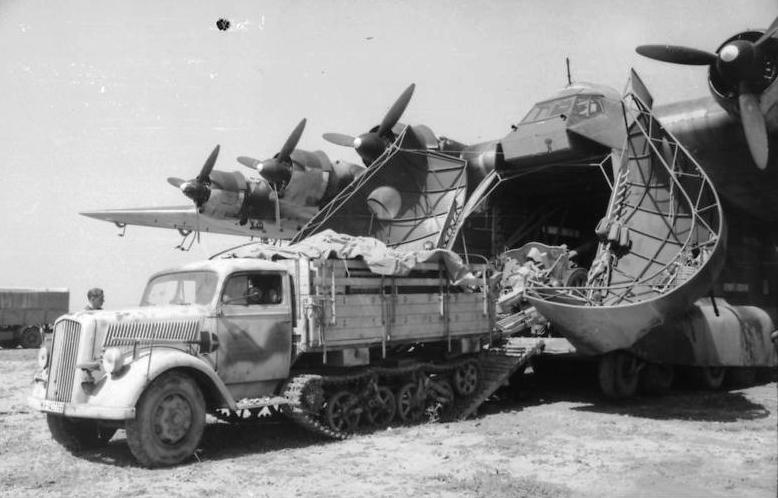
Messerschmitt 323 Gigant Disgorging Cargo

A year of researching obscure World War 2 era archival materials has paid off for Italian diver Cristina Freghieri and her team of divers. Although looking for a different wreck, the group discovered the intact remains of a Messerschmitt 323 Gigant downed by a Royal Air Force Bristol Beaufighter on July 26, 1943. The wreck was discovered nearly intact approximately 8 miles off Italy’s Maddalena Islands. Only ~200 Me 323 Gigants were produced during World War 2 and none survive today, thus there is a distinct possibility that the plane will be recovered and restored. Earlier this year the German Navy recovered the remains of a Ju 88 from the Baltic Sea with plans to restore and display the plane at the German Historical Museum’s Air Force Museum.

The Me 323 Gigant was developed from a glider design the Luftwaffe had commissioned in October 1940. The plane could accommodate up to 100 assault troops or 10-12 tons of cargo (by comparison a C-130 can lift 22.5 tons) in the form of field artillery and its halftrack, two trucks or even the ubiquitous 88mm flak gun. By the time they were deployed in late 1942, the Luftwaffe had begun to lose air superiority and the Gigant often fell prey to Allied fighters due to its slow speed. Due to its low volume of production and Allied air superiority, the Gigant never lived up to its full potential.

russian nuclear powered icebreaker

Icebreaker off Antarctica
CC Image Courtesy of Matt Geske on Flickr

Russia recently commissioned the building of the world’s largest nuclear powered icebreaker in an effort to increase traffic in the Northern Sea Route and better compete for resources in the Arctic. Global warming (anthropogenic or not) has made use of the Northern Sea Route a viable possibility in the past few years and the Barents Observer is reporting that a record amount of cargo may transit the route this year. The current record is 820,789 tons of cargo and 749,706 tons have already made their way through the shipping lane in 2012. Russia hopes to increase trade at its northern ports as the Northern Sea Route stays open longer and longer each season and through the artificial extension of the shipping season via use of its yet to be named icebreaker.

The new icebreaker will be 558 feet long and 102 feet wide, making the vessel 46 feet longer and 12 feet wider than any other icebreaker in Russia’s fleet. The ship’s enormous size will enable it to break up thicker sheets of ice than other ships. In addition to being vastly larger than anything currently in the Russian icebreaking fleet, the ship will have on-board ballast tanks allowing it to raise and lower its draft from 28 to 35 feet. Thus the ship will be able to sail up previously inaccessible Siberian rivers. Powering the icebreaker will be dual nuclear reactors producing 60 megawatts of power which make it capable of towing ships displacing up to 70,000 tons through Arctic waters. While the selection of nuclear reactors as a power source for civilian ships may seem strange, Russia’s first nuclear powered icebreaker, Lenin, first sailed in 1959 and the country currently operates around a dozen nuclear powered icebreakers. As a sidenote, the US experimented with nuclear powered civilian vessels beginning with the launch of the NS Savannah in 1959, but ceased operating her in 1972 due to cost inefficiencies.

While the icebreaker is chiefly intended for improving the commercial flow of goods in the Arctic, the ship’s strategic value can not be ignored. Russia, Norway, Denmark, Canada and the US have all laid claim to parts of the region in order to secure access to the oil and gas believed to be located beneath the seabed. Just as China views its deep water oil rigs as “strategic weapons,” Russia’s possession of the most capable icebreaker in the world will have serious implications in who exercises control of the region.

Winter War

Photo: Wikimedia Commons

In November of 1939, Soviet forces invaded Finland with the intention of bringing additional territory into the communist fold. Even though the Soviet forces vastly outnumbered the Finns, Finnish troops put up a heroic resistance and the conflict was resolved 4 months later with the loss of ~11% of Finland’s pre-war territory. Thus when Nazi Germany launched its invasion of the Soviet Union on June 22, 1941 the Finns were quick to lend their support to the Nazis in an effort to regain their lost territory.

Flowing from this cooperation was the use of Finnish naval forces to screen against Soviet naval forces while German ground forces advanced through the Baltic states. In one such operation, Operation Nordwind, one of Finland’s two capital ships, the Ilmarinen, struck a mine and sank with 271 casualties. The loss of the Ilmarinen on September 13, 1941 was devastating to the tiny Finnish Navy. For a force consisting of only 3,800 officers and sailors, the loss represented  7% of Finnish naval forces. By comparison, less than .8% of the US Navy perished in the attack on Pearl Harbor.

The Ilmarinen had been built in the 1930s as a coastal defence ship for the purpose of defending the numerous islands and islets of Finland’s Baltic coastline. Video of the ship in 1938 can be seen here (the Ilmarinen is the first ship shown in the video). The ship saw service in the Winter War defending the Finnish coast against the Soviet invaders and later shelled Soviet forces after the beginning of the German invasion.

Even though the Finns initially sided with the Nazis, they fought not for ideology, but for self-preservation. In September 1944, the Finns established a separate peace with the Soviets and engaged the Nazis in open combat in the Lapland region until the Nazis withdrew to Norway in April 1945.

Aagtekerke

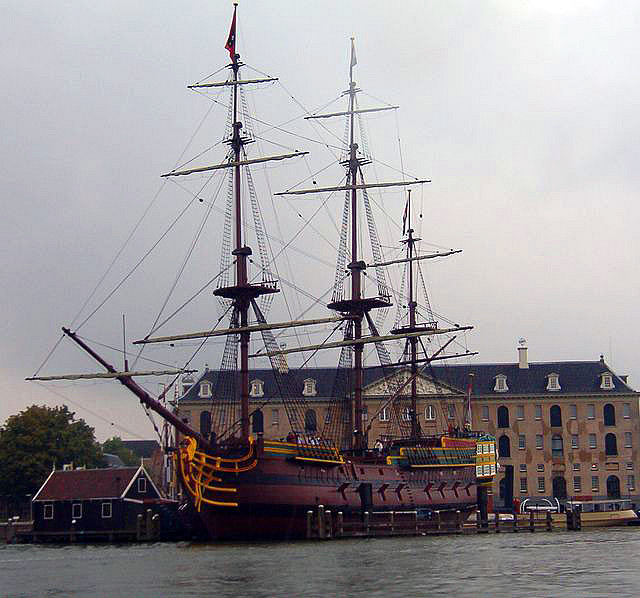
CC Image courtesy of Enrique Ruiz Crespo on Flickr

Australian shipwreck diver Hugh Edwards believes he has located the wreck of the 18th century Dutch East Indiaman Aagtekerke in waters off the Abrolhos Islands in Western Australia. Lost in 1726, the Aagtekerke was en route from Africa to Batavia in the Dutch East Indies (now Jakarta, Indonesia). This isn’t the first wreck Edwards has discovered in his 50+ year diving career. In 1963, Edwards located the Dutch East Indiaman Batavia which had wrecked on its maiden voyage in 1629. Over a period of four years from 1970 – 1974, marine archaeologists worked to recover and preserve artifacts from the Batavia and they are now housed in the Western Australia Museum in Perth. The author intends to make a site visit to the museum in the near future and will post his findings when he does so. Additionally, a replica of the Batavia serves as a museum ship in Leylstad, Netherlands.

In the same year Edwards found the Batavia, he located another Dutch East Indiaman, the Zeewyck, which had sunk in 1727. In subsequent trips to the wreck site Edwards discovered several artifacts including an elephant tusk that didn’t coincide with the historical record for the Zeewyck. After nearly 50 years of piecing together various clues, Edwards has come to the conclusion that the Zeewyck and the Aagtekerke sank within 300 meters of one another and their debris field intermixed. Translated journal entries from survivors of the Zeewyck indicate that they had come across debris from another shipwreck when their own ship sank and the presence of the elephant tusk (the Aagtekerke was carrying 214 tusks and the Zeewyck none) seem to confirm his thesis.

Edwards is continuing to explore the site and is hoping to locate the ~30,000 silver coins believed to be among the Aagtekerke’s cargo. Under Australian law, any artifacts raised from the site would belong to the Australian government, however, under generally recognized principles of admiralty/salvage law, Edwards might be entitled to a salvage award for any artifacts he recovers.

Shi Lang

Former Soviet Carrier Varyag
Photo: Information Dissemination

China’s first aircraft carrier is finally getting an official name.  Blogger Andrew S. Erickson, an expert in Chinese naval affairs, is reporting that an official state media outlet has stated that the ship’s name will be Liaoning, in honor of the province where the ship was recently re-built. The ship’s name has been the source of much speculation with it often being referred to as Shi Lang in Western news reports. While many might scoff at the hubbub surrounding the naming of the carrier, its name will carry some significance regarding Chinese attitudes towards other countries in the region. Shi Lang was a Qing general who subdued Taiwan through a seaborne invasion and the naming of the ship after him would have had sinister overtones for Chinese-Taiwanese relations. Another name choice reportedly debated within government circles was Diaoyu Dao which is an island group controlled by Japan, but disputed by both China and Taiwan. Either of those names would have indicated a bellicose attitude towards Japan and/or Taiwan.

Liaoning was originally launched as the Varyag in 1988 by the Soviet Union and remained unfinished at the time of the collapse of the Soviet Union. China purchased the Varyag from the Ukraine in 1998 and the ship sat derelict for several years until the decision was made to rebuild the carrier to fulfill its original role. Re-building of the ship was completed earlier last year and she has undergone multiple sea trials since. Naval experts have differed as to whether China intends to use the carrier for belligerent purposes or merely as a training vessel. It takes years to hone the skills necessary to effectively conduct the air-sea ballet that is carrier operations and it is most likely that the Liaoning will serve merely to train the crew and officers of the follow-on carriers China intends to build. The Chinese have even built a mock-up of the ship on dry land to get a head-start on training its newest generation of naval aviators.