ironclad sinking

Lt. Cushing Sinks the CSS Albemarle

Before there were the Navy’s UDT, SEAL or SWCC units, there was Lieutenant William B. Cushing. Only a few days before his 22nd birthday, Cushing led 15 men in a daring raid behind Confederate lines against the ironclad CSS Albemarle. The Albemarle had been built by the Confederate Navy in a cornfield astride the Roanoke River in eastern North Carolina. Shortly after her launch in April 1864, the Albemarle sortied down the Roanoke River in a combined operation with General Robert F. Hoke’s infantry brigade. Hoke’s brigade retook the town of Plymouth, North Carolina while Albemarle sank the USS Southfield and drove the remaining US Navy forces downriver.

The re-capture of Plymouth and the presence of Albemarle on the Roanoke River threatened Union dominance of the North Carolina coast. A successful sally by the ironclad could break the blockade then strangling the economic lifeblood of the dying Confederacy. Desperate to destroy the threat of the Albemarle, Union commanders entertained a unique proposal by young Lt. Cushing. Cushing proposed piloting a small picket boat up the Roanoke River and destroying the Albemarle with a spar torpedo. Spar torpedoes, the forerunners of modern self-propelled torpedoes, were a new innovation consisting of crude explosive devices mounted to a long wooden pole that were detonated either manually or on impact.

On the night of October 27, 1864, Cushing and his men silently steamed up the Roanoke River. Protecting the Albemarle was a barrier of chained logs and several sentries. Cushing maneuvered his boat to strike the Albemarle and opened the throttle to full speed. As the launch struck the log boom and rode up over it, Cushing detonated the spar torpedo and blew a massive hole in the Albemarle’s hull. Two of Cushing’s men perished in the attack, 11 were captured and Cushing and another escaped. The Albemarle settled on the river bottom and, unable to raise her, the Confederates quickly lost control of the Roanoke River and were forced to cede back to the Yankees. The Albemarle was raised by the Union and later sold for scrap in 1867.

Cushing continued his exploits with the capture of 3 blockade runners after the fall of Fort Fisher in January of 1865. The blockade runners, unaware Fort Fisher had fallen, were lured into Cushing’s trap when he continued to operate the fort’s signal lights as if it were still in Confederate hands.

chinese shipwrecks

Li River, Guilin, China
CC Image Courtesy of olly301 on Flickr

Xinhua News is reporting that China is building its first dedicated marine archaeology vessel. The ~175 foot ship will displace 860 tons and have the ability to both locate and excavate shipwrecks within Chinese coastal waters. Operated by the State Administration of Cultural Heritage, it will be put to use finding and preserving China’s numerous ancient shipwrecks.

Much like Vietnam, China has the potential to be the location of a vast number of discoveries due to its society having been stunted from revolution, insularity and the ravages of communism. Today, the increase of both nations’ wealth and openness to the world has created opportunities for marine exploration to blossom.

Currently, Chinese marine archaeologists must rely on rented fishing vessels to serve as expedition platforms, although in the case of the Awa Maru project, the Chinese government spent millions on a dedicated salvage barge.

Roald AmundsenIn his latest book, The Last Viking, author Stephen Bown documents the epic life of Norwegian explorer Roald Amundsen. Amundsen is best known for winning a dramatic race to the South Pole and becoming the first human to reach the bottom of the world. Bown presents readers with a modern retelling of Amundsen’s life and stunning achievements. Amundsen was not only the first to journey to the South Pole, he also was the first to reach the North Pole and to sail the Northwest Passage.

Divided into five parts, The Last Viking chronicles each of Amundsen’s polar explorations including his last ill-fated voyage to rescue the stranded crew of an Italian airship in the Arctic. Bown, though, resists the urge to focus solely on Amundsen’s explorations and presents readers with a portrait of a confident leader whose drive and attention to detail helped him become one of the most successful explorers of the 20th century.

Utilizing contemporary newspaper accounts and previously untapped archival materials, Bown describes in detail Amundsen’s voyages, personal financial problems and character flaws. The reader also learns of the behind the scenes struggles Amundsen endured with duplicitous agents, rival explorers driven by nationalism, and the cataclysm of World War I which hampered one of his voyages.

Each section of the book opens with a map of the region corresponding to the exploits Bown documents in that section. This is especially helpful to understand the vast distances Amundsen covered either by ship, sled, skis, airship or plane.

In a world where little is left to explore, Bown transports his readers to a time when great men battled nature to explore the earth’s last remaining terra incognita. As the winter months approach, readers would be well served to buy The Last Viking and curl up in front of a roaring fire to enjoy Bown’s gripping account of Amundsen’s epic polar adventures.

alaskan ferry

Kalakala Ferry Today
CC Image Courtesy of rbanks on Flickr

Once a majestic art deco ship shuttling passengers across Puget Sound, the Kalakala is today rusting away at her moorings in Tacoma, Washington. For nearly a decade, owner Steve Rodrigues has attempted to restore the ship to her former glory, but has faced serious funding issues and legal troubles with the US Coast Guard and the state of Washington. Unless someone with deep pockets steps up soon, the ship is most likely destined for the breakers yard.

Originally built in 1926, the Kalakala has had a colorful history and began life as the Peralta, a traditionally styled ferry operating in San Francisco, California. In 1933, a fire at Peralta’s terminal wrecked the ship’s superstructure and, instead of rebuilding the vessel in its prior form, the ship was graced with a sleek art deco superstructure to become the world’s first art deco ship.

Kalakala entered service in 1935, but a design defect obstructed the view of the bow from the bridge and the ship was plagued with poor handling in the tight confines of ferry terminals. Kalakala continued ferrying passengers around Washington and British Columbia until 1967. The vessel then sailed to Alaska where she was purposely run aground and converted into a shrimp processing plant on dry land. In 1982, the Kalakala’s owners declared bankruptcy. Thus began a 30 year dance of legal maneuvering and fundraising during which the vessel was moved back to Washington and efforts launched to restore the ship.

art deco ship

Kalakala Ferry in 1958
CC Image Courtesy of kitchener.lord on Flickr

Portimao shipwreck

Portimao, Portugal
CC Image Courtesy of Juan Antonio Canales on Flickr

Last week, archaeologists began dive operations on a wreck in the Arade River near Portimao, Portugal. Amphora have previously been discovered at the wreck site, pointing to the ship having sunk during from Roman times. The survey of the site is the first in a series of expeditions to the ship planned for the next 3 to 4 years. Archaeologists are hoping to learn more about Portimao’s role in Roman trade routes. Dives are also planned to wrecks discovered in the 1990’s that are believed to be Spanish ships from the 17th century.

The surveying of the wreck site coincides with the deliberate sinking of two decommissioned Portuguese warships to create artificial reefs. Local authorities are hoping to make Portimao a diving tourism site and the warships, which will eventually be joined by two more ships, into an underwater diving resort.

japanese submarine

Japanese Midget Submarine HA-19
CC Image Courtesy of Brian Bennett on Flickr

Located in Fredericksburg, Texas, the National Museum of the Pacific War honors the sacrifices made by American and Allied Coast Guardsmen, Marines, sailors and soldiers during World War II. Surrounded by picturesque ranches, Fredericksburg is in the heart of Hill Country and the hometown of Admiral Chester W. Nimitz, the Commander in Chief of the Pacific Theater during World War II. Among the Museum’s artifacts is the HA-19, a Japanese midget submarine that ran aground during the attack on Pearl Harbor on December 7, 1941.

HA-19 was only one of several midget submarines deployed by the Japanese to torpedo American ships at anchor in Pearl Harbor during the air raid. The submarine was discovered and depth charged by the USS Helm and subsequently wrecked on a reef near Waimānalo. Recent photographic analysis has led some to suspect that one of HA-19’s sister ships successfully launched her torpedoes at the USS Oklahoma or USS West Virginia on Battleship Row. US forces later recovered HA-19 and paraded it around the US during war bond drives.

Unlike modern SEAL Delivery Vehicles, the Royal Navy’s X type submarinesor the Kriegsmarine’s Seehund subs, the Japanese Navy’s midget submarine program was largely unsuccessful and is today a minor footnote in the greater story of World War II. For more information on planning a visit to the National Museum of the Pacific War, go to their website here.

Vikings in America

Baffin Island
CC Image Courtesy of Mike Beauregard on Flickr

National Geographic reports that archaeologists working in Tanfield Valley on Baffin Island have uncovered evidence pointing to a second Viking camp in North America. Canadian archaeologists led by Memorial University adjunct professor Patricia Sutherland began excavations in the area in 2001. While excavating the ruins of an ancient building on the island, Sutherland and her crew found whetstones with traces of a copper alloy known to be used by Viking metalsmiths, but not natives of the region. Items with Viking origins have previously been found on the island including Viking yarn, tally sticks and whetstones.

Sutherland’s latest discovery solidifies evidence for Viking contact with the peoples of Baffin Island and provides further foundation for her assertion that a northern transatlantic trade route existed between the Vikings and Arctic natives. The high demand in northern Europe for ivory and furs would have provided significant economic incentive for the Vikings to trade with Arctic natives.

Archaeologists first discovered evidence of Viking contact with North America at L’Anse aux Meadows in 1960. Numerous modern day adventurers have utilized Viking ships and navigation techniques to sail from the Vikings’ Scandinavian homeland to various points in North America. The feat was even accomplished 120 years ago when Norwegian Magnus Anderson built and sailed a Viking longship replica from Norway to Chicago for the 1892 World’s Columbian Exposition. The ship is now on display in Chicago, Illinois.

Trafalgar

Admiral Nelson’s Flagship HMS Victory
CC Image Courtesy of Nigel Swales on Flickr

Today marks the 207th anniversary of the Battle of Trafalgar – perhaps the most noted victory by the Royal Navy in its 400 year history. Fought during the Napoleonic Wars of the early 1800s, the battle was the result of Napoleon Bonaparte’s efforts to invade Great Britain. Napoleon dispatched a fleet to rendezvous with a Spanish fleet in the Caribbean and then return to France to provide an armed escort for Napoleon’s invasion fleet. The combined French and Spanish fleet numbered 41 ships and was commanded by Admiral Pierre-Charles Villeneuve. After the rendezvous in the Mediterranean, the fleet sailed to Cadiz, Spain where they were found by Admiral Horatio Nelson and his 33 ship fleet.

Napoleon had changed his plans for an invasion of Great Britain and decided instead to have Villeneuve sail to the Mediterranean to support his operations there. Eager to engage the enemy, Admiral Nelson kept only a few frigates on station close to Cadiz in order to lure Villeneuve into making a run for the Mediterranean. Sensing an opportunity to break out of Cadiz, Villeneuve ordered his ships to weigh anchor.

Upon receiving the signal that Villeneuve was setting sail, Nelson laid out a daring and audacious plan to his officers in the cabin of his flagship, HMS Victory. Instead of following the traditional tactics of the day and sailing abreast of the Franco-Spanish fleet, Nelson divided his fleet into two squadrons. Each squadron was to sail perpendicular to Villeneuve’s fleet and slice through their battle line. If successful, the plan would split Villeneuve’s fleet and allow Nelson’s fleet to riddle them with broadsides from both sides.

Before engaging the Franco-Spanish fleet, Nelson ordered the signal “England expects that every man will do his duty” to be raised from the Victory. Nelson’s plan worked brilliantly and before the day was over more than 21 ships of the Franco-Spanish fleet had been sunk or captured. Tragically, Nelson paid for his triumph with his life as a French marine mortally wounded him with a musket shot.

Today, Admiral Nelson is honored as one of, if not the, greatest admiral who ever served in the Royal Navy. His statute guards Trafalgar Square in London and the HMS Victory serves as the flagship of the First Sea Lord and as a museum ship alongside the Mary Rose.

hms dasher

Ardrossan, Scotland
CC Image Courtesy of Gordon Cowan on Flickr

Next week British archaeologists will excavate a possible mass grave of British sailors in Ardrossan, Scotland. The sailors believed buried there served aboard HMS Dasher, a British escort carrier which sunk in 1943 during World War II. Some have alleged that the mass grave is the result of a government cover-up.

Dasher was originally laid down as the merchant vessel Rio de Janiero, however, the exigent circumstances of wartime prompted her conversion into an escort carrier. Escort carriers were small aircraft carriers designed to provide air cover for convoys as they crossed the North Atlantic. Additionally, the diminutive carriers saw action in the Pacific Theater, most notably during the Battle of Leyte Gulf.

Dasher could embark 15 aircraft which helped substantially lessen the risk of attack by U-boats or the Luftwaffe. The ship sank under mysterious circumstances on March 27, 1943 and 379 of her 528 man crew lost their lives. Various theories have been put forth as to what caused the ship to sink among them design defects or a plane wrecking upon landing. Following the sinking, the British government acted quickly to prevent news of the ship’s loss from spreading and weakening wartime morale. Among the actions taken were the burying of the majority of the sailors in a mass grave and a gag order being issued to the local press.

Earlier this year the British government announced it would make public documents surrounding the loss of the Dasher. Hopefully the release of these documents along with the excavation and reburial of the sailors will lay to rest a tragic and controversial event in the history of the Royal Navy. Today, a new HMS Dasher serves the Royal Navy as a coastal training vessel.

kublai khan

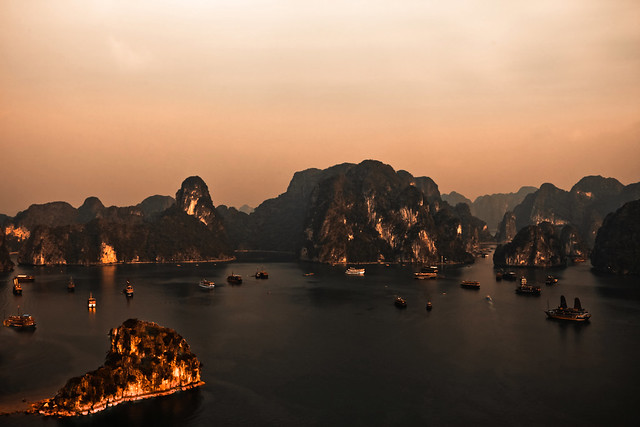
Ha Long Bay
CC Image Courtesy of Aftab Uzzaman on Flickr

Australian news site The Age reports that Australian archaeologists are continuing to assist Vietnamese cultural authorities in the development of their maritime archaeological program. Every month Australian advisers from various universities spend time in Vietnam holding seminars on the tools and best practices techniques necessary for excavation of wrecks located off the Vietnamese coast. Additionally, the advisers are assisting with two specific projects – the porcelain shipwreck found earlier this year off Quang Ngai and the search for Kublai Khan’s 1288 invasion fleet.

Kublai Khan, the grandson of Genghis Khan, founded China’s Yuan Dynasty in 1279 and set off on a campaign of expansion. Khan set his sights on northern Vietnam and in 1288 dispatched an army and fleet to subjugate Vietnam’s Dai Viet dynasty. The Yuan fleet arrived off Ha Long Bay with the aim of re-supplying the Yuan army and maneuvered up the Bach Dang River. Unfortunately for Khan’s fleet, the Dai Viet had prepared for such a contingency. The Dai Viet had placed wooden stakes in the riverbed and prepared fire ships to attack Khan’s fleet. As the tide began to ebb, the Dai Viet released their fire ships in the narrow confines of the river. In an attempt to avoid the fire ships, the Yuan fleet fled down the river and holed themselves on the wooden stakes which had been exposed by low tide.

The destruction of the Yuan fleet effectively ended Khan’s designs on Vietnam and preserved the Dai Viet dynasty. Archaeologists have located some of the wooden stakes and ships from the battle and efforts are underway to excavate and preserve artifacts from Khan’s fleet.