battle of the atlantic

Blackett’s War documents the application of science to the Battle of the Atlantic and the outsized impact a small collection of British scientists had on its outcome. Author Stephen Budiansky charts the life of Nobel Prize winner Patrick Blackett, a British naval officer turned scientist, from his service in World War I to his 1930s academic life and conversion from civilian scientist to architect of a scientific method of fighting the Battle of the Atlantic. In the first section of the book, Budiansky follows Blackett’s World War I and inter-war experiences as well as those of the United Kingdom as a whole. In particular, Budiansky focuses on the deployment of the submarine as an unconventional offensive weapon and how it nearly brought Britain to her knees in World War I.

As the tale progresses, other scientists and historical events are woven into the story to add context and depth to the fascinating melding of ruthless warfare with statistical analysis, cryptography and electronic detection and countermeasures. While this often helps advance the storyline, at times it becomes difficult to keep track of the countless characters and events. If there is any flaw in the book, it is that the inclusion of these characters renders the title slightly misleading. The book is less about Patrick Blackett than it is about the scientific teams on both sides of the Atlantic that fought both their own civilian and military bureaucracy and the Kriegsmarine to win the naval war. Overall Blackett’s War is an intriguing read that provides a unique blend of scientific and military history.

Ramming Speed

April 4, 2013 — Leave a comment
battering ram

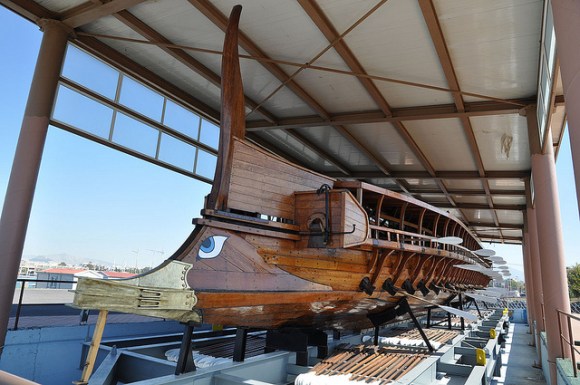
Athenian Trireme
CC Image Courtesy of Yannis on Flickr

Nearly 50 years ago, British divers off the coast of Libya discovered a metal object that turned out to be a 44 pound bronze ram from a Greek or Roman warship. Only recently, though, has a thorough analysis of the object, dubbed the Belgammel Ram, been conducted and the results have been published in the International Journal of Nautical Archaeology. Dr. Flemming of the UK’s National Oceanography Centre brought together a scientific team with skill sets ranging from radiocarbon dating to metallurgy to 3-D imaging.

The ram had been previously established as not the primary ram found at the waterline of a ship, but rather a secondary ram termed a proembolion which would have “served to break the oars of an enemy ship.” Through the use of radiocarbon dating, the team established that the ram had originally been attached to a ship dating from 100 BC to 100 AD. 3-D imaging by Dr. Jon Adams of the University of Southampton revealed decorative images of tridents with a bird motif on the ram. Additionally, metallurgical sampling of the ram helped further archaeologists understanding of casting techniques from ancient times. Following the study, the Belgammel Ram will be returned to a museum in Libya.

Copenhagen

Copenhagen Harbor
CC Image Courtesy of Tuan Hoang Nguyen on Flickr

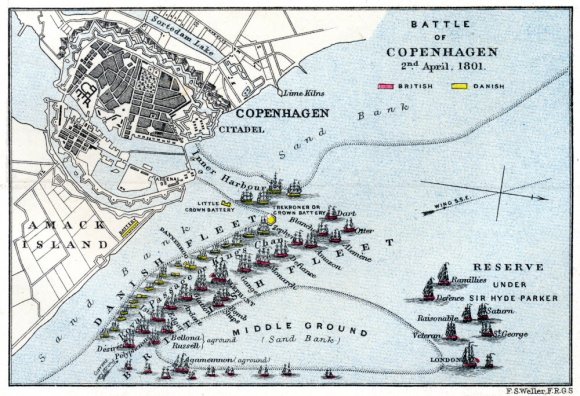
In early 1801, the Royal Navy dispatched a fleet to the Kattegat to break up the League of Armed Neutrality – an alliance of nations helping to supply the French Revolutionary government which was at war with Britain. After much debate between the fleet’s two senior commanders, Admiral Sir Hyde Parker and Lord Nelson, the decision was made to destroy the Danish fleet by launching a daring assault on its Copenhagen anchorage. Destruction of the Danish fleet would secure British access to Scandinavian timber and render much of the Baltic Sea a British lake.

After personally reconoittering Copenhagen’s harbor, Admiral Nelson sailed his force into the teeth of the Danish fleet’s well-prepared positions. Disaster struck quickly as three British ships of the line (Agamemnon, Bellona and Russell) ran aground on the Middle Ground sand bank. Lord Nelson ignored this setback, though, and his ships began pounding the Danish line with devastatingly accurate fire. Despite being ordered to retreat by Admiral Sir Hyde Parker, Lord Nelson continued the battle and ship by ship the Danish guns fell silent. Approximately four hours after the battle began, a ceasefire was agreed upon and twelve Danish ships were turned over to the Royal Navy in addition to three more lost to British gunfire. Only one of the prizes was kept afloat and the British victory signalled the beginning of the end for the League of Armed Neutrality.

First Battle of Copenhagen

First Battle of Copenhagen

Lord Nelson not only earned his Viscount title as a result of the battle, he also enhanced the Nelsonian myth by refusing to withdraw despite Admiral Sir Hyde Parker’s orders. Legend has it that Lord Nelson raised his telescope to his blind eye to read Parker’s signal and remarked “I really do not see the signal” and therefore would continue the battle. Regardless of the truth of the tale, Lord Nelson’s actions once again proved legendary.

war of 1812

In Ships of Oak, Guns of Iron, Dr. Ronald D. Utt has produced a magnificent 500 page tome that provides readers with a well-researched and highly readable account of the War of 1812 at sea. As Utt masterfully argues, the United States Navy truly came into its own during the War of 1812, a conflict that is undergoing a renaissance in the pop history circle as the bicentennial of the war began in 2012.

Although the US Navy fought several notable battles during the American Revolution, including John Paul Jones’ famous duel with HMS Serapis, these were primarily performed with foreign crews and former merchant vessels adapted for naval service. The War of 1812 was the first time that the fledgling US Navy faced a first world power in a declared war and its spectacular results allowed the Navy to create epic lore and traditions in only three years.

Utt skillfully guides the reader from the opening salvos of the war through the US Navy’s early single-ship victories over the vaunted Royal Navy to the two squadron level clashes on the Great Lakes, privateer derring-do against the British merchant marine, and the later and lesser known naval actions of the war. Readers will be unable to put down the book at certain points, especially when reading the chapters concerning privateering and some of the lesser known single-ship voyages against British merchant and warships. The heroic and honorable actions of officers and sailors from both sides will keep readers captivated with tales of a breed of gentlemen warriors whose time has long since passed.

Among the many strengths of Utt’s work is his organization of the book into chapters that take the reader from events at sea to land and then back to sea. In most cases, Utt keeps his narration of the land war to only a few pages in order to give readers an idea of how the sea war affected the land war and vice versa. At times the land war descriptions can grow a bit tedious as Utt jumps between the numerous Indian tribes, Americans, Brits, and Canadians who intermingled in the land conflict. For readers concerned more with the war at sea, the land warfare chapters are sometimes roadbumps in the greater storyline. This minor weakness, though, does not overshadow the overall excellence of Utt’s book.

Another strength is Utt’s strong documentation and endnotes – he has clearly worked to craft a book that is both historically accurate and accessible to the everyday reader. Overall, in Ships of Oak, Guns of Iron, Utt has created a fantastic piece that opens the naval battles of the War of 1812 to a wider audience.

SMS Adler

SMS Adler
Photo: wrecksite.eu

During the last three decades of the 19th century, various Western nations carved up not just Africa, and the Near and Far East, but also various Pacific islands. In many cases, the smaller European powers sought to do empire on the cheap by not governing the islands but encouraging the installation of puppet governments. Thus, the nation could merely secure resources and coaling stations for its naval fleet. In the case of the Samoan Islands in the late 1880s, the German Empire encouraged a civil war between several tribes in order to weaken the tribes’ hold on the island and secure German concessions. Recognizing the strategic importance of the islands, the British and Americans shipped military assistance to opponents of the tribes aligned with Germany.

us gunboat samoa

USS Vandalia
Photo: wrecksite.eu

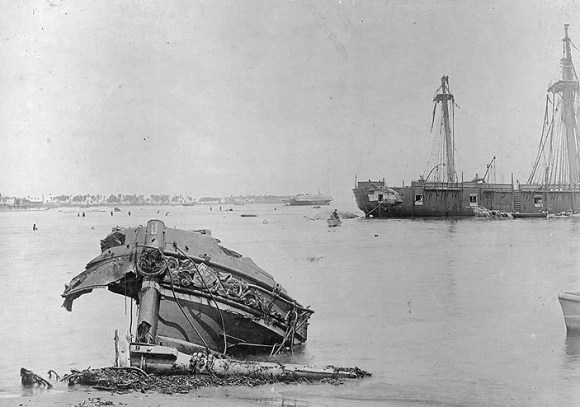
As the conflict escalated, each Western nation dispatched naval vessels to Samoa and the three nations confronted one another in Apia Harbor during 1889. Britain sought to remain a peaceful arbitrator while America and Germany faced each other with the threat of belligerent action. The need for negotiations or military action between the American and German vessels, though, was swept away by the March 15/16th Apia Cyclone. Unbeknownst to either side, a cyclone had been bearing down on Samoa as each side scowled at one another across the harbor. Samoans awoke on the morning of the 16th to discover both the American and the German squadrons beached, sunk or wrecked in the harbor. The loss of the naval squadrons effectively defused the situation and the dispute was resolved by the Tripartite Convention of 1889 by which Samoa was divided between America and Germany.

wrecked german ships

SMS Eber’s Bow
Photo: Wrecksite.eu

Wien

SS Po
Photo: Wrecksite

Less than a hundred years ago, Austria wasn’t a landlocked central European nation, but a large empire with a coastline stretching from Trieste in the north to modern day Montenegro in the south. During this period, ocean liners of  Lloyd Triestino plied back between Austria-Hungary and other locales throughout the Mediterranean, Middle East, India and Far East. Among those liners was the SS Wien, a 7,767 ton liner built in 1911 and named for the Austrian capital of Vienna. Upon the outbreak of World War I in 1914, the ship was requisitioned by the Austrian Navy for service as a hospital ship. During the war she served in both the Austrian and German navies until a mere ten days before Armistice Day. On November 1, 1918, Italian frogmen launched a mission that resulted in the successful sinking of the Wien.

Raised in 1921 and renamed Vienna, the ship returned to service as a liner and had her name changed yet again to Po – a name change which better reflected her post-war Italian ownership. The Po was again requisitioned for service as a hospital ship, this time for the Italian Regia Marina. On March 14, 1941 the Po was sunk by British aircraft in Valona Bay off the coast of Albania. Thus the ship suffered the ignominy of having been sunk in both World Wars.

City of Medicine Hat
 
Saskatoon, Saskatchewan
CC Image Courtesy of Space Ritual on Flickr

UPDATE 3/12/13 – The Star Phoenix released a story yesterday concerning recent archaeological work performed on the SS City of Medicine Hat which sank under mysterious circumstances on June 7, 1908. The lead archaeologist on the project, Butch Amundson, now believes that the steamer was wrecked on purpose. This is due to a surprising lack of personal effects on the wreck and the removal of expensive items such as its 6-foot tall brass music box just prior to the ship’s sinking.

PREVIOUS POSTThe Star Phoenix reported earlier last week that more than 1,000 artifacts have been recovered from what is believed to the wreck of the SS City of Medicine Hat. Designed and built by the wealthy and eccentric Scottish nobleman Horatio Hamilton Ross, the ship was intended to operate as an inland steamer in Alberta, Manitoba and Saskatchewan, Canada.The ship sank on her maiden voyage from Medicine Hat, Alberta to Winnipeg, Manitoba on June 7, 1908. City of Medicine Hat’s rudder was rendered inoperable when it snagged an underwater obstacle and the vessel drifted against a bridge abutment where it capsized under the swift river currents of the South Saskatchewan River.

There were no casualties in the sinking and the ship sank into both metaphysical and physical obscurity. This August, though, a crew working to replace a bridge across the South Saskatchewan River recovered more than 1,000 artifacts from approximately 25 feet below the surface. Archaeologists working with the project believe with substantial certainty that the artifacts belong to the City of Medicine Hat. Miscellaneous artifacts such as an anchor were previously recovered in 2006 and 2008, but this is the first comprehensive recovery of items since initial salvage efforts concluded on the vessel in 1908. While the final disposition of the artifacts is still in question, they most certainly will assist historians in painting a more complete picture of turn of the century riverine life in central Canada.

clipper ship

Clipper Blue Jacket Aflame
Photo: Wrecksite

In 1869 the clipper ship Blue Jacket embarked 71 passengers and crew and departed Lyttelton, New Zealand bound for Liverpool. On March 9, off the coast of the Falkland Islands, the ship caught fire and was abandoned. A total of 39 survivors were picked up with 36 having spent a week adrift and 3 spending 3 weeks subject to the vagaries of the South Atlantic. While March 9th may have signaled the end of the Blue Jacket’s voyage, it marked the beginning of a voyage of a different sort for her figurehead. For nearly 20 months the Blue Jacket’s figurehead floated with the currents and on December 8, 1871 washed ashore on Rottnest Island near Perth, Australia – 6,000 miles from where the Blue Jacket was abandoned.

Cartagena Coastline

Coast off Cartagena, Spain
CC Image Courtesy of Begona Martinez on Flickr

Civil wars are always tragic affairs with brother turned against brother and a country ripped asunder over conflicting social, economic or political visions. The Spanish Civil War of 1936 – 1939 was especially tragic, though, as the country became a proxy battlefield for the two nastiest political philosophies of the 20th century – communism and national socialism. Units from the Soviet Union supported the Republicans while forces from Nazi Germany and Fascist Italy operated in support of the Nationalists under Francisco Franco. All three outside actors used the conflict as an opportunity to hone the tactics they would employ in World War II, among them terrorizing civilian populations with airstrikes such as that of Guernica.

The largest naval battle of the war occurred on March 6, 1938 and flowed directly from international involvement in the conflict. Nationalist naval forces including heavy cruisers Baleares and Canarias were escorting a convoy of war material from Italy when they happened upon a Republican force of two light cruisers and five destroyers off the coast of Cartagena, Spain. At first it seemed as if a pitched battle would be avoided as the squadrons passed one another and made no serious effort to engage the other. The Republicans, though, later decided to pursue the Nationalist forces and around 2:15am the exchange of naval gunfire began.

Nationalist Heavy Cruiser BalearesPhoto: Wrecksite

Nationalist Heavy Cruiser Baleares
Photo: Wrecksite

Unbeknownst to the Nationalist force, the Republican squadron had detached its destroyer escort which launched a torpedo attack on the Nationalists’ heavy cruisers. Two or three torpedoes struck home on the Baleares and caused a catastrophic explosion in her forward magazine. The bow of the ship quickly sank, taking with her 765 crew and officers, while the stern remained afloat and sheltered her 441 remaining crewmen from death. The rest of the Nationalist force withdrew and two Royal Navy destroyers intervened to rescue the survivors.

Although not strategically significant, the battle, which came to be known as the Battle of Cape Palos, did serve as a propaganda victory for the waning Republican cause. During the 1970s, a second Baleares, a guided missile frigate,  joined the Spanish Navy and was recently retired.

Egyptian boat

Khufu’s Solar Barge
CC Image Courtesy of Hannah Pethen on Flickr

Egyptian news site Bikya News is reporting that the museum which houses Khufu’s (King Cheop’s) solar barge has suffered a sewage leak that potentially threatens the preservation of the thousands year old barge.

Buried in 2500 BC, the solar barge was one of two barges buried in a pit at the foot of the Great Pyramid of Giza. Rediscovered in 1954, the barge was reconstructed and an entire museum built to house the magnificent 143 foot long vessel. The barge was most likely built to serve a ritual purpose in the after-life as its design does not lend itself to practical use on the water.

The Egyptians were not the only ones to provide their dead with boats or ships for the after-life. The Vikings often buried dead chieftains in enormous burial mounds complete with full-sized ships. Today, three of those ships are preserved in Scandinavia and are open to the public.