Archives For November 30, 1999

kublai khan

Ha Long Bay
CC Image Courtesy of Aftab Uzzaman on Flickr

Australian news site The Age reports that Australian archaeologists are continuing to assist Vietnamese cultural authorities in the development of their maritime archaeological program. Every month Australian advisers from various universities spend time in Vietnam holding seminars on the tools and best practices techniques necessary for excavation of wrecks located off the Vietnamese coast. Additionally, the advisers are assisting with two specific projects – the porcelain shipwreck found earlier this year off Quang Ngai and the search for Kublai Khan’s 1288 invasion fleet.

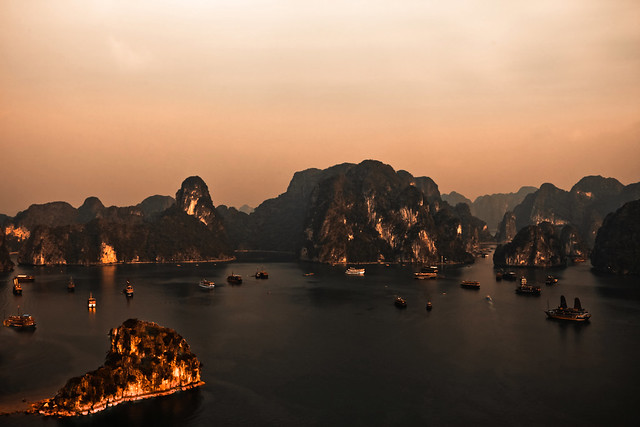
Kublai Khan, the grandson of Genghis Khan, founded China’s Yuan Dynasty in 1279 and set off on a campaign of expansion. Khan set his sights on northern Vietnam and in 1288 dispatched an army and fleet to subjugate Vietnam’s Dai Viet dynasty. The Yuan fleet arrived off Ha Long Bay with the aim of re-supplying the Yuan army and maneuvered up the Bach Dang River. Unfortunately for Khan’s fleet, the Dai Viet had prepared for such a contingency. The Dai Viet had placed wooden stakes in the riverbed and prepared fire ships to attack Khan’s fleet. As the tide began to ebb, the Dai Viet released their fire ships in the narrow confines of the river. In an attempt to avoid the fire ships, the Yuan fleet fled down the river and holed themselves on the wooden stakes which had been exposed by low tide.

The destruction of the Yuan fleet effectively ended Khan’s designs on Vietnam and preserved the Dai Viet dynasty. Archaeologists have located some of the wooden stakes and ships from the battle and efforts are underway to excavate and preserve artifacts from Khan’s fleet.

Captain Cook

HMB Endeavour
CC Image Courtesy of Alex Bikfalvi on Flickr

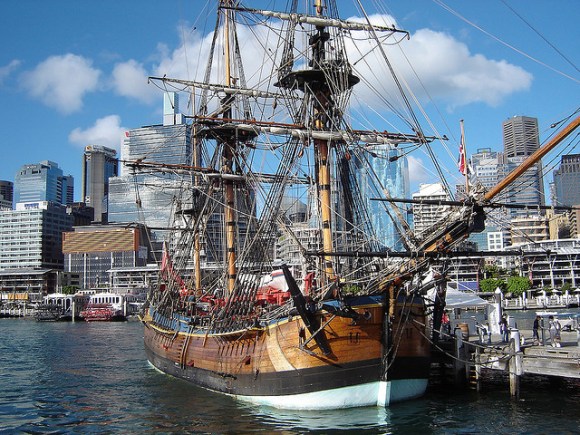
Launched in 1993, HMB Endeavour is a faithful recreation of the bark used by Lieutenant James Cook on his expedition to Australia and New Zealand from 1768 – 1771. Cook and his crew explored various parts of Australia and New Zealand, gave Botany Bay its name and even ran aground on the Great Barrier Reef. Returning home a hero, Cook led two more expeditions of discovery before his death at the hands of natives in the Hawaiian Islands. The Endeavour continued in his majesty’s service as a troop transport before being sold into private hands. Renamed Lord Sandwich the bark was eventually scuttled as a blockship off Providence, Rhode Island during the American Revolution.

Having sailed over 170,000 nautical miles and visited 29 countries, the bark now calls the Australian National Maritime Museum home. Located in Sydney, the Australian National Maritime Museum has more than a half dozen museum ships including the patrol vessel HMAS Advance, submarine HMAS Onslow, destroyer HMAS Vampire, and barque James Craig. The bark is open for tours and more information can be found here.

research vessel

R/V Sikuliaq
Photo: The Glosten Associates

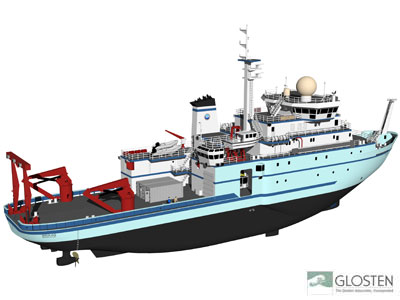
Yesterday, Marinette Marine launched the arctic research vessel Sikuliaq which will enter service with the University of Alaska Fairbanks in 2014. Sikuliaq, which means young sea ice in Inupiaq, will replace the 40 year old R/V Alpha Helix. The $140 million ship is not only newer, but also is more capable than Alpha Helix. Being designed specifically for arctic use, the ship is capable of cutting through ice up to 3 feet thick and can house 26 scientists for up to 60 days at a time. With the increase in commercial use of the polar regions, the ship will be put to good use studying the geology of the arctic, its fisheries and changes in ice levels. One of Inupiaq‘s designers was also responsible for the new Neil Armstrong research vessel class for the US Navy. The University of Alaska Fairbanks plans for the ship to be deployed on oceanographic expeditions for 270 days out of the year.

Canadian coast guard cutter

CCGS Terry Fox in St. John’s Harbour, Newfoundland
Photo: Canadian Coast Guard

The Canadian Coast Guard has announced its plan to spend $332,000 to investigate the feasibility of incorporating fuel cell technology into its new offshore fishery science vessels. Under the current proposal, the vessels would have hybrid diesel-fuel cell propulsion systems. While at sea, the ship will be able to rely on its diesel engines and then switch to the fuel cell system to generate electricity while in port. The system is designed to both reduce emissions and fuel costs as diesel technology operates most efficiently at sea, but has a high amount of energy waste when used simply to produce electricity while docked. This feasibility study is in addition to a delayed project at the University of Victoria where the British Columbia approved $13.3 million for converting an existing ship to the technology.

The Canadian Coast Guard isn’t the first to experiment with alternative fuel technologies for marine propulsion. Maritime consultancy group Germanischer Lloyd Group has also developed plans for a hydrogen powered commercial container vessel. In addition, Norwegians have been operating several dozen liquefied natural gas (LNG) fueled vessels for a decade. The vessels have reduced emissions and their fuel costs can be as much as 25% less than a traditionally powered ship. Less than two weeks ago, the Central Commission for the Navigation of the Rhine and the United Nations Economic Commission for Europe approved a LNG powered vessel for use on all international inland waterways. This move could spur additional adoption of LNG technology as the EU passes ever more stringent emissions regulations. Nuclear powered vessels have also seen limited commercial experimentation, but for now are reserved almost exclusively for icebreaking and military functions.

If the current path of ever more onerous emissions regulations is continued, then shipowners will migrate in ever greater numbers to LNG and other alternative fuel sources for propulsion. Adoption of LNG technology by US shipowners might occur even faster considering natural gas prices are at near historic lows and the country is experiencing a boom in supply.

chinese ice breaker

Chinese Ice Breaker Xue Long
Photo: Ajai Shukla

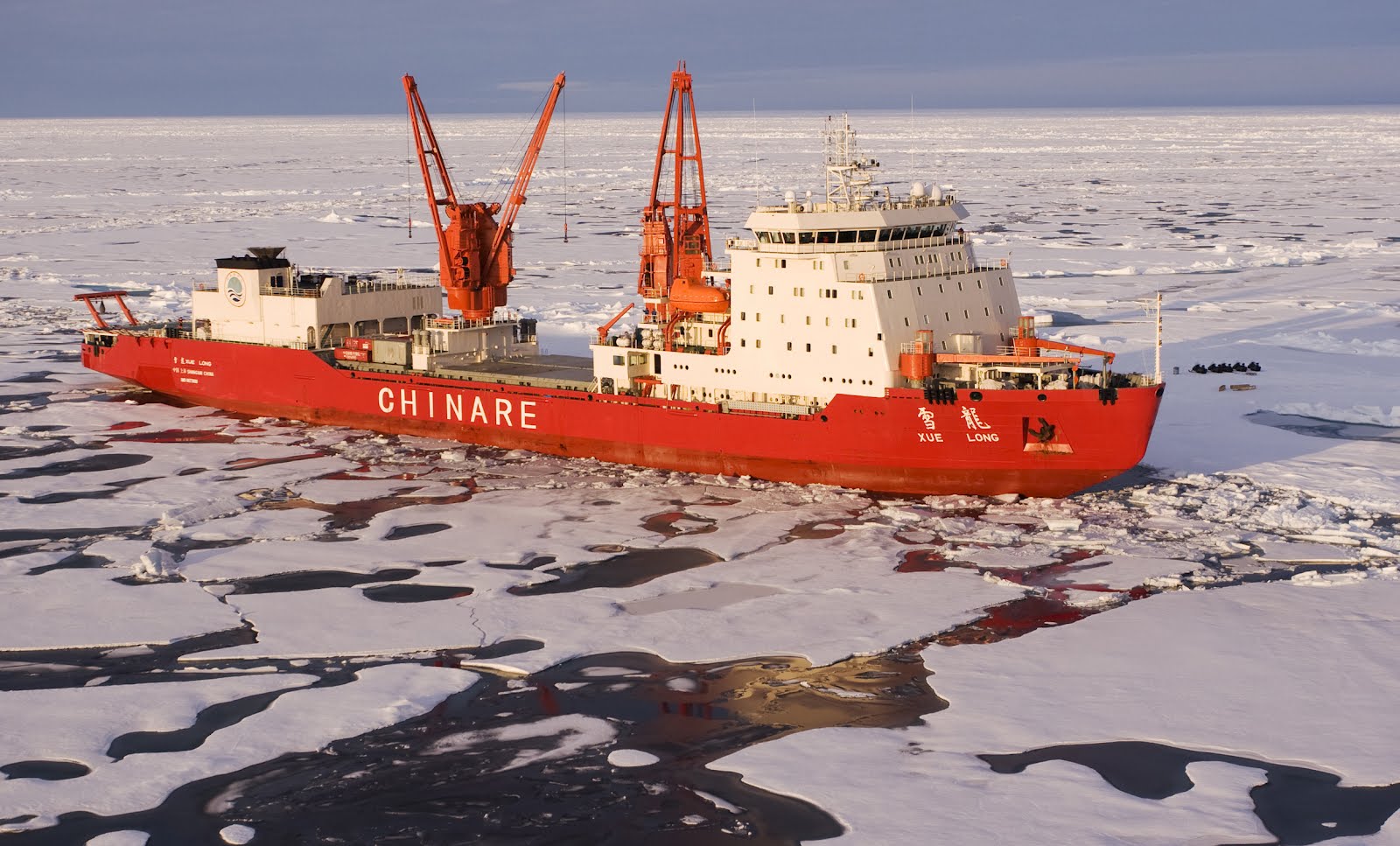
This week has proven to be a historic one in Chinese naval affairs. On Tuesday, the Chinese Navy commissioned its first aircraft carrier, Liaoning. Although still lacking a naval air wing capable of operating from the carrier, the Chinese Navy has joined the exclusive club of nations which operate aircraft carriers and set itself on a path to developing the skills requisite to its efficient operation. In addition, crowds in Shanghai welcomed home the ice breaker Xue Long (Snow Dragon) as it completed a historic 18,500 mile scientific voyage and became the first Chinese ship to sail through the Northern Sea Route.

Manned by 119 scientists and crew, Xue Long departed Qingdao (best known for its Tsingtao beer, a relic of its Imperial German colonial past) on July 2nd. During her 3 month voyage, the Xue Long and her crew conducted various geophysical surveys and installed an automatic meteorological station. The ship also stopped over in Iceland to collaborate with scientists there and to perform joint oceanic surveys.

These two events further mark the strides China has made towards projecting its power on a global scale. Not since Admiral Zheng He’s 15th century sailing expeditions has China reached this far afield. A final event this week which could either end up a small footnote in diplomatic history or the catalyst to an Asian conflagration was the cruising of Chinese maritime surveillance cutters and naval frigates to the disputed Diaoyu/Senkaku Islands. Long a subject of dispute between China and Japan and to a lesser extent Taiwan, Japan purchased the islands earlier this month from a private party. The presence of large oil reserves in the waters around the islands make them, like the Falklands, quite valuable economically. It remains to be seen whether the dispute is simply kicked down the road, spurs Japan to acquire a nuclear deterrent or erupts in limited to full scale conflict.

research vessel

Photo: Woods Hole Oceanographic Institute

The US Navy has announced that their newest Auxiliary General Oceanographic Research (AGOR) class of vessels will be named after naval aviator and astronaut Neil Armstrong who passed away last month. The class will be composed of two vessels and construction on the lead ship, R/V Neil Armstrong, began in August. Neil Armstrong is set to enter service in summer 2015.

The Neil Armstrong class of vessels will displace 3,200 tons, stretch 238 feet in length and have a cruising range of 11,500 nautical miles at 12 knots. Neil Armstrong’s 1,800 square feet of dry, wet and computer labs will give its 24 embarked scientists plenty of space to conduct research and exploration operations throughout the globe. In addition to its lab and staging spaces, the Neil Armstrong will be able to launch and recover various ROVs and mini-submersibles with its stern and main cranes. Among the innovations included in the ship’s design is a hull optimized to divert bubbles from the sonar area for enhanced sonar performance.

The ships are funded by the Office of Naval Research, but will be operated by non-profit oceanographic institutes. The yet unnamed second vessel of the class (AGOR 28) will be operated by the Scripps Institution of Oceanography in San Diego, California. Neil Armstrong will be based at the Woods Hole Institute of Robert Ballard fame and conduct most of her operations in the Atlantic.

Robert Ballard Cyprus

CC Image courtesy of Erik Charlton on Flickr

Legendary underwater explorer Robert Ballard has added two more shipwrecks to his already incredible list of discoveries (RMS TitanicBismarck, USS Yorktown and John F. Kennedy’s PT 109). Ballard and his team spent two weeks off the Cypriot coast exploring the Erastosthenes Seamount, a 120km by 80km undersea mountain that was previously above water. The expedition’s chief goal was to survey the seamount’s geology through the use of submersibles and high definition cameras. Ballard plans to return in several weeks after the Nautilus is equipped with a new sonar system that will allow him and his team to map the seamount. Previously the seamount was believed to contain only limestone, but the expedition located a formation of volcanic rock that doesn’t fit the area’s geologic profile. Additionally, the team found a curious methane source on the formation which requires further investigation.

It was in the process of completing their geologic mapping that the team discovered the two wrecks. One ship is believed to have sunk 2,300 to 2,500 years ago and carried cargoes between Greece and Cyprus. Among the artifacts photographed at the scene are a variety of ceramics, two anchors, a possible bun ingot and several other unidentified objects. The second ship appears to be an Ottoman war galley and an 18th century flintlock pistol and black rum bottles were located amongst the wreckage. One question left unanswered by the expedition is the speculation that Ballard’s team was searching for a WWII-era wreck containing a gold cargo. There exists little grounds for such speculation, though, as Ballard is known for not seeking to directly profit from his underseas exploration.

Prior to this month’s expedition, Ballard helped Turkey locate the two Turkish pilots lost when their F-4 crashed under mysterious circumstances near the Syrian border.

Last week, researchers announced the discovery of the famous polar exploration vessel SS Terra Nova in waters off the southern coast of Greenland. SS Terra Nova was discovered during routine tests of mapping equipment aboard the Schmidt Ocean Institute’s R/V Falcor. The ship is lying in less than 160M of water, but its exact location has not been disclosed by Schmidt Ocean Institute.

Lost in 1943 after a collision with an ice pack, the SS Terra Nova was built in 1884 to withstand the rigors of operating as a whaler and sealer in polar regions. Following a ten year commercial career, the ship served the Jackson-Harmsworth Arctic Expedition from 1894 – 1897. Terra Nova is most famous, though, for its role in Captain Robert Scott’s doomed Terra Nova Expedition (1910 – 1912).  Captain Scott and his team of British explorers sought to become the first humans to reach the South Pole; however they were beaten by a Norwegian team led by Roald Amundsen. Amundsen’s party reached the South Pole on December 14, 1911, beating Scott by approximately 30 days. Scott’s team perished on their return trek and their bodies were not discovered until nearly 8 months later. In death, Scott was mythologized throughout his native Britain and has been the subject of numerous books and articles. Historians continue to debate his legacy – historian Roland Huntford’s The Last Place on Earth is a stinging critique of Captain Scott while polar explorer Sir Ranulph Fienne’s Captain Scott defends Scott and the choices he made during the expedition.