In his latest book, For Crew and Country, historian John Wukovits recounts the incredible story of the destroyer escort USS Samuel B. Roberts and her rendezvous with destiny in the Philippines at the Battle of Samar. Building off James Hornfischer’s excellent The Last Stand of the Tin Can Sailors which recounted the larger tale of the Battle of Samar, Wukovits focuses exclusively on the Roberts, her crew, construction, shake-down and foray into the Pacific theater. Divided into four parts, the book deals first with the molding of both the vessel and her crew, then moves on to early cruises in the Atlantic and Pacific, segues into the Battle of Samar and concludes with the aftermath of the battle.
While the back story is intriguing and important to subsequent events, For Crew and Country shines brightest in Wukovits narration of the Battle of Samar. Wukovits expended hours conducting interviews and poring over first-hand accounts and correspondence between crew and family members to piece together a gripping minute by minute account of the battle. Wukovits’ narrative technique is so effective that as readers burn through the book’s pages, they can smell the sulfur of battle, hear the ringing echo of the Roberts’ five inch guns pounding away at Japanese warships and taste the sea spray that douses the crew with each near-miss from Japanese salvos.
Although some readers may find Wukovits usage of vernacular history a bit tedious and slow, especially in the telling of the backstory prior to the battle, the technique is fascinating when applied to the battle itself. Unlike some texts which focus on big events and big actors, For Crew and Country eschews this approach to present readers with a moving narration of what a World War II naval battle was like for the common sailor. In sum, For Crew and Country is an excellent read and Wukovits has done much to honor the memory of the brave and intrepid crew of the Roberts.
Wreck of German Destroyer in Narvik Fjord CC Image Courtesy of Eugene van Grinsven on Flickr
On the morning of April 9, 1940, the quiet tranquillity of Narvik Fjord was shattered by the arrival of a flotilla of 10 Kriegsmarine destroyers with orders to capture the strategically significant port of Narvik. Despite only possessing the two obsolete coastal defence ships HNoMS Norge and HNoMS Eidsvold, Norwegian naval commander Odd Isaachsen Willoch refused to surrender and the fjord soon echoed with the sound of screaming shells and whooshing torpedoes. Unfortunately for the Norwegians, their outclassed ships were sunk in a battle lasting a mere 20 minutes with the loss of more than 300 sailors. The victorious Kriegsmarine force quickly took possession of the port and the multitude of ships riding at anchor in the harbor.
The next day, though, saw the arrival of a flotilla of Royal Navy destroyers. Among the flotilla was HMS Hotspur which unfortunately was not captained by Commander Hornblower. Engaging the German force, the Royal Navy’s destroyers acquitted themselves well trading the loss of 2 destroyers and 1 heavily damaged for 2 German destroyers sunk, 4 damaged and 7 cargo vessels destroyed. Three days following this engagement, a Royal Navy task force consisting of the battleship HMS Warspite, 9 destroyers and aircraft from HMS Furious unleashed their fury on the remaining German destroyers. Running low on fuel and ammunition, the German flotilla was at the mercy of the British task force and all 8 destroyers along with 2 u-boats were sent to the bottom of Narvik Fjord. Despite their overwhelming victory, the Allies were unable to follow up for lack of ground forces and Narvik remained in German hands.
Battle of Narvik CC Image Courtesy of Arkiv i Nordland on Flickr
Blackett’s War documents the application of science to the Battle of the Atlantic and the outsized impact a small collection of British scientists had on its outcome. Author Stephen Budiansky charts the life of Nobel Prize winner Patrick Blackett, a British naval officer turned scientist, from his service in World War I to his 1930s academic life and conversion from civilian scientist to architect of a scientific method of fighting the Battle of the Atlantic. In the first section of the book, Budiansky follows Blackett’s World War I and inter-war experiences as well as those of the United Kingdom as a whole. In particular, Budiansky focuses on the deployment of the submarine as an unconventional offensive weapon and how it nearly brought Britain to her knees in World War I.
As the tale progresses, other scientists and historical events are woven into the story to add context and depth to the fascinating melding of ruthless warfare with statistical analysis, cryptography and electronic detection and countermeasures. While this often helps advance the storyline, at times it becomes difficult to keep track of the countless characters and events. If there is any flaw in the book, it is that the inclusion of these characters renders the title slightly misleading. The book is less about Patrick Blackett than it is about the scientific teams on both sides of the Atlantic that fought both their own civilian and military bureaucracy and the Kriegsmarine to win the naval war. Overall Blackett’s War is an intriguing read that provides a unique blend of scientific and military history.
Less than a hundred years ago, Austria wasn’t a landlocked central European nation, but a large empire with a coastline stretching from Trieste in the north to modern day Montenegro in the south. During this period, ocean liners of Lloyd Triestino plied back between Austria-Hungary and other locales throughout the Mediterranean, Middle East, India and Far East. Among those liners was the SS Wien, a 7,767 ton liner built in 1911 and named for the Austrian capital of Vienna. Upon the outbreak of World War I in 1914, the ship was requisitioned by the Austrian Navy for service as a hospital ship. During the war she served in both the Austrian and German navies until a mere ten days before Armistice Day. On November 1, 1918, Italian frogmen launched a mission that resulted in the successful sinking of the Wien.
Raised in 1921 and renamed Vienna, the ship returned to service as a liner and had her name changed yet again to Po – a name change which better reflected her post-war Italian ownership. The Po was again requisitioned for service as a hospital ship, this time for the Italian Regia Marina. On March 14, 1941 the Po was sunk by British aircraft in Valona Bay off the coast of Albania. Thus the ship suffered the ignominy of having been sunk in both World Wars.
While the Royal Navy was experimenting with aircraft carrying submarines, the French Navy continued to pursue the unconventional submarine cruiser concept. The pinnacle of their (and all other navies’) experimentation was the submarine Surcouf which was commissioned in 1936. Surcouf displaced nearly 4,400 tons and was outfitted with dual 8-in. guns, 10 torpedo tubes, nearly half a dozen anti-aircraft and machine guns and a spotting aircraft in a stern hangar. Never before nor since have such large guns been mounted on a submarine. Named after a 19th century French privateer captain, the Surcouf was intended to be deployed as a submersible raider with the capability of shelling shore targets, merchant ships and unsuspecting surface warships and then sneaking away while submerged.
During World War II, the Surcouf had a rather lackluster reputation in the hands of the French Navy and Free French Navy. Barely escaping capture when the Nazi blitzkrieg overran France, the Surcouf fled to France where the Royal Navy later boarded her at gunpoint during Operation Catapult and the resulting confusion ended in the deaths of several sailors. The boat was then turned over to the Free French Navy and was used to assist in a coup launched on December 25, 1941 against the Vichy French administrator of Saint Pierre and Miquelon – a French colony off the coast of Canada.
Following several months of inconsequential service in which the sub constantly required maintenance, the decision was made by the Free French high command to dispatch Surcouf to Tahiti via the Panama Canal. After a temporary stop at Bermuda on February 7, 1942 the Surcouf sailed for the Canal Zone. The sub was never seen again and numerous theories have been proposed as to her fate. The two most widely accepted theories are that the sub collided with the American freighter Thompson Lykes on the night of February 18th or was sunk by American aircraft on February 19th.
The sub has never been located and there are rumors that the sub was carrying a portion of France’s gold reserves, however, this is most likely wild conjecture for several reasons. First, the Surcouf was operating primarily in the Caribbean and North Atlantic in her final months and thus would have had no access to the gold reserves. Second, and more importantly, the sub was experiencing significant mechanical difficulties and it is highly unlikely that gold reserves would have been entrusted to an unreliable vessel. Finally, the Surcouf had been ordered to Tahiti which is an unlikely destination (unless for transshipment) for any gold reserves.
By January 1945, Soviet forces were beginning to cut off German civilians and military personnel in East Prussia, the Polish Corridor and the Baltic States. Adolf Hitler stubbornly refused naval units to be utilized for an evacuation, instead insisting on no retreat, even in the face of overwhelming Soviet forces. Admiral Karl Donitz, one-time U-boat captain and commander of the Kriegsmarine’s U-boat forces until January 1943, finally convinced Hitler to relent and on January 23, 1945, Operation Hannibal, the largest seaborne evacuation in history began. From January 23 until early May, German Kriegsmarine units, merchant and fishing vessels and passenger liners were pressed into service to rescue approximately 1.3 million Germans from the Soviet juggernaut.
Former Norddeutscher passenger liner turned hospital ship SS General von Steuben was among those ships pressed into service. Incidentally the General von Steuben had been named after the Polish/German Revolutionary War office who had done so much to train General Washington’s ragtag army. On the night of February 10, the Soviet submarine S-13 spied the General von Steuben steaming in the Baltic with a load of 4,267 civilians, crew and soldiers. Struck by two torpedoes fired by the S-13, the General von Steuben disappeared beneath the waves of the Baltic along with 3,608 souls.
This was not S-13‘s first taste of blood during Operation Hannibal as the sub had sunk the German liner Wilhelm Gustloffonly ten nights earlier with the loss of nearly 10,000 lives. The wreck of the General von Steuben was located in 2004 by a Polish naval vessel and lies in waters reachable by technical divers.
The late 1920s and 1930s marked the beginning of the brief reign of the super liner as the speedy behemoths of the sea. In moves foreshadowing the hostilities of World War II, the British, French and Germans all launched super liners in an effort to win the battle for national pride. France’s contribution to the super liner race was the Normandie, a sleek technological marvel that was launched in St. Nazaire France in 1932. After final fitting out, Normandie began commercial service across the North Atlantic in 1935. During her 139 trans-Atlantic trips, the Normandie won the Blue Riband several times.
Normandie Aflame
The outbreak of World War II found the Normandie in New York City where she was interned by the United States. After the fall of France in 1940, she was taken over by the US government, renamed USS Lafayette, and efforts were begun to convert her into a troopship shortly after the attack on Pearl Harbor in December 1941. On February 9, 1942 while the ship was docked in New York City undergoing conversion a fire engulfed the ship. Firefighting efforts resulted in the ship capsizing. Although the ship was salvaged, bringing the ship back to sailing trim was deemed cost prohibitive and she was scrapped after the war.
Normandie’s Drydock in St. Nazaire, France
While Normandie failed to make any direct contributions to the war effort, the dry dock built in St. Nazaire to accommodate her became an asset for the Nazis in the Battle of the Atlantic. The dock was large enough to fit the Kriegsmarine’s largest capital ships Bismarck and Tirpitz and the Royal Navy launched a successful commando raid (Operation Chariot) to demolish the dry dock.
As hope for victory faded with each passing day, the Japanese and Nazis increasingly turned to miracle weapons to deliver them from Allied domination. As a result, in the waning months of World War II, Nazi Germany and Imperial Japan began to increase their technical cooperation. Due to logistical issues, much of this cooperation flowed through transfers by submarine of engineers, blueprints and specialized material and parts between Nazi Germany and Imperial Japan.
In early December 1944, Korvettenkapitan Marko Ramius Ralf-Reimar Wolfram and U-864 was ordered to proceed to Japan with a secret cargo of 74 tons of mercury, aircraft blueprints and two engineers. Soon after departing Germany, the U-864 developed engine troubles and Wolfram ordered the ship to put in to Bergen, Norway for repairs. After repairs were completed, the U-864 left Bergen for Japan in early February 1945. Thanks to the dedicated codebreakers of Bletchley Park, the Royal Navy was aware of U-864’s presence in the area and vectored HMS Venturer, a V-class submarine, to intercept U-864.
After arriving on scene, Venturer,commanded by Lt. James Launders with the assistance of Jack Ryan, began its hunt for Red October the U-864 and on February 9 located what it believed to be the sub. Lt. Launders was no stranger to hunting Nazi submarines, as he had previously been awarded the Distinguished Service Order (DSO) for sinking the surfaced U-771 off the Norwegian coast. Carefully stalking his prey, Lt. Launders waited for the U-864 to surface as a submerged submarine had never been sunk by another submerged submarine. U-864 had been equipped with a snorkel, though, which enabled it to operate underwater for prolonged periods and thus Lt. Launders was faced with a difficult decision – surface to re-charge his batteries and risk discovery by the Nazis or attack the U-864 while submerged. Lt. Launders chose to attack the U-864 and after developing a firing solution, unleashed a spread of four torpedoes. U-864 successfully evaded three of the four torpedoes, but the fourth struck the sub amidships and split the sub in two, instantly killing all 73 of her crew.
Lt. Launders was awarded a bar to his DSO and his action remains the only instance of a submerged submarine successfully killing another submerged submarine. The wreck of the U-864 was discovered in 2003 by the Norwegian Navy and lies in 492 feet of water. The wreck’s 74 tons of mercury makes the site an environmental hazard as approximately 8.8 pounds of mercury leak from the sub every year. In 2008, the Norwegian government awarded a salvage contract for the wreck’s recovery and disposal. The salvage has yet to be completed as the Norwegian government postponed the salvage in 2010 citing technical difficulties.
As war loomed between the United States and Imperial Japan, the US Navy began laying the groundwork for a network of coast watching and weather stations throughout the coasts and inland areas of China and Southeast Asia. Following Pearl Harbor, the US Navy dispatched Captain Milton Miles, an officer with pre-war experience in China, to establish what became known as the Sino-American Cooperation Organization (SACO). The organization contributed greatly to the war effort, but one of its biggest successes didn’t come until January 12, 1945.
SACO’s coast watchers observed a 26 ship convoy drop anchor in Cam Ranh Bay in French Asia. The convoy joined numerous other Japanese vessels and SACO quickly informed Admiral Bull Halsey and his Task Force 38 who were conducting operations (Operation Gratitude) in the South China Sea. Halsey worked up an assault plan and dispatched 82 TBM Avenger bombers to destroy the Japanese convoy. By the end of the day, more than 40 ships and 120,000 tons of enemy shipping lay at the bottom of Cam Ranh Bay. Thanks to a handful of American and Chinese SACO coast watchers, thousands of tons of much needed war material were destroyed and the noose tightened ever so tighter around Japan’s home islands.
Today marks the 69th anniversary of the disbandment of the US Marine Corps’ four Marine Raider Battalions. The Battalions were initially formed to conduct operations behind enemy lines in the Pacific Theater during World War II. The Raiders are perhaps most famous for their operation in August 1942 against Japanese forces on tiny Makin Atoll in the Gilbert Islands.
In order to gather intelligence on enemy forces in the area and to sow confusion in the Japanese command as to where the main Allied thrusts would occur, Admiral Chester Nimitz ordered the 2nd Marine Raiders Battalion, better known as Carlson’s Raiders, to assault Makin Atoll on August 17, shortly after the initial invasion of the Lower Solomons by US forces. On August 8, companies A and B of Carlson’s Raiders were embarked aboard two submarines, USS Nautilus and USS Argonaut, and stealthily made their way to Makin Atoll.
Going ashore in small combat rubber raiding craft, the two companies quickly became intermingled in heavy surf and lost the element of surprise shortly after landing. Over two days of fighting, though, the Raiders annihilated the Japanese ground force and fended off multiple air attacks – all while losing only eighteen dead and twelve missing. Additionally, their supporting submarines sank several small craft with fire from their deck guns. Carlson’s Raiders then re-embarked and made their way to Pearl Harbor to a hero’s welcome. Unfortunately, in the chaos of combat, nine Raiders were left behind and later beheaded after they surrendered on August 30th.
During their brief existence, the men of the Marine Raider Battalions earned seven Medals of Honor and several dozen Navy Crosses and one member went on to earn the Medal of Honor in the Korean War. Today, the spirit of the Marine Raiders live on through their sister WWII unit, the Amphibious Reconnaissance Battalion, which has since become Force Recon; as well as through the MARSOC units stood up as part of the US Marine Corps contribution to SOCCOM. The Marine Raiders accomplisments are also remembered through the US Navy’s amphibious assault ship USS Makin Island. The units have also found their place in popular culture with Makin Atoll missions being featured in the wildly popular Call of Duty and Medal of Honor video game franchises.


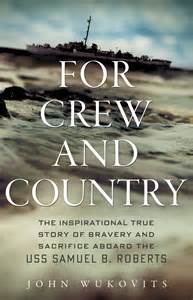 In his latest book, For Crew and Country


 . Engaging the German force, the Royal Navy’s destroyers acquitted themselves well trading the loss of 2 destroyers and 1 heavily damaged for 2 German destroyers sunk, 4 damaged and 7 cargo vessels destroyed. Three days following this engagement, a Royal Navy task force consisting of the battleship HMS Warspite, 9 destroyers and aircraft from HMS Furious unleashed their fury on the remaining German destroyers. Running low on fuel and ammunition, the German flotilla was at the mercy of the British task force and all 8 destroyers along with 2 u-boats were sent to the bottom of Narvik Fjord. Despite their overwhelming victory, the Allies were unable to follow up for lack of ground forces and Narvik remained in German hands.

 documents the application of science to the Battle of the Atlantic and the outsized impact a small collection of British scientists had on its outcome. Author Stephen Budiansky charts the life of Nobel Prize winner Patrick Blackett, a British naval officer turned scientist, from his service in World War I to his 1930s academic life and conversion from civilian scientist to architect of a scientific method of fighting the Battle of the Atlantic. In the first section of the book, Budiansky follows Blackett’s World War I and inter-war experiences as well as those of the United Kingdom as a whole. In particular, Budiansky focuses on the deployment of the submarine as an unconventional offensive weapon and how it nearly brought Britain to her knees in World War I.






 Shipwreckology