Archives For November 30, 1999

SMS Adler

SMS Adler
Photo: wrecksite.eu

During the last three decades of the 19th century, various Western nations carved up not just Africa, and the Near and Far East, but also various Pacific islands. In many cases, the smaller European powers sought to do empire on the cheap by not governing the islands but encouraging the installation of puppet governments. Thus, the nation could merely secure resources and coaling stations for its naval fleet. In the case of the Samoan Islands in the late 1880s, the German Empire encouraged a civil war between several tribes in order to weaken the tribes’ hold on the island and secure German concessions. Recognizing the strategic importance of the islands, the British and Americans shipped military assistance to opponents of the tribes aligned with Germany.

us gunboat samoa

USS Vandalia
Photo: wrecksite.eu

As the conflict escalated, each Western nation dispatched naval vessels to Samoa and the three nations confronted one another in Apia Harbor during 1889. Britain sought to remain a peaceful arbitrator while America and Germany faced each other with the threat of belligerent action. The need for negotiations or military action between the American and German vessels, though, was swept away by the March 15/16th Apia Cyclone. Unbeknownst to either side, a cyclone had been bearing down on Samoa as each side scowled at one another across the harbor. Samoans awoke on the morning of the 16th to discover both the American and the German squadrons beached, sunk or wrecked in the harbor. The loss of the naval squadrons effectively defused the situation and the dispute was resolved by the Tripartite Convention of 1889 by which Samoa was divided between America and Germany.
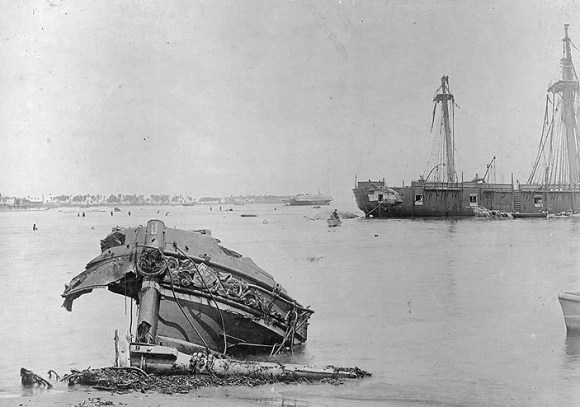
wrecked german ships

SMS Eber’s Bow
Photo: Wrecksite.eu

Remember the Maine!

February 15, 2013 — Leave a comment
USS Maine

Remember the Maine!

In many ways, today marks the 115th anniversary of the beginning of the American “Empire.” In early 1898, the battleship USS Maine was dispatched to Havana, Cuba to protect American interests as Cuba was wracked by a war for independence from Spain. On the evening of February 15, 1898, an explosion ripped through the forward section of the Maine. The ship quickly settled to the bottom of Havana’s harbor taking with her 261 of 355 man crew.

Six weeks after the catastrophe, a US Naval Court of Inquiry determined that the sinking could be attributed to a naval mine. Popular opinion was quickly inflamed by the popular press and “Remember the Maine! To Hell with Spain” became a rallying cry for war with Spain. Two months later, in April 1898, war began as Spain declared war on the United States after the US issued an ultimatum to Spain demanding it grant Cuba independence. The war was an overwhelming American victory and had numerous domestic and international consequences. First, the war helped heal the wounds of the War Between the States as former Confederate General Joseph Wheeler (along with Robert E. Lee’s son Fitzhugh Lee, himself a former Confederate commander) proudly led US troops into battle. Second, the war helped propel Teddy Roosevelt to national prominence and ultimately the White House. Finally, the war in many ways marked the rise of the US as an international power as the US gained control of Cuba, Guam, the Philippines, and Puerto Rico.

The true cause of the sinking of the Maine remains a mystery, but modern inquiry by none other than the US Navy’s own brilliant Admiral Hyman Rickover has led many to conclude that the sinking was the result of spontaneous combustion of the ship’s coal bunkers and not a Spanish mine. The Maine was later removed from Havana harbor and scuttled off the coast of Florida in 1912.

french liner

Normandie Capsizes at Anchor

The late 1920s and 1930s marked the beginning of the brief reign of the super liner as the speedy behemoths of the sea. In moves foreshadowing the hostilities of World War II, the British, French and Germans all launched super liners in an effort to  win the battle for national pride. France’s contribution to the super liner race was the Normandie, a sleek technological marvel that was launched in St. Nazaire France in 1932. After final fitting out, Normandie began commercial service across the North Atlantic in 1935. During her 139 trans-Atlantic trips, the Normandie won the Blue Riband several times.

cruise liner fire

Normandie Aflame

The outbreak of World War II found the Normandie in New York City where she was interned by the United States. After the fall of France in 1940, she was taken over by the US government, renamed USS Lafayette, and efforts were begun to convert her into a troopship shortly after the attack on Pearl Harbor in December 1941. On February 9, 1942 while the ship was docked in New York City undergoing conversion a fire engulfed the ship. Firefighting efforts resulted in the ship capsizing. Although the ship was salvaged, bringing the ship back to sailing trim was deemed cost prohibitive and she was scrapped after the war.

Bismarck

Normandie’s Drydock in St. Nazaire, France

While Normandie failed to make any direct contributions to the war effort, the dry dock built in St. Nazaire to accommodate her became an asset for the Nazis in the Battle of the Atlantic. The dock was large enough to fit the Kriegsmarine’s largest capital ships Bismarck and Tirpitz and the Royal Navy launched a successful commando raid (Operation Chariot) to demolish the dry dock.

spy ship

USS Pueblo
Photo: US Navy

On January 23, 1968, the US Navy intelligence ship USS Pueblo was gathering signals intelligence (SIGINT) and electronic intelligence (ELINT) in international waters off the North Korean coast. Within a matter of hours, the Pueblo and her crew would have their lives turned upside down and become players in an international drama.

The Pueblo began life as a cargo and passenger ship in 1944 and spent 20+ years as a logistics ship for the US Army before being transferred to the US Navy in 1966. Pueblo was then converted into an intelligence ship and deployed to the Pacific Ocean to monitor Soviet and North Korean activity in the region.

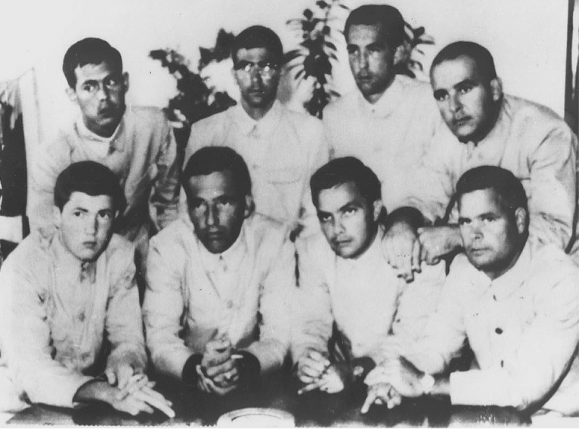
For reasons that still remain unclear, the North Koreans decided that the capture of the Pueblo would be either a propaganda or intelligence coup (or perhaps both) and thus deployed multiple subchasers, torpedo boats and even air assets to capture the Pueblo on the pretext of violating North Korea’s territorial waters. Faced with destruction or capture and no prospect of armed relief, Commander Lloyd Bucher ordered the destruction of all sensitive materials and submitted to the North Korean demand for surrender.

The crew and ship were then paraded before cameras multiple times as a propaganda tool. They were also subjected to physical and psychological torture, but, much like Admiral James Stockdale, refused to allow the North Koreans to defeat their spirit. In fact, the crew became even more famous for displaying the “Hawaiian Good Luck Sign” in photos taken of them by the North Koreans. Demonstrating the ineptness of the North Korean intelligence system, the photos were published because the North Koreans didn’t understand the meaning behind the gesture.

uss pueblo middle finger

Hawaiian Good Luck Sign

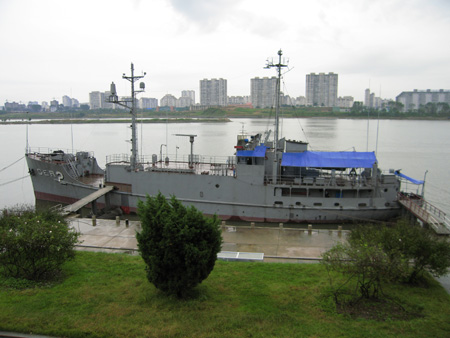
Eleven months after their capture, the officers and crew were released and returned to the United States. Today the Pueblo is the only active US naval warship in captivity. The North Koreans use the ship as a “museum ship” to further the propaganda campaign necessary to keep their own people in chains and transnational elites duped into thinking the North Korean regime is merely a victim of capitalistic bloodlust and excess. While tenuous diplomatic talks have occurred about the return of the vessel to US hands, none have been successful and the ship remains a pawn in North Korean diplomatic efforts.

North Korea spy ship

USS Pueblo in North Korea

confederate fort

Fort Fisher
CC Photo Courtesy of NC Culture on Flickr

At the beginning of 1865, General Winfield Scott’s Anaconda Plan was slowly suffocating the Confederacy and only one major port, Wilmington, NC, remained open in defiance of the Yankee invaders. Wilmington’s location made it one of the South’s most successful ports for blockade runners. The city itself lay 30 miles up the Cape Fear River from the Atlantic Ocean and blockade runners had two islets from which to enter the Atlantic and evade the Union blockade fleet.

Early in the war, Confederate forces recognized the importance of securing the mouth of the Cape Fear. By 1865, what had begun life as a small artillery battery had become Fort Fisher, one of the largest coastal emplacements of the 19th century, and had been dubbed the Gibraltar of the South. Fort Fisher was shaped in the form of an L with a northern land face and a westward facing sea face.

In addition to its fearsome batteries of heavy guns, the fort’s commander, Colonel William Lamb, created a roving artillery unit equipped with advanced breech-loading Whitworth cannon. Colonel Lamb utilized the squadron to drive off Union warships that sought to attack blockade runners steaming through the surf zone or beached during an unsuccessful run.

On December 24, 1864 the Union Army and Navy attempted a combined operations attack on the fort, but were driven off thanks to the effective command of Colonel Lamb and the incompetence of the Union ground commander, Major General Benjamin “Spoons” Butler. Less than a month later, on January 12, 1865 a larger, better equipped Union force arrived off Fort Fisher determined to carry the fort regardless of the cost. On January 15, after a 60 hour bombardment, 8,000 Union troops surged forward and captured the fort after a fierce 6 hour battle. Fort Fisher’s capture sealed the fate of Wilmington and ensured that no more foreign war material would reach General Robert E. Lee’s beleaguered troops in Petersburg, Virginia.

Today the sea has claimed much of the fort and what little remains is a museum and historic site run by the state of North Carolina. Visitors to the museum should be sure to stop in at the world-class Fort Fisher Aquarium just down the road.

goshen

Maury River Flowing Through Goshen Pass
Photo: Brightman Thomas

Matthew Fontaine Maury is relatively unknown today, but his contributions to oceanography continue to impact modern mariners. Maury was born in Spotsylvania County, Virginia on January 14, 1806, but spent his formative years in Tennessee. Seeking to follow in the footsteps of his older brother, Lieutenant John Minor Maury, Maury attended the Naval Academy through an appointment by US Senator Sam Houston. Upon graduation, Maury was assigned to various ships throughout the Navy and was aboard the USS Vincennes when it became the first US naval vessel to circumnavigate the globe.

Maury quickly developed an interest in the scientific aspects of sailing and became even more engrossed in the subject when a leg injury rendered him unfit for duty at sea. Appointed to command the US Naval Observatory in 1842, Maury published several seminal navigational works including Wind and Current Chart of the North Atlantic, Sailing Directions and Physical Geography of the Seas and its Meteorology. Many of Maury’s achievements came through his collecting of data from whalers, merchant captains and naval warship logs.

Maury became internationally recognized for his work in the field that became known as oceanography, but unfortunately his research was interrupted by the coming of the American Civil War. Maury, considering himself a loyal Virginian, volunteered his services to the fledgling Confederate Navy. Appointed Chief of Sea Coast, River and Harbor Defences, Maury applied his brilliant mind to the protection of the Confederacy and developed a torpedo (forerunners to today’s naval mines) that wreaked devastation on invading Union ships. Maury also leveraged his international reputation and worked abroad on behalf of the Confederacy’s diplomatic efforts to procure weapons and foreign recognition.

Following the war, Maury retired to sleepy Lexington, VA where he chaired the Virginia Military Institute’s physics department. Around the same time, General Robert E. Lee arrived next door,and began his transformative presidency of struggling Washington College. Maury continued his contributions to scientific advancement with the publication of a book categorizing the mineral deposits of Virginia and how best to exploit them. Maury passed away in 1873 and was buried in Richmond. Today, Washington & Lee students (and VMI cadets when they can get off post) enjoy lazy Spring Term spring days tubing along the Maury River which was named in his honor.

Operation Gratitude

January 12, 2013 — Leave a comment
cam ranh bay

Photo: US Navy

As war loomed between the United States and Imperial Japan, the US Navy began laying the groundwork for a network of coast watching and weather stations throughout the coasts and inland areas of China and Southeast Asia. Following Pearl Harbor, the US Navy dispatched Captain Milton Miles, an officer with pre-war experience in China, to establish what became known as the Sino-American Cooperation Organization (SACO). The organization contributed greatly to the war effort, but one of its biggest successes didn’t come until January 12, 1945.

SACO’s coast watchers observed a 26 ship convoy drop anchor in Cam Ranh Bay in French Asia. The convoy joined numerous other Japanese vessels and SACO quickly informed Admiral Bull Halsey and his Task Force 38 who were conducting operations (Operation Gratitude) in the South China Sea. Halsey worked up an assault plan and dispatched 82 TBM Avenger bombers to destroy the Japanese convoy. By the end of the day, more than 40 ships and 120,000 tons of enemy shipping lay at the bottom of Cam Ranh Bay. Thanks to a handful of American and Chinese SACO coast watchers, thousands of tons of much needed war material were destroyed and the noose tightened ever so tighter around Japan’s home islands.

USMC

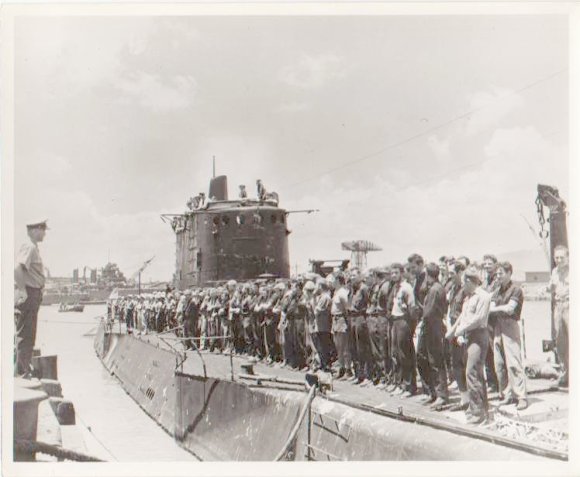
Marine Raiders embarked aboard US Navy submarine

Today marks the 69th anniversary of the disbandment of the US Marine Corps’ four Marine Raider Battalions. The Battalions were initially formed to conduct operations behind enemy lines in the Pacific Theater during World War II. The Raiders are perhaps most famous for their operation in August 1942 against Japanese forces on tiny Makin Atoll in the Gilbert Islands.

In order to gather intelligence on enemy forces in the area and to sow confusion in the Japanese command as to where the main Allied thrusts would occur, Admiral Chester Nimitz ordered the 2nd Marine Raiders Battalion, better known as Carlson’s Raiders, to assault Makin Atoll on August 17, shortly after the initial invasion of the Lower Solomons by US forces. On August 8, companies A and B of Carlson’s Raiders were embarked aboard two submarines, USS Nautilus and USS Argonaut, and stealthily made their way to Makin Atoll.

Going ashore in small combat rubber raiding craft, the two companies quickly became intermingled in heavy surf and lost the element of surprise shortly after landing. Over two days of fighting, though, the Raiders annihilated the Japanese ground force and fended off multiple air attacks – all while losing only eighteen dead and twelve missing. Additionally, their supporting submarines sank several small craft with fire from their deck guns. Carlson’s Raiders then re-embarked and made their way to Pearl Harbor to a hero’s welcome. Unfortunately, in the chaos of combat, nine Raiders were left behind and later beheaded after they surrendered on August 30th.

During their brief existence, the men of the Marine Raider Battalions earned seven Medals of Honor and several dozen Navy Crosses and one member went on to earn the Medal of Honor in the Korean War. Today, the spirit of the Marine Raiders live on through their sister WWII unit, the Amphibious Reconnaissance Battalion, which has since become Force Recon; as well as through the MARSOC units stood up as part of the US Marine Corps contribution to SOCCOM. The Marine Raiders accomplisments are also remembered through the US Navy’s amphibious assault ship USS Makin Island. The units have also found their place in popular culture with Makin Atoll missions being featured in the wildly popular Call of Duty and Medal of Honor video game franchises.

amphibious assault ship

USS Makin Island
Photo: US Navy

US Navy Seals

Photo: US Department of Defense

While today the US Navy’s Sea, Air and Land (SEAL) units have become household names for taking down Osama Bin Laden and Somali pirates, there was a time when their exploits were much more in keeping with their reputation as Silent Professionals. In 1989, during the invasion of Panama (Operation Just Cause), a team of SEALs played a quiet, but integral role to the success of the invasion.

Although Panamanian dictator Manuel Noriega had been a US ally in the early 1980s, his relations with the US took a chilly turn in the late 1980s. Fueled by disputes over the Panama Canal Zone and the War on Drugs, tensions escalated between the US and Panama until December 20, 1989 when President George H.W. Bush ordered that Operation Just Cause be set into motion.

One of the primary objectives of the invasion was to secure Manuel Noriega and bring him back to the United States to stand trial. The SEALs were tasked with preventing Noriega’s escape by capturing, disabling or destroying his private jet and gunboat. A team of four SEALs used a combat rubber raiding craft (CRRC) to approach within swimming range of the gunboat. The team then silently approached the gunboat, but were detected and attacked with grenades. Despite this minor setback, the SEALs successfully planted their explosives and exfiltrated out of the area. The gunboat was destroyed and, even though the plan had originally been to merely sever the propellers with explosives, in the aftermath of the attack one of the gunboat’s engines couldn’t even be located because so much explosives had been used.

Meanwhile a team of three SEAL platoons moved on Noriega’s private, but unfortunately took 12 casualties including 4 KIA in a firefight surrounding the hangar. The jet was destroyed with rocket fire and the SEALs’ objective of sealing off Noriega’s escape routes was accomplished. Operation Just Cause concluded less than 2 weeks later when Noriega, who had holed up in the Vatican Embassy, surrendered to US forces.

Photo: US Navy

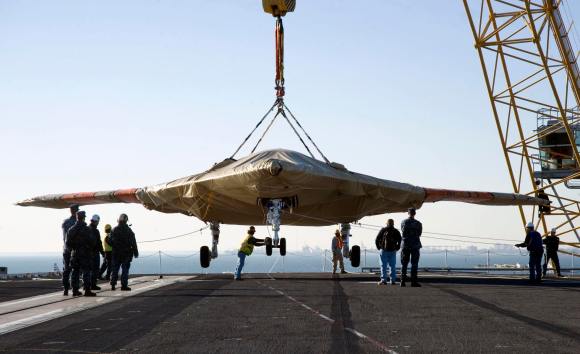
Earlier this week the first of two test X-47B unmanned carrier aircraft systems was hoisted aboard the aircraft carrier USS Harry S Truman. The aircraft will continue a slate of tests that have occurred primarily at the Patuxent River Naval Air Station. Completion of the shipboard tests will bring the X-47B one step closer to proof of concept.

As illustrated below, the X-47B is a fighter sized unmanned aircraft system designed by Northrop Grumman. The X-47B is intended to provide the US Navy with an unmanned strike capability and, while the X-47B is merely a test bed for further development, the craft has been outfitted with two internal weapons bays capable of carrying a 4,500 lb, payload. Unlike most drones, the X-47B was designed to fly a specified route and return to base as opposed to being actively flown. If the X-47B’s concept is brought into production, then sometime in the next decade or two the US Navy will be able to strike targets without risking a single naval aviator.

Photo: Northrop Grumman

Below is official US Navy footage of the X-47B’s first test flight.

More photos of the X-47B can be found here.