Archives For November 30, 1999

City of Medicine Hat
 
Saskatoon, Saskatchewan
CC Image Courtesy of Space Ritual on Flickr

UPDATE 3/12/13 – The Star Phoenix released a story yesterday concerning recent archaeological work performed on the SS City of Medicine Hat which sank under mysterious circumstances on June 7, 1908. The lead archaeologist on the project, Butch Amundson, now believes that the steamer was wrecked on purpose. This is due to a surprising lack of personal effects on the wreck and the removal of expensive items such as its 6-foot tall brass music box just prior to the ship’s sinking.

PREVIOUS POSTThe Star Phoenix reported earlier last week that more than 1,000 artifacts have been recovered from what is believed to the wreck of the SS City of Medicine Hat. Designed and built by the wealthy and eccentric Scottish nobleman Horatio Hamilton Ross, the ship was intended to operate as an inland steamer in Alberta, Manitoba and Saskatchewan, Canada.The ship sank on her maiden voyage from Medicine Hat, Alberta to Winnipeg, Manitoba on June 7, 1908. City of Medicine Hat’s rudder was rendered inoperable when it snagged an underwater obstacle and the vessel drifted against a bridge abutment where it capsized under the swift river currents of the South Saskatchewan River.

There were no casualties in the sinking and the ship sank into both metaphysical and physical obscurity. This August, though, a crew working to replace a bridge across the South Saskatchewan River recovered more than 1,000 artifacts from approximately 25 feet below the surface. Archaeologists working with the project believe with substantial certainty that the artifacts belong to the City of Medicine Hat. Miscellaneous artifacts such as an anchor were previously recovered in 2006 and 2008, but this is the first comprehensive recovery of items since initial salvage efforts concluded on the vessel in 1908. While the final disposition of the artifacts is still in question, they most certainly will assist historians in painting a more complete picture of turn of the century riverine life in central Canada.

clipper ship

Clipper Blue Jacket Aflame
Photo: Wrecksite

In 1869 the clipper ship Blue Jacket embarked 71 passengers and crew and departed Lyttelton, New Zealand bound for Liverpool. On March 9, off the coast of the Falkland Islands, the ship caught fire and was abandoned. A total of 39 survivors were picked up with 36 having spent a week adrift and 3 spending 3 weeks subject to the vagaries of the South Atlantic. While March 9th may have signaled the end of the Blue Jacket’s voyage, it marked the beginning of a voyage of a different sort for her figurehead. For nearly 20 months the Blue Jacket’s figurehead floated with the currents and on December 8, 1871 washed ashore on Rottnest Island near Perth, Australia – 6,000 miles from where the Blue Jacket was abandoned.

nazi passenger ship

SS General von Steuben

By January 1945, Soviet forces were beginning to cut off German civilians and military personnel in East Prussia, the Polish Corridor and the Baltic States. Adolf Hitler stubbornly refused naval units to be utilized for an evacuation, instead insisting on no retreat, even in the face of overwhelming Soviet forces. Admiral Karl Donitz, one-time U-boat captain and commander of the Kriegsmarine’s U-boat forces until January 1943, finally convinced Hitler to relent and on January 23, 1945, Operation Hannibal, the largest seaborne evacuation in history began. From January 23 until early May, German Kriegsmarine units, merchant and fishing vessels and passenger liners were pressed into service to rescue approximately 1.3 million Germans from the Soviet juggernaut.

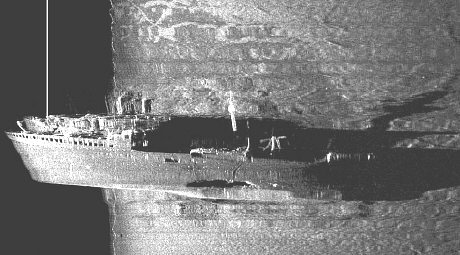
Former Norddeutscher passenger liner turned hospital ship SS General von Steuben was among those ships pressed into service. Incidentally the General von Steuben had been named after the Polish/German Revolutionary War office who had done so much to train General Washington’s ragtag army. On the night of February 10, the Soviet submarine S-13 spied the General von Steuben steaming in the Baltic with a load of 4,267 civilians, crew and soldiers. Struck by two torpedoes fired by the S-13, the General von Steuben disappeared beneath the waves of the Baltic along with 3,608 souls.

This was not S-13s first taste of blood during Operation Hannibal as the sub had sunk the German liner Wilhelm Gustloff only ten nights earlier with the loss of nearly 10,000 lives. The wreck of the General von Steuben was located in 2004 by a Polish naval vessel and lies in waters reachable by technical divers.

sunk nazi ship

SS General von Steuben on the Baltic Sea Floor

french liner

Normandie Capsizes at Anchor

The late 1920s and 1930s marked the beginning of the brief reign of the super liner as the speedy behemoths of the sea. In moves foreshadowing the hostilities of World War II, the British, French and Germans all launched super liners in an effort to  win the battle for national pride. France’s contribution to the super liner race was the Normandie, a sleek technological marvel that was launched in St. Nazaire France in 1932. After final fitting out, Normandie began commercial service across the North Atlantic in 1935. During her 139 trans-Atlantic trips, the Normandie won the Blue Riband several times.

cruise liner fire

Normandie Aflame

The outbreak of World War II found the Normandie in New York City where she was interned by the United States. After the fall of France in 1940, she was taken over by the US government, renamed USS Lafayette, and efforts were begun to convert her into a troopship shortly after the attack on Pearl Harbor in December 1941. On February 9, 1942 while the ship was docked in New York City undergoing conversion a fire engulfed the ship. Firefighting efforts resulted in the ship capsizing. Although the ship was salvaged, bringing the ship back to sailing trim was deemed cost prohibitive and she was scrapped after the war.

Bismarck

Normandie’s Drydock in St. Nazaire, France

While Normandie failed to make any direct contributions to the war effort, the dry dock built in St. Nazaire to accommodate her became an asset for the Nazis in the Battle of the Atlantic. The dock was large enough to fit the Kriegsmarine’s largest capital ships Bismarck and Tirpitz and the Royal Navy launched a successful commando raid (Operation Chariot) to demolish the dry dock.

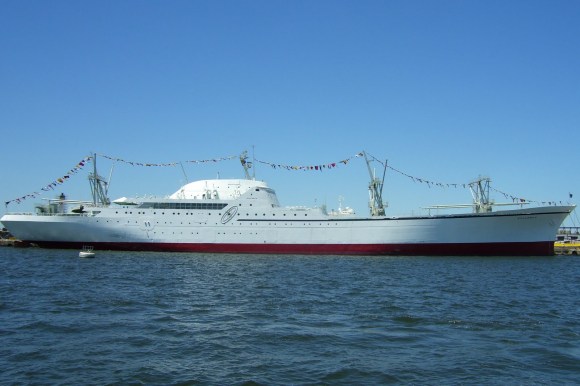
Nuclear Ship Savannah

January 10, 2013 — Leave a comment

nuclear powered merchant ship

The early 1950s were the glory days of the Atomic Age as scientists and the public eagerly sought to apply atomic technology to as many uses as possible. Unlike today when there are enough anti-nuclear groups to populate a mid-size state, atomic energy was embraced as the wave of the future. Among the applications atomic power was devoted to was that of merchant shipping. In 1955, President Dwight D. Eisenhower ordered the construction of what was to become the NS Savannah as part of his “Atoms for Peace” initiative.

The Savannah was conceived as a proof of concept ship that could transport both cargo and passengers and sailed on her maiden voyage on August 20, 1962. It’s Babcock & Wilcox nuclear reactor was more than 50% of the cost of the $49.6 million ship and she could cruise at full power for 2 years before needing to re-fuel. Unfortunately, high operating costs made her unable to compete against oil-burning ships with oil at only a few dollars a barrel. Additionally, the cost of infrastructure required to support the ship couldn’t be spread across multiple vessels and her cargo holds weren’t designed for load efficiency. Thus, on January 10, 1972 the ship was taken out of active service.

Today the ship is moored in Baltimore, Maryland where it is hoped she can become a museum ship after her nuclear reactor is decommissoined. Savannah stands as a memorial to a time when Americans dreamed big and stood as a beacon of freedom in a squall of socialism and devastation wrought by world war.

City of Medicine Hat

Saskatoon, Saskatchewan
CC Image Courtesy of Space Ritual on Flickr

The Star Phoenix reported earlier last week that more than 1,000 artifacts have been recovered from what is believed to the wreck of the SS City of Medicine Hat. Designed and built by the wealthy and eccentric Scottish nobleman Horatio Hamilton Ross, the ship was intended to operate as an inland steamer in Alberta, Manitoba and Saskatchewan, Canada.The ship sank on her maiden voyage from Medicine Hat, Alberta to Winnipeg, Manitoba on June 7, 1908. City of Medicine Hat’s rudder was rendered inoperable when it snagged an underwater obstacle and the vessel drifted against a bridge abutment where it capsized under the swift river currents of the South Saskatchewan River.

There were no casualties in the sinking and the ship sank into both metaphysical and physical obscurity. This August, though, a crew working to replace a bridge across the South Saskatchewan River recovered more than 1,000 artifacts from approximately 25 feet below the surface. Archaeologists working with the project believe with substantial certainty that the artifacts belong to the City of Medicine Hat. Miscellaneous artifacts such as an anchor were previously recovered in 2006 and 2008, but this is the first comprehensive recovery of items since initial salvage efforts concluded on the vessel in 1908. While the final disposition of the artifacts is still in question, they most certainly will assist historians in painting a more complete picture of turn of the century riverine life in central Canada.

alaskan ferry

Kalakala Ferry Today
CC Image Courtesy of rbanks on Flickr

Once a majestic art deco ship shuttling passengers across Puget Sound, the Kalakala is today rusting away at her moorings in Tacoma, Washington. For nearly a decade, owner Steve Rodrigues has attempted to restore the ship to her former glory, but has faced serious funding issues and legal troubles with the US Coast Guard and the state of Washington. Unless someone with deep pockets steps up soon, the ship is most likely destined for the breakers yard.

Originally built in 1926, the Kalakala has had a colorful history and began life as the Peralta, a traditionally styled ferry operating in San Francisco, California. In 1933, a fire at Peralta’s terminal wrecked the ship’s superstructure and, instead of rebuilding the vessel in its prior form, the ship was graced with a sleek art deco superstructure to become the world’s first art deco ship.

Kalakala entered service in 1935, but a design defect obstructed the view of the bow from the bridge and the ship was plagued with poor handling in the tight confines of ferry terminals. Kalakala continued ferrying passengers around Washington and British Columbia until 1967. The vessel then sailed to Alaska where she was purposely run aground and converted into a shrimp processing plant on dry land. In 1982, the Kalakala’s owners declared bankruptcy. Thus began a 30 year dance of legal maneuvering and fundraising during which the vessel was moved back to Washington and efforts launched to restore the ship.

art deco ship

Kalakala Ferry in 1958
CC Image Courtesy of kitchener.lord on Flickr

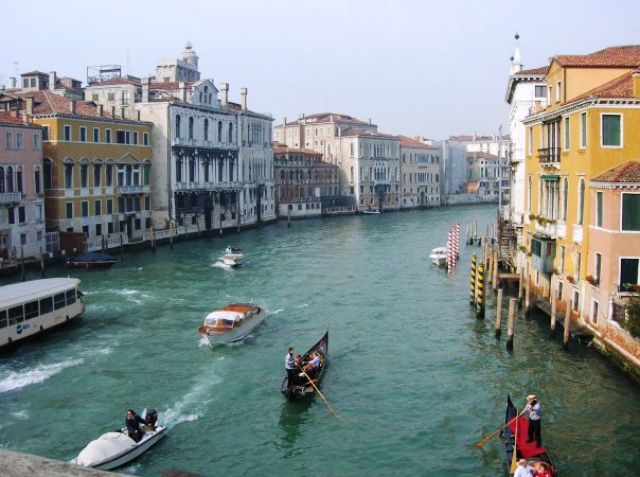
gondola

Today, Venice is best known for its graceful gondolas and idyllic streets of water, however, for several centuries it was a powerful city-state which exerted economic and political control over a large swath of northern Italy and the Adriatic Sea. Perhaps the Republic of Venice’s greatest accomplishment was on October 7, 1571 when naval forces led by Venice’s Doge Sebastiano Venier defeated Ottoman forces at the Battle of Lepanto.

For nearly a hundred years the Ottomans had waged an off and on war against various Italian city-states and the Kingdom of Spain. Prompted by the capture of a Venetian colony on the island of Cyprus, the Venetians and their Christian allies assembled a force of 212 galleys and galleasses to launch a punitive expedition against the Ottomans and free the imprisoned colonists. The Christian and Ottoman fleets encountered one another in the Gulf of Patras on October 7th and immediately engaged in combat. Although outnumbering the Christian fleet by nearly 40 ships, the Ottoman forces were decimated by the superior guns and seamanship of the Christian fleet. The Christians captured approximately 130 ships and destroyed another 80 while losing only 50 of their own with 1 captured by the Ottomans. Additionally, the Ottomans suffered 20,000 casualties to the 7,500 lost by the Christian fleet and more than 10,000 imprisoned Christian rowers were freed from slavery.

The battle was one of the most significant naval victories in history and marked the high-water mark of the Ottoman Navy. No longer would Venice or any of her sister Italian city-states be existentially threatened by the Ottoman Empire. Venice reasserted her economic dominance of the region, however, changes in technology and trading routes eventually led to the city’s graceful dive into impotence. The city lost her independence in 1797 when Napoleon Bonaparte captured the city and she became a pawn in European geopolitics for the next 80 years until her incorporation into the Kingdom of Italy in 1866. Today though, there are growing calls for Venetian independence amidst the Eurozone crisis and continuing Italian austerity.

The Battle of Lepanto has been honored by the naming of two ships in the Italian Navy after the battle. The Genoese commander of one wing of the Christian fleet, Admiral Andrea Doria, became one of Italy’s most famous naval heroes and is perhaps most associated with the wreck of his namesake, the Italian liner Andrea Doria, which sank after colliding with the Swedish ship Stockholm in 1956.

hong kong ferry

CC Image Courtesy of Trey Menefee on Flickr

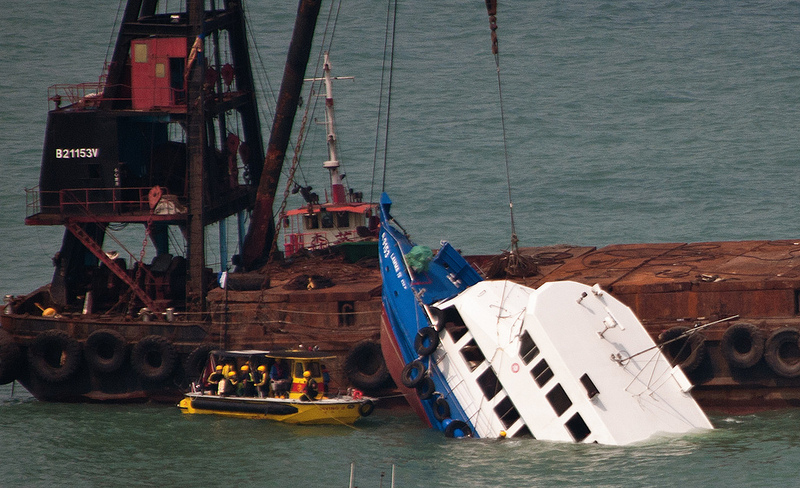
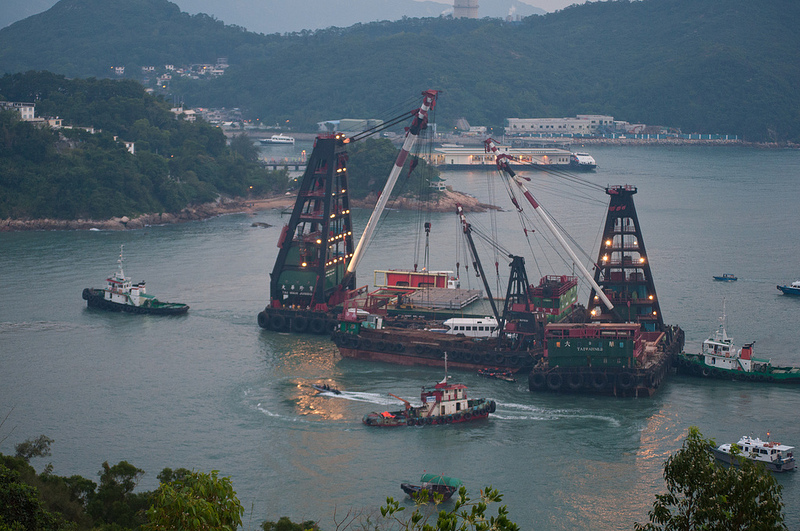
A commuter ferry and a boat full of Hongkong Electric Co. employees collided Monday night around 8:30pm. The Hongkong Electric boat, Lamma IV, was carrying 120 passengers on their way back from a tour of a power facility and were about to take in a fireworks display in Victoria Harbor. The ferry, Sea Smooth, collided with the Lamma IV’s stern and caused the Lamma IV to sink quickly by the stern, stranding dozens of passengers below deck.

So far 38 people have been declared dead of the 120 aboard while only minor wounds were suffered by the Sea Smooth‘s passengers and crew. Authorities have towed the Lamma IV to a nearby beach and discovered a large hole on the port side of the vessel’s stern. Both captains and several of the crew from each vessel have been arrested and released on bail. Hongkong Electric has already pledged to pay $25,800 to each victim’s family. The exact cause and responsibility for the wreck has yet to be determined.

hong kong ferry

CC Image Courtesy of Trey Menefee on Flickr

Viking Sally

Photo: Wikicommons

Eighteen years ago today, the Baltic ferry M/V Estonia sank in heavy seas while en route from Talinn, Estonia to Stockholm, Sweden. Designed for use as a ferry, the Estonia was launched in 1980 as the Viking Sally. Following Estonian independence, the ship was purchased by Estlines in 1993 and was the largest ship flying the Estonian flag at the time of its sinking.

The loss of the Estonia is one of the world’s 10 worst maritime disasters and 1 of 2 to have occurred in the Baltic Sea. The official explanation for the wreck is that the bow door locks failed due to the heavy seas the Estonia encountered and the failure resulted in the ship taking on large amounts of water in its vehicle deck. Eventually the incoming water in the vehicle deck caused the vessel to capsize and then sink. Termed the free surface effect, this phenomenon of a ferry sinking from water flooding its vehicle deck is widely associated with roll-on, roll-off ferries such as the Estonia and could have been a contributor to the sinking of the M/V Le Joola.

Alternative conspiracy theories have circulated claiming the Estonia sank due to the explosion of a secret military cargo being transported by Britain’s MI-6 and the American CIA. Fueling the conspiracy claims is the prohibition of diving on the wreck site which has prevented independent analysis of the wreckage. Conspiracists claim the prohibition is to prevent the true reason for the sinking from coming to light while the Estonian government states it is to preserve the site as a monument to the 852 souls who perished in the sinking. The conspiracy has even made it to the big screen in the form of the movie Baltic Storm