Archives For November 30, 1999

voyage of the damned

SS St. Louis in Havana Harbor
Photo: US Holocaust Memorial Museum

On May 13, 1939, the Hamburg-Amerika Line ocean liner SS St. Louis departed Hamburg, Germany for Havana, Cuba. Aboard the St. Louis were more than 930 Jewish refugees seeking refuge in Cuba from Nazi oppression. The refugees had secured legitimate landing certificates for Cuba, however, upon their arrival the refugees learned that the pro-fascist Cuban government had invalidated the visas and all but 27 of the refugees were denied entry. Much like White Russians after the 1917 Revolution, the refugees were now a people without a country. The refugees sought entry into the United States, but in a shameful and cowardly act, the US government denied them access.

Thus, on June 6 the St. Louis was forced to return to Europe where the refugees were eventually divvied up among several European countries – 287 to the United Kingdom, 214 to Belgium, 224 to France and 181 to the Netherlands. As the Nazi juggernaut flattened Europe over the next 18 months many of the refugees once again found themselves under the heel of the Nazi jackboot. Many of the refugees perished in the Holocaust, however, a majority were able to survive the war.

In the subsequent years, the plight of the refugees aboard the St. Louis has been highlighted in print (Refuge Denied & Voyage of the Damned) and the big screen (Voyage of the Damned). As the great statesman Edmund Burke once said, “The only thing necessary for the triumph of evil is for good men to do nothing.” Sadly, good men chose to do nothing when the refugees aboard the St. Louis came calling in Cuba and the United States.

Scotch

Today, two bottles of scotch from the wreck of the 8,000 ton SS Politician went up for auction on Scotch Whisky Auctions’ website. Politican departed Liverpool in February 1941 with a general cargo bound for Kingston, Jamaica and New Orleans. Stuffed within the ship’s holds were 28,000 case of malt whisky. While sailing around the Outer Hebrides, the Politician wrecked off the island of Eriska and the local islanders moved quickly to salvage the cargo and quench their war-deprived thirst.

Forty six years later, in 1987, professional diver Donald MacPhee discovered 8 bottles of whisky on the wreck which were subsequently auctioned by Christie’s for £4,000. As of this writing the winning bid for just 2 of the bottles at the Scotch Whisky Auctions site is £2,400 – a tidy profit for the previous owner.

battle of the atlantic

Blackett’s War documents the application of science to the Battle of the Atlantic and the outsized impact a small collection of British scientists had on its outcome. Author Stephen Budiansky charts the life of Nobel Prize winner Patrick Blackett, a British naval officer turned scientist, from his service in World War I to his 1930s academic life and conversion from civilian scientist to architect of a scientific method of fighting the Battle of the Atlantic. In the first section of the book, Budiansky follows Blackett’s World War I and inter-war experiences as well as those of the United Kingdom as a whole. In particular, Budiansky focuses on the deployment of the submarine as an unconventional offensive weapon and how it nearly brought Britain to her knees in World War I.
As the tale progresses, other scientists and historical events are woven into the story to add context and depth to the fascinating melding of ruthless warfare with statistical analysis, cryptography and electronic detection and countermeasures. While this often helps advance the storyline, at times it becomes difficult to keep track of the countless characters and events. If there is any flaw in the book, it is that the inclusion of these characters renders the title slightly misleading. The book is less about Patrick Blackett than it is about the scientific teams on both sides of the Atlantic that fought both their own civilian and military bureaucracy and the Kriegsmarine to win the naval war. Overall Blackett’s War is an intriguing read that provides a unique blend of scientific and military history.

ghost ship

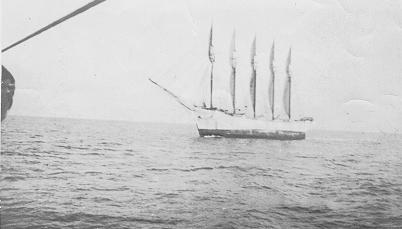
Carrol A. Deering Run Aground on Diamond Shoals
Photo: Wikimedia

On the morning of January 31, 1921 the five-masted schooner Carrol A. Deering was spotted aground on Diamond Shoals off the coast of North Carolina. Coast Guardsmen from the Cape Hatteras Life-Saving Station rowed out to the ship only to find not a soul aboard and no sign of what might have happened to the crew.

Built in Bath, Maine, the Deering was designed to ply the trading lanes between the eastern seaboard of the US and South America. On her final, ill-fated voyage in January 1921, the ship sailed from Rio de Janeiro and, after a brief stopover in Barbados, continued her voyage north. The ship was last seen manned by the Cape Lookout lightship on January 28, 1921 and only 3 days later she was found run aground nearly 100 miles northeast on Diamond Shoals.

When the Coast Guard was finally able to board the ship on February 4, the Coasties found the ship deserted, the crew’s belongings, navigational equipment and lifeboats gone, and the ship’s galley appearing as if a meal was in the process of being prepared. Despite numerous inquiries at various levels and branches of governments, the mystery of the crew’s disappearance was never solved. The most likely explanation is that the crew mutinied as mutinous comments had been overheard by some observers when the ship was last in port. Other explanations offered over the last 90 years have included piracy, a Communist plot, the Bermuda Triangle and even that the crew was the victim of some paranormal phenomenon. The ship herself survived her crew by only a month as, unable to be re-floated, she was dynamited to prevent her from becoming a hazard to navigation.

confederate fort

Fort Fisher
CC Photo Courtesy of NC Culture on Flickr

At the beginning of 1865, General Winfield Scott’s Anaconda Plan was slowly suffocating the Confederacy and only one major port, Wilmington, NC, remained open in defiance of the Yankee invaders. Wilmington’s location made it one of the South’s most successful ports for blockade runners. The city itself lay 30 miles up the Cape Fear River from the Atlantic Ocean and blockade runners had two islets from which to enter the Atlantic and evade the Union blockade fleet.

Early in the war, Confederate forces recognized the importance of securing the mouth of the Cape Fear. By 1865, what had begun life as a small artillery battery had become Fort Fisher, one of the largest coastal emplacements of the 19th century, and had been dubbed the Gibraltar of the South. Fort Fisher was shaped in the form of an L with a northern land face and a westward facing sea face.

In addition to its fearsome batteries of heavy guns, the fort’s commander, Colonel William Lamb, created a roving artillery unit equipped with advanced breech-loading Whitworth cannon. Colonel Lamb utilized the squadron to drive off Union warships that sought to attack blockade runners steaming through the surf zone or beached during an unsuccessful run.

On December 24, 1864 the Union Army and Navy attempted a combined operations attack on the fort, but were driven off thanks to the effective command of Colonel Lamb and the incompetence of the Union ground commander, Major General Benjamin “Spoons” Butler. Less than a month later, on January 12, 1865 a larger, better equipped Union force arrived off Fort Fisher determined to carry the fort regardless of the cost. On January 15, after a 60 hour bombardment, 8,000 Union troops surged forward and captured the fort after a fierce 6 hour battle. Fort Fisher’s capture sealed the fate of Wilmington and ensured that no more foreign war material would reach General Robert E. Lee’s beleaguered troops in Petersburg, Virginia.

Today the sea has claimed much of the fort and what little remains is a museum and historic site run by the state of North Carolina. Visitors to the museum should be sure to stop in at the world-class Fort Fisher Aquarium just down the road.

Graf Spee sinking

Sinking of the Graf Spee

At the outset of World War II, the Nazi Kriegsmarine didn’t just deploy their merchant raiders and U-boats, but also tasked capital ships with the destruction of Allied shipping. One such ship was the Graf Spee, a pocket battleship constructed during the 1930s before Nazi Germany renounced the provisions of the Versailles Treaty. Germany’s pocket battleships were designed as a re-incarnation of the World War I battlecruiser concept – better armed than heavy cruisers and faster than battleships. The strategic concept was that each ship could operate independently against Allied merchant shipping and choose fight or flight when faced with the threat of engaging a warship.

The Graf Spee was named for Admiral Graf von Spee who had defeated a British squadron at the Battle of Coronel (November 1, 1914) only to have his squadron destroyed by a superior British force a month later at the Battle of the Falklands. Admiral von Spee was lauded by both sides of the conflict as a brilliant tactician and consummate naval officer and gentleman. After his death at the Battle of the Falklands, Admiral von Spee was quickly enshrined in the then small pantheon of Germany’s naval heroes. In addition to the Graf Spee, Germany built two other pocket battleships – the Deutschland and Admiral Scheer – both of which ended the war as floating artillery batteries and were destroyed in the waning weeks of the war.

Commanded by Captain Hans Langsdorff, the Graf Spee found herself in the South Atlantic at the outbreak of the war. Captain Langsdorff and his crew quickly got to work dispatching Allied shipping and sank 50,000 tons of British shipping before being engaged on December 13, 1939 by a trio of British cruisers – Achilles, Ajax, and Exeter. In the subsequent battle, dubbed the Battle of the River Plate, the Graf Spee seriously damaged the Exeter but was herself damaged and Captain Langsdorff sought shelter to perform repairs in Montevideo, Uruguay. Fearing a superior British force had gathered outside Montevideo, Captain Langsdorff and a skeleton crew sailed the Graf Spee into the river estuary on December 18 and scuttled the ship to prevent her from falling into Allied hands. Captain Langsdorff then committed suicide and the crew were interned in Uruguary.

The destruction of the Graf Spee and her limited contributions to the war effort enraged Adolf Hitler who instructed the commander of the Kriegsmarine, Admiral Raeder, to issue an order stating, “The German warship and her crew are to fight with all their strength to the last shell; until they win or go down with their flag flying.” For the Allies, the victory provided a healthy morale boost after the loss of Poland earlier in the year.

argentina navy

ARA Libertad
CC Image Courtesy of maduroman on Flickr

Earlier this October, a court in Ghana ordered the Argentinian naval training vessel ARA Libertad to be held until the Argentinian government posts a $20 million bond to release the ship. The action ultimately stems from Argentina defaulting on its debt in the early 2000s. Argentina’s default wiped its balance sheet clean of billions in bond liabilities while leaving bondholders with bonds worth 30% of their face value. Because Argentinian courts will not force repayment of the bonds, some bondholders who are holding out for the full value of the bonds have turned to more novel methods of collecting on Argentina’s sovereign debts.

One of the most time tested techniques for securing a judgment and payment on a debt is arresting the debtor’s assets when they are in a jurisdiction favorable to the bondholder. Thus, when Libertad arrived in Ghana, Elliott Capital Management sued for the vessel to be held until the Argentinian government pays the bond. While some would characterize the technique as nothing more than holding the ship hostage in exchange for a ransom, the bondholders merely seek to recoup the money the Argentinian government received from the sale of the bonds and promised to repay.

Elliott Capital Management, a New York based hedge fund, manages money for large institutional investors which often includes the likes of pension funds for firemen in Peoria, teachers in Chicago or trash collectors in Milwaukee. The Argentinian government has protested Ghana’s actions with their usual populist rhetoric and decried Elliott Capital Management’s actions as “trickery” instead of accepting it as simply the rule of law. Elliott Capital Management and other bondholders have received more than 100 court judgments against the Argentinian government, none of which the Argentinians have honored.

Yesterday the International Tribunal for the Law of the Sea ordered Ghana to release the Libertad. Because both Argentina and Ghana are signatories to the Law of the Sea Treaty, the International Tribunal’s decision is binding and Ghana must release the ship. The United States has thus far not signed the treaty and this incident is yet another example of why signing the treaty would be a serious mistake for the US and would impede US sovereignty.

Canada WWII Navy

HMCS Sackville
CC Image Courtesy of Paul B on Flickr

The HMCS Sackville was laid down in early 1940 and was 1 of 267 Flower-class Corvettes built for the Allied navies during World War II. The U-boat threat to the Atlantic shipping lanes required hundreds of small, nimble ocean going warships to fend off U-boat and Luftwaffe bomber attacks on Allied convoys. The Flower-class were intended to fulfill this role and helped get American and Canadian men and war material across the Atlantic safely.

The Sackville first saw service in early 1942 when she was deployed to the Northern Atlantic to protect convoys off the coast of Newfoundland. The ship damaged several U-boats during her wartime patrols and even forced two U-boats to completely break off their attacks and return to occupied Europe for extensive repairs. Unfortunately, the Sackville was herself damaged in August 1944 when a massive explosion damaged one of her boilers. The cause of the explosion is still unknown, but was most likely the result of one of her depth charges exploding a Nazi torpedo close to the Sackville’s hull.

Relegated to harbor duty the ship was later converted into a research vessel for use by the Canadian Department of Marine and Fisheries. Finally retired in 1982, the Sackville avoided the scrap heap and is now the last remaining Flower-class corvette in the world. She now continues in service as a museum ship and Canada’s Naval Memorial in Halifax, Nova Scotia. The ship can be visited during the summer months and more information can be found here.

Edward Pellew

Stephen Taylor’s latest book, Commander, documents the life of Edward Pellew, a British naval officer who rose to fame during the Napoleonic Wars. Taylor builds on the work of two previous biographies to present the most complete and balanced description of a man considered to be the greatest frigate captain of the Royal Navy. Most Americans, and perhaps many British citizens, associate Pellew with the same-named fictional commander of HMS Indefatigable in C.S. Forester’s Horatio Hornblower novels. Pellew, though, is considered the inspiration (along with Sir Thomas Cochrane) for Forester’s Hornblower character as well as Patrick O’Brian’s Jack Aubrey character.

Taylor meticulously documents Pellew’s entire life including his youth in Cornwall, his path to the sea, and his early service in the American Revolution on the Great Lakes. Relying on personal correspondence and the efforts of Pellew’s son at preserving his father’s legacy, Taylor reconstructs for the reader Pellew’s various single ship commands and joint operations, including his most famous command, HMS Indefatigable. Especially noteworthy is the behind the scene squabbles that occurred between Pellew and various members of the British nobility and naval establishment.

For instance, while serving as commander of the Indian naval station, Pellew engaged in rigorous conflict with the Admiralty in England as well as another commander on station. Taylor highlights how this particular conflict not only hurt Pellew’s career, but also prevented the taking of the French island of Mauritius (an idea Pellew was pursuing) until later in the war. As a result, French privateers and men of war continued to operate from Mauritius at great cost to British shipping. Taylor concludes with Pellew’s masterful victory over the Barbary Pirates at Algiers in August 1816 and his retirement in England.

Overall, Taylor presents the reader with a well-documented and readable account of Pellew’s life. While some readers may wish for more swashbuckling tales a la Horatio Hornblower, Taylor’s intent was to present a well-rounded account of Pellew’s entire life and not just the daring exploits for which he became famous. Commander is an excellent read and anyone wishing to better understand the Napoleonic Wars and a central figure from them would do well to purchase and read it.

Falklands War

Captain Ian North
Photo: Commander Nick Messinger

This year marks the 30th anniversary of the Falklands War. A solitary remnant of the British Empire, the Falklands Islands have long been claimed by Argentina. In 1982 the Falklands were invaded by an Argentinian government looking to distract its citizens from deteriorating economic conditions at home. Faced with the possibility of ceding the Falklands (and their citizens who overwhelmingly identify as British subjects) to Argentina, the British government, led by Prime Minister Margaret Thatcher, organized a task force to re-take the islands.

Among the vessels selected for the mission was the container ship M/V Atlantic Conveyor, captained by Ian North, a 33 year veteran of the British Merchant Navy. Argentinian Super Etendard jets attacked the British task force several times and on May 25, 1982, the Argies were successful in striking the Atlantic Conveyor with a pair of Exocet missiles. Fires quickly spread throughout the ship and forced its evacuation. A dozen crew perished when the ship sank, among them Captain North.

The Atlantic Conveyor was loaded with the majority of the task force’s transport helicopters and as a result the assault forces encountered greater difficulties than expected in invading the islands. The Argentinian commander of the Super Etendard squadron eulogized Captain North, writing “Captain North was a real sea-dog with his snowy beard, he was a great and brave man.” For his superb service, Captain North was posthumously awarded the Distinguished Service Cross.