Richard Montgomery

The remains of SS Richard Montgomery
CC Image courtesy of tomylees on Flickr

Today marks the 68th anniversary of the abandonment and beginnings of salvage on the SS Richard Montgomery. The ship ran aground near an approach channel to the Thames River on August 20, 1944 and salvage operations began on August 23rd after it was determined the ship could not be saved. Named after Revolutionary War General Richard Montgomery, the SS Richard Montgomery was a Liberty Ship carrying a cargo of ammunition from the United States to the UK. Liberty Ships were designed by William Francis Gibbs to be cheap, mass-produced cargo haulers for the Allied powers during World War Two. Over 2,500 were built and only two survive today, carrying on service as museum ships – SS Jeremiah O’Brien and SS John W. Brown.

Salvage operations were unable to remove all of its deadly cargo and according to a survey performed in 2010 by the UK Maritime and Coastguard Agency, the wreck has 1,500 tons of high explosives still aboard. Due to the presence of so many tons of TNT, the ship remains a serious hazard to navigation and is closely monitored with yearly surveys by UK authorities. A detonation of the ship’s cargo could occur from natural deterioration, a collision with another vessel or even an act of terrorism and would result in an explosion 1/12th the size of the atomic bombs dropped on Hiroshima and Nagasaki. The BBC reported in 2004 that UK authorities believe an explosion could cause a 1,000 x 10,000 foot column of debris and water as well as a 16 foot high wave that would swamp low lying coastal areas.

In death, the SS Richard Montgomery has taken on a pop culture life of its own and has been featured in numerous novels and tv shows. It was even the centerpiece of the fictionalized plot of a 1970s novel wherein terrorists attempted to use speedboats to detonate the ship’s explosives and wreak havoc on the English coast.

Viking longboat

CC Image courtesy of TNDrumGuy on Flickr

Divers operating near the Swedish village of Birka announced the discovery yesterday of underwater jetties dating back to the Vikings. The stone foundations found by the dive team were deeper than historians had believed Vikings could build. The discovery is causing archaeologists to re-examine some of their basic understandings of the Birka village and Viking building techniques. Historians have long thought Birka to merely have had small jetties and a trading post, but the foundations now lead them to believe the village could have been 30% larger than previously thought. They also now believe that it functioned as a port with a marketplace near the wharf

The village of Birka on the Swedish island of Björkö has long been the site of archaeological excavations because of its Viking history. Work in the area first began in the late 19th century and continues today. The village is a UNESCO world heritage site and contains a reconstructed Viking village and museum.

Shackleton’s Whiskey

August 22, 2012 — 1 Comment
Shackleton's Whisky

CC Image courtesy of sandwichgirl on Flickr

Two years ago, three bottles of whisky were recovered from the base camp Sir Ernest Shackleton used during his British Antarctic Expedition (1907 – 1909). Shackleton and his team approached to within ~100 miles of the South Pole and turned back after Shackelton decided it would be too risky to continue. Two years later Captain Robert Scott’s Terra Nova expedition would return to successfully reach the South Pole (although they were beaten by a month by Norwegian Roald Amundsen), but perished on the return journey. Shackleton had been on Captain Scott’s Discovery Expedition in 1904 and later returned to the South Pole as commander of the Imperial Trans-Antarctic Expedition (1914 – 1917). The Imperial Trans-Antarctic Expedition is most famous for the loss of the ship Endurance and the subsequent account of the travails of the crew.

Fast-forward to 2010 and the recovery of the three bottles of whisky by the Antarctic History Trust. Although the whisky was not frozen due to its alcohol content, the bottles were slowly thawed in a New Zealand conservation lab. In 2011, they were then turned over to Whyte & Mackay, the distillery that succeeded the originally producer of the whisky. Using a painstaking process chronicled here and here, scientists at Whyte & Mackay discerned the whisky’s recipe and the distillery has released a limited run of 50,000 bottles of the whisky for sale.

SS United States

Launched in 1951, the trans-Atlantic passenger liner SS United States was a triumph of American engineering. Designed for speed, safety, comfort and easy wartime conversion to a troopship, the ship incorporated numerous innovations in its construction. During her maiden voyage, she captured the speed record known as the Blue Riband for both the eastern and western crossings of the Atlantic. Commercially operated from 1952 to 1969, the SS United States carried thousands of passengers between Europe and New York City in speed and style. Among her passengers were such notables as John Wayne, Bob Hope, Salvador Dali and the Duke and Duchess of Windsor.  Historian Steven Ujifusa’s recently published A Man and His Ship is a history of the SS United States and her designer, William Francis Gibbs. In his book, Ujifusa masterfully weaves together the biography of William Francis Gibbs, his quest to design the ultimate passenger liner and the construction and life of the SS United States.

Neatly divided into two parts, Ujifusa opens the book with William Francis Gibbs’ life prior to the construction of the SS United States. Gibbs had no formal training as a naval architect and yet he went on to a wildly successful career in naval architecture after designing and pitching a ship in collaboration with his younger brother. Ujifusa lays out Gibbs story in a manner compelling to any reader interested in what drives individuals to the pinnacle of success in their field. The second half of the book focuses on Gibbs’ crowning achievement – the design, construction, life and record-breaking performance of  the SS United States. Ujifusa writes with a style easily accessible to a layperson and doesn’t require a knowledge of the minutiae of naval architecture.

Ujifusa concludes with the recent history of the ship including an unsuccessful attempt by Norwegian Cruise Lines to utilize the ship as a cruise liner and the current plan by the SS United States Conservancy to convert the ship to a floating hotel/conference center in Philadelphia or New York City. In sum, A Man and His Ship is a page turning tome celebrating the ingenuity, self-motivation and indomitability of the American spirit.

Global Combat Ship

Photo: BAE Systems/MOD

The Royal Navy has projected British power since the 16th century and is responsible for sending hundreds, if not thousands of ships to the sea floor. Yesterday, the UK Ministry of Defence unveiled plans and specifications for the latest weapon in the Royal Navy’s arsenal. Designated the Type 26 Global Combat Ship, the 485.5 foot, 5,314 ton frigate will replace the Royal Navy’s aging Type 23 frigates which began entering service in 1990.

Noted defense contractor BAE Systems designed the ship and incorporated numerous innovations into its plans. A rear helicopter hangar, vertical missile silos,  “a flexible mission space for unmanned air, surface and underwater vehicles, or additional boats” and a medium caliber deck gun give the Type 26 a potent punch. What is most remarkable about the ship is not its armament, but rather its sensor systems and radar silhouette. Even though the ship will be 485.5 feet, its radar silhouette will be akin to that of a small fishing boat. The Type 26’s armament, sensors suite and design give it the ability to perform both power projection and humanitarian duties. Current cost estimates peg the construction of the frigates at approximately $393 – 500 million each and the Royal Navy aims to purchase 13 of the vessels. If the cost troubles of the UK’s two new Queen Elizabeth class aircraft carriers are a guide for the Type 26s, though, then expect costs to be significantly more than $393 – 500 million.

In a separate twist to the procurement story of the Type 26 frigates, the award of the shipyard contracts will take place after Scotland’s 2014 referendum on independence and a vote for independence would most likely keep Scottish shipyards from competing for the contract. Irregardless of where the ships are built, they will give the Royal Navy a formidable tool to ensure freedom of the seas and locales such as the Falkland and South Georgia Islands.

Last week, researchers announced the discovery of the famous polar exploration vessel SS Terra Nova in waters off the southern coast of Greenland. SS Terra Nova was discovered during routine tests of mapping equipment aboard the Schmidt Ocean Institute’s R/V Falcor. The ship is lying in less than 160M of water, but its exact location has not been disclosed by Schmidt Ocean Institute.

Lost in 1943 after a collision with an ice pack, the SS Terra Nova was built in 1884 to withstand the rigors of operating as a whaler and sealer in polar regions. Following a ten year commercial career, the ship served the Jackson-Harmsworth Arctic Expedition from 1894 – 1897. Terra Nova is most famous, though, for its role in Captain Robert Scott’s doomed Terra Nova Expedition (1910 – 1912).  Captain Scott and his team of British explorers sought to become the first humans to reach the South Pole; however they were beaten by a Norwegian team led by Roald Amundsen. Amundsen’s party reached the South Pole on December 14, 1911, beating Scott by approximately 30 days. Scott’s team perished on their return trek and their bodies were not discovered until nearly 8 months later. In death, Scott was mythologized throughout his native Britain and has been the subject of numerous books and articles. Historians continue to debate his legacy – historian Roland Huntford’s The Last Place on Earth is a stinging critique of Captain Scott while polar explorer Sir Ranulph Fienne’s Captain Scott defends Scott and the choices he made during the expedition.

Photo: Shipspotting.com

The lure of easy money has long driven salvors and their financial backers to chase rumors of buried treasure. Unfortunately for many, the vast amounts of money necessary to find a ship, much less recover it, has often resulted in bankruptcy. For others, though, the successful location and excavation of a ship garnered them nothing more than worthless trinkets.  One of the greatest and costliest failures in shipwreck hunting history is the search for the Japanese WWII transport Awa Maru.

Guaranteed safe passage by the US government, the Awa Maru sailed for Tokyo from Singapore with more than 2,000 Japanese civilians and medical supplies in late March 1945. Although the ship was marked with a red cross and instructions given to US forces to grant the Awa Maru safe passage, a tragic miscommunication resulted in the torpedoing of the ship by the USS Queenfish on April 1, 1945.  Of the 2,004 souls on board, only one survived. The US submarine commander was removed from command and court-martialled. Rumors immediately began to run rampant that the ship was carrying millions of dollars in precious metals and artwork.

In the late 1970s, the People’s Republic of China began hunting for the wreck and successfully located it. Over the course of 3 dive seasons, Chinese salvors made 10,000 dives and and cleared 10,000 cubic meters of mud from the site.  In addition, the Chinese spent $20 million on the Dalihao, a specialized salvage barge, to perform work on the site. The Chinese eventually declared defeat after only finding human remains and personal effects which were sent to Japan. A declassified 1981 US government document revealed that the treasure was never aboard the Awa Maru, that it had been shipped via another vessel and that the Chinese expended millions of yuan and thousands of man-hours chasing after a treasure that had never existed. In defense of the Chinese efforts, though, noted shipwreck treasure expert Nigel Pickford listed the Awa Maru in his 1995 book The Atlas of Shipwrecks & Treasure as a significant treasure ship lost during World War Two.

Photo: Wiki Commons

British archaeologists have finally deciphered a perplexing puzzle found beneath an English millwright’s floorboards. In 1995, workers discovered the timbers of what appeared to be an 18th century warship – it’s just that no one knew what ship the timbers belonged to. Now, 17 years after the initial discovery, archaeologists have been able to identify the ship as the HMS Namur based on an investigation of its structure and fittings. In particular, the ship’s round bow helped archaeologists pinpoint the exact identity of the ship.

HMS Namur served as a ship-of-the-line in Britain’s Royal Navy and was Admiral Edward Boscawen’s flagship at the Battle of Lagos fought 253 years ago today (August 18 – 19, 1759). The ship was later broken up at the Chatham Royal Dockyard in 1833 and her timbers were placed beneath the millwright shop’s floors.

Photo: Nick Messinger

A century old mystery may soon be solved in the frigid depths off Alaska’s coast. The SS Islander, a 240 foot liner operated by the Canadian Pacific Navigation Company, sank on August 15, 1901 while en route from Skagway, Alaska to Vancouver, British Columbia. Approximately 40 people perished in the sinking including the highest government official of the Yukon Territory. The steamer was purportedly carrying 6 tons of gold which led to a series of salvage efforts beginning only weeks after the ship’s sinking. Not until 1934, though, were any successful attempts made due to hazardous working conditions and primitive salvage equipment. The 1934 expedition used a process similar to that employed on the Swedish Vasa shipwreck to raise a 175 foot section of the ship and beach it on shore. The tremendous efforts expended to float the ship are documented in Sunken Klondike Gold written by the expedition’s official photographer, Leonard Delano. Unfortunately for the salvors, only $75,000 in gold dust and nuggets was found – not even enough to cover the expedition’s costs. Either the 6 tons of gold was never aboard or it had been stored in the Mail and Storage Room in the bow of the ship which wasn’t recovered.
Eight decades later another group, Ocean Mar, Inc., has returned to (hopefully) complete the salvage of the ship. Ocean Mar began its efforts in the early 1990s, but were stymied by legal wranglings with another salvage company – Yukon Recovery LLC. A federal court finally resolved the dispute in June of 2012 and the state of Alaska issued Ocean Mar, Inc. a work permit for the site this week, nearly 111 years to the day since the ship’s sinking. The permit extends through December 31 and the Alaska State Museum will serve as a repository for salvaged artifacts. If recovered, the melt value of the gold alone would be worth more than $300,000,000.00 in 2012 dollars. Ocean Mar has a salvage agreement in place with Salvage Association of London whereby Ocean Mar would pay Salvage Association 25% of any recovery in order to pay off any insurers’ claims.

Photo: Charles McCain

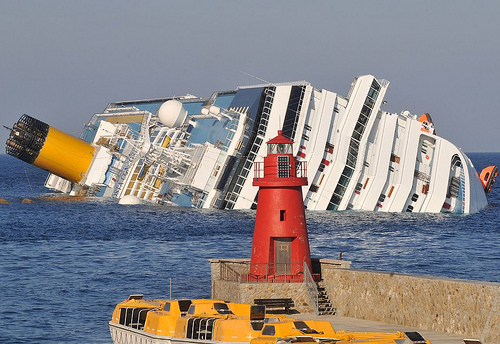
Earlier this week, Titan Salvage and its Italian partner Micoperi presented updated salvage plans for the stricken cruise ship Costa Concordia to the Italian goverment. Titan/Micoperi’s initial plan called for removal of the ship in January 2013, but delays in subcontractor deliveries has pushed the completion date to spring of 2013.

Immediately after the wreck on January 13, 2012, all fuel oil was pumped out of the ship’s bunkers and a bidding process initiated for salvage proposals. Titan/Micoperi was awarded the salvage contract and began planning for the removal of the ship from the coast off the Italian island of Giglio.  Titan has salvaged some of the world’s most difficult wrecks and has now completed initial environmental and site assessment for the Concordia salvage. The wreck initially hurt the general tourism industry on Giglio, but “disaster tourism” has spurred an increase in day trippers ferrying to the island to gawk at the wreck.