Merchant Navy Flag

UK Merchant Navy Ensign
CC Image courtesy of L2F1 on Flickr

Today the United Kingdom, along with Australia, Canada and New Zealand, remembers the sacrifices of their merchant marine from World War One to the present day. The Merchant Navy has served in WWI, WWI, Korea, the Suez Crisis, the Falklands War, and Gulf Wars I & II. More than 14,500 seamen lost their lives in World War I and another 30,000 perished during World War II. September 3rd was chosen as the date to honor the Merchant Navy because September 3, 1939 marked the first loss of British shipping in World War 2 – the SS Athenia. Two shipwrecks, SS Storaa and M/V Atlantic Conveyor, have subsequently been designated protected places under the UK Protection of Military Remains Act. Storaa was lost in World War One to a German u-boat while Atlantic Conveyor is the most recent Merchant Navy loss, having been sunk while supporting British efforts to free the Falkland Islands from their Argentinian invaders.

HMS Ajax

HMS Ajax
CC Image courtesy of Charles McCain on Flickr

Only two days after the Nazi invasion of Poland on September 1, Great Britain declared war on Germany and dispatched the Royal Navy to clear the seas of Germany’s merchant fleet and warships. Within hours of the commencement of hostilities, the light cruiser HMS Ajax encountered the German merchantman Olinda off the coast of Uruguay and promptly destroyed the ship with gunfire. Shortly thereafter, Ajax found and sank another Nazi freighter, the Carl Fritzen. Ajax continued to serve on the South American Station until February 1940 when it returned to the UK for a refit. While on station, Ajax along with HMS Exeter and HMS Achilles accounted for the destruction of several more German merchant ships. Additionally, Ajax, Exeter and Achilles engaged the German pocket battleship Graf Spee which was scuttled by her crew after the Battle of the River Plate. Thus began a nearly six year struggle between the Royal Navy and the Kriegsmarine, Regia Marina, the Imperial Japanese Navy and even the Vichy French Navy.

USNS Spearhead

Joint High Speed Vessel Concept Rendering

Despite Hurricane Isaac disrupting Austal’s Mobile, AL shipyard operations for two days, the USNS Spearhead has now completed its performance and acceptance trials for the US Navy. Successful completion of the trials means the Navy should soon be accepting the first of 9 Joint High Speed Vessels (JHSV) into service. The second ship in its class, USNS Vigilant, is set to be christened September 15th.

The JHSVs were designed to act as fast transports for deploying US servicemen throughout the world in support of combat and humanitarian missions. Austal, the winner of the Navy contract for design and construction of the vessels, drew upon its experience building civilian catamaran ferries to produce the ship. The JHSV can embark 312 troops in airline style seating and has on-board berthing for 150 plus 41 crew. Its rear loading ramp can accommodate vehicles up to the size of an M1A Abrams tank and can operate a single helicopter off of its landing pad. The JHSVs are designed to operate in austere conditions and can disembark their troops and cargo without advanced port facilities. A single JHSV can move a Marine or Army company with all of their equipment or an entire battalion if operating solely as a troop transport. Additionally, the vessel can transport troops and equipment 25% cheaper than an airlift operation and around 50% faster than current seaborne options.

Russian submarine

CC Image courtesy of The Bellona Foundation on Flickr

Nine years ago today the Russian Navy lost the nuclear powered submarine K-159 when it foundered in the Barents Sea . The sub had recently been slated for scrapping and was en route to a date with the breakers yard. Commissioned in 1963, the K-159 served in the Soviet Northern Fleet (the same fleet as Tom Clancy’s Red October) and suffered a reactor accident in 1965. Reports vary on the extent of repairs to the reactor, but the ship returned to active service and was retired in 1989. The K-159 lay derelict in a Russian naval yard for fourteen years with minimal maintenance until the decision was made to scrap the ship in 2003. Due to extensive rusting of the ship’s outer hull, pontoons were secured to the K-159 to provide additional flotation.

Manned with a 10 man skeleton crew, the sub was taken under tow to a Russian scrapyard. While under tow, a storm ripped away the K-159’s pontoons and the sub began to take on water. Within a few hours the K-159 dipped below the waves of the Barents Sea and came to rest in 781 feet of water. In addition to killing 9 of her crew members, the sub took with it 1,760 pounds of radioactive spent fuel. Plans for salvage have continually been postponed, however the Scottish salvage company Adus located the sub and published sonar scan images of it resting on the sea floor in 2010. The Dutch salvage company Smit & Mammoet (the same firm which salvaged the Russian sub Kursk) submitted a salvage proposal in 2011, but salvage work has yet to begin. While the wreck generated initial concerns of radioactive contamination of the Barents Sea, to date there has been no documented increase in radiation levels in the area.

Pouto Point Shipwreck

CC Image courtesy of NASA on Flickr

Thirty years ago locals discovered the remains of a wooden ship off Pouto Point in New Zealand. The group salvaged a few wooden timbers before the vagaries of the sea buried the wreck under more than 90 feet of sand. Through the use of radio carbon dating and tree ring sequencing, scientists now believe the ship to have sunk around 1705 – making it 65 years earlier than Captain Cook’s exploratory voyages to New Zealand.

New Zealand was first located by European explorers in 1642 when Dutchman Abel Tasman landed on the islands. Although numerous places and items have been named after Tasman, he is perhaps best known for the Tasmanian Devil Looney Tunes character. The current historical narrative asserts that the next European to visit the islands was Captain Cook in 1769; however, the dating of this ship calls into question whether Cook was indeed the next European to visit the islands. The types of wood recovered have led researchers to believe the ship was refitted at Genoa or Java before wrecking off Pouto Point, New Zealand. British admiralty maps dated 1803 suggest the Portugese may have discovered New Zealand in the 1550s. The wood recovered from the wreck and the timing of its sinking in 1705 would be in line with the supposition that the wreck was the result of another expedition to New Zealand as both Genoa and Java were transit stations for Portuguese ships. One researcher had believed it to be the wreck of the Portuguese ship Cicilla Maria, however the new dating information now precludes that possibility. Irregardless, the dating of the wreck sheds further light on the origins of European settlement in New Zealand.

Robert Ballard Cyprus

CC Image courtesy of Erik Charlton on Flickr

Legendary underwater explorer Robert Ballard has added two more shipwrecks to his already incredible list of discoveries (RMS TitanicBismarck, USS Yorktown and John F. Kennedy’s PT 109). Ballard and his team spent two weeks off the Cypriot coast exploring the Erastosthenes Seamount, a 120km by 80km undersea mountain that was previously above water. The expedition’s chief goal was to survey the seamount’s geology through the use of submersibles and high definition cameras. Ballard plans to return in several weeks after the Nautilus is equipped with a new sonar system that will allow him and his team to map the seamount. Previously the seamount was believed to contain only limestone, but the expedition located a formation of volcanic rock that doesn’t fit the area’s geologic profile. Additionally, the team found a curious methane source on the formation which requires further investigation.

It was in the process of completing their geologic mapping that the team discovered the two wrecks. One ship is believed to have sunk 2,300 to 2,500 years ago and carried cargoes between Greece and Cyprus. Among the artifacts photographed at the scene are a variety of ceramics, two anchors, a possible bun ingot and several other unidentified objects. The second ship appears to be an Ottoman war galley and an 18th century flintlock pistol and black rum bottles were located amongst the wreckage. One question left unanswered by the expedition is the speculation that Ballard’s team was searching for a WWII-era wreck containing a gold cargo. There exists little grounds for such speculation, though, as Ballard is known for not seeking to directly profit from his underseas exploration.

Prior to this month’s expedition, Ballard helped Turkey locate the two Turkish pilots lost when their F-4 crashed under mysterious circumstances near the Syrian border.

Peter Stevens

Reporter Peter Stevens’ latest book, Fatal Dive, is an engaging and easy to read work about the disappearance of the US sub USS Grunion off the coast of Alaska during World War II. Launched only a few weeks after the Japanese attack on Pearl Harbor, the Grunion’s first combat deployment was against Japanese shipping in the Aleutian Islands. Commanded by Lieutenant Commander Jim Abele, Grunion and her 70 man crew successfully sank 2 Japanese sub-chasers, survived a depth charge attack by a Japanese destroyer and then disappeared with all hands after crippling the Japanese merchantman Kano Maru. Apart from Western Union telegrams declaring the crew members Missing In Action, the relatives of the crew were largely kept in the dark as to the causes of the sub’s loss.

Stevens’ straightforward writing style and the book’s relatively short-length of 175 pages (plus a 60 page appendix containing short bios of each crew member) make it a quick, but thoroughly enjoyable read. Fatal Dive chronicles the life of Lt. Commander Abele, the Grunion’s first combat cruise and subsequent loss, and the dramatic story of her discovery by Lt. Commander Abele’s sons 65 years later. Stevens’ avoids getting bogged down in historical minutiae and instead focuses on the characters in the story from both sides of the conflict. His writing effectively conveys the sense of excitement and danger faced by the Abele brothers and their crew as they work to locate the ship in the treacherous waters of the Bering Sea. Stevens concludes the book with a discussion of the causes of the ship’s sinking and why the US Navy subsequently chose to torpedo any explanation of her loss. Fatal Dive is a great choice for a quick weekend read for any history or mystery buff.

Charleston, SC Civil War

The Attack on Fort Sumter, Currier & Ives

Archaeologists from the University of South Carolina just completed a 4 year long survey of Charleston, South Carolina’s Civil War naval battlefield. While many associate Charleston with the attack on Fort Sumter or the CSS Hunley, the city was the scene of multiple naval engagements and an important port for Confederate blockade runners. The archaeological team created a map of wrecks, gun emplacements and harbor obstructions in 2010 and has spent the last 2 years surveying some of those sites.

Among the sites are the wrecks of several Union ironclads that were sunk in action with Confederate land batteries or by “torpedoes” – early versions of what are mines in today’s naval parlance. The archaeologists also sought the wrecks of the “Stone Fleets” – a fleet of approximately 30 ex-whaling ships and merchant vessels purchased by the US Navy, stripped of all valuable implements, loaded with stone and then sunk as block ships in the approach channels to Charleston Harbor. Because the ships were wooden hulled and had been stripped of most of their metal fittings, the USC team had to rely on side scan sonar, further complicating the task of locating the ships. The remains of Confederate blockade runners were also surveyed by the team, including a set of three wrecks that are now buried beneath dry land due to the shifting sands of the beach. The survey will be helpful not only to historians, but also to the US Army Corps of Engineers and other planning entities for the avoidance of wrecks and other obstructions in the harbor.

Wilhelm Gustloff

Photo: German Federal Archive

The worst maritime disaster in recorded human history occurred in the closing days of World War II and is little known in popular history. The torpedoing of the M/V Wilhelm Gustloff claimed ~9,000 lives including as many as 4,000 children. By comparison the RMS Titanic disaster cost 1,517 lives. In the waning days of World War II, the once vaunted German Wehrmacht was pressed into ever shrinking pockets of territory by advancing Soviet armies. Admiral Karl Donitz, desperate to evacuate 2 million German personnel and civilians from isolated pockets of German territory on the Baltic Coast, initiated Operation Hannibal – an evacuation almost six times the size of Dunkirk.

Among the ships used in the evacuation was the Wilhelm Gustloff, a former luxury liner built in 1938 to provide holiday excursions as part of Hitler’s “Strength Through Joy” program. Confiscated by the Kriegsmarine at the outbreak of hostilities in September, 1939, the ship served as a hospital ship and floating barracks. The Wilhelm Gustloff departed Gotenhafen on January 30, 1945 with more than 10,000 refugees and military personnel. Less than 9 hours after leaving Gotenhafen, the ship was spotted by the Soviet submarine S-13 which loosed a four torpedo salvo. Three of the four torpedoes (the fourth jammed in the tube) found their mark and within 70 minutes the Wilhelm Gustloff lay 150 feet beneath the Baltic Sea. More than 9,000 souls perished in the sinking, but for propaganda reasons the Nazi regime kept news of the sinking from spreading within the crumbling Third Reich. For numerous reasons, most importantly the overshadowing of the tragedy by the ending of the war and the exposure of Nazi death camps, the disaster is not a pop culture icon like the sinking of the RMS Titanic or the RMS Lusitania.

Some historians have speculated that the looted Amber Room might have been aboard and the Soviets allegedly launched an expedition to the wreck site during the Cold War. Evidence pointing to the Amber Room being aboard is circumstantial at best. The last known sighting of the room was in nearby Konigsberg Castle just days before the ship sailed. The room had been packaged into 27 crates and eyewitnesses report the moving of similar sized crates from trucks to the ship prior to its departure. In the most thorough analysis of the fate of the Amber Room to date, authors Catherine Scott-Clark and Adrian Levy posit that the Amber Room was destroyed on land sometime during the frantic evacuations from East Prussia and has been forever lost.

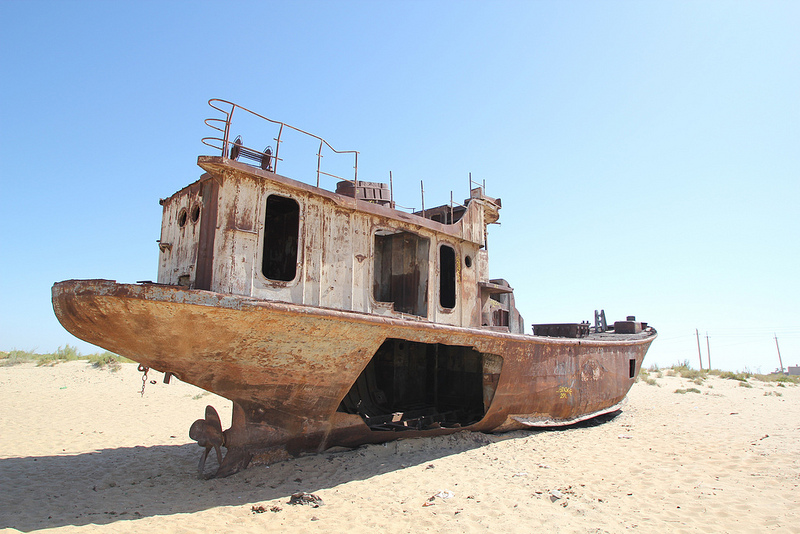
Aral Sea Ship

CC Image courtesy of farflungistan on Flickr

The 2005 movie Sahara centered around the disappearance of a Confederate ironclad at the end of the Civil War. Matthew McConnaughey’s character, Dirk Pitt, is endlessly jibed for thinking the ship could have ended up in the African desert. Although Dirk is eventually proved correct when the ship is discovered in the desert, he would have faced much less derision had he been looking for a ship in the deserts of Uzbekistan.

The Aral Sea, located between Uzbekistan and Kazakhstan, was once one of the largest lakes in the world. Beginning in 1918, though, Soviet central planners decided that cotton exports from the region were of vital importance and trumped all other considerations. Beginning in the 1930s, numerous irrigation canals were constructed to divert water from the rivers feeding the Aral Sea to cotton fields throughout the region. This decision devastated the ecosystem of the region, though, and the Aral Sea began to shrink in the 1960s as the irrigation canals robbed the Aral Sea of the inflows necessary to maintain its water levels. The sea had declined so much by 1987 that it split into two separate entities – the North Aral Sea located mainly in Kazakhstan and the South Aral Sea in Uzbekistan. The reduction in freshwater inflows spiked the salinity of the sea, devastating the fishing industry. Additionally, the continued receding of water levels left dozens of vessels high and dry in what has now become a desert.

Fortunately for residents of Kazakhstan, Kazakh authorities have worked to refill the North Aral Sea and it is now growing. Uzbekistan, though, has chosen to continue to divert inflows to irrigation which has resulted in further desertification of the area.