african ferry

CC Image Courtesy of Yaamboo on Wikimedia Commons

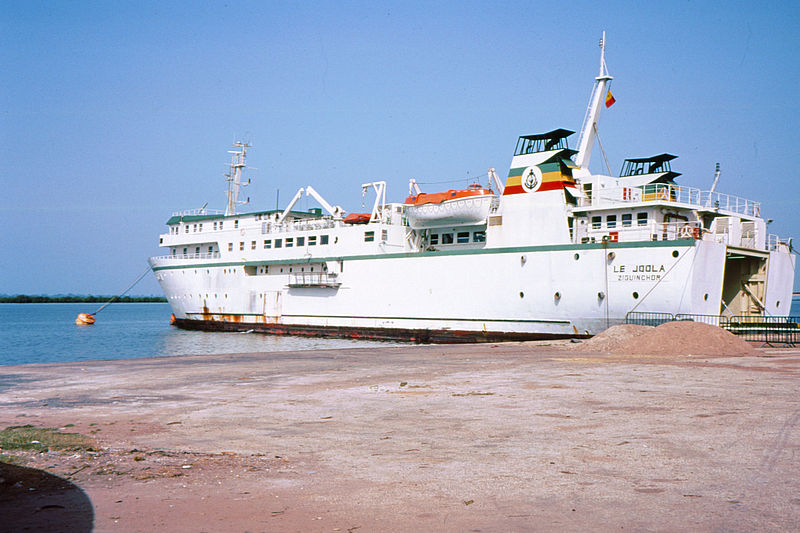
Today marks the tenth anniversary of the capsizing of the Sengalese ship, M/V Le Joola, on September 26, 2002. Le Joola was a government owned roll-on, roll-off ferry which operated between Senegalese ports on the Atlantic Ocean. At the time of its sinking, ferry travel was a popular option because a civil war made the land route prohibitively dangerous. The ferry’s maximum capacity was approximately 550, however, there were nearly 2,000 passengers aboard the ship when it capsized 35 kilometers off the Gambian coast.

A combination of overcrowding and gross neglect (the ship had only recently returned to service after a multi-year hiatus) contributed to the ship’s capsizing although the exact cause of the sinking has never been conclusively proven. It was also alleged that political considerations regarding the appeasement of separatist groups within Senegal encouraged the Senegalese government to return the ferry to service before it was fully seaworthy.

Sadly, only ~60 of the nearly 2,000 souls aboard survived and an exact body count has never been determined. The disaster is one of the worst sinkings in history with more lives lost than that of RMS Titanic, however it pales in comparison to the ~9,000 lives lost aboard the M/V Wilhelm Gustloff in 1945. The ship’s sinking continues to have ramifications today with survivors and victims’ families demanding a new inquiry into the causes of the sinking.

research vessel

Photo: Woods Hole Oceanographic Institute

The US Navy has announced that their newest Auxiliary General Oceanographic Research (AGOR) class of vessels will be named after naval aviator and astronaut Neil Armstrong who passed away last month. The class will be composed of two vessels and construction on the lead ship, R/V Neil Armstrong, began in August. Neil Armstrong is set to enter service in summer 2015.

The Neil Armstrong class of vessels will displace 3,200 tons, stretch 238 feet in length and have a cruising range of 11,500 nautical miles at 12 knots. Neil Armstrong’s 1,800 square feet of dry, wet and computer labs will give its 24 embarked scientists plenty of space to conduct research and exploration operations throughout the globe. In addition to its lab and staging spaces, the Neil Armstrong will be able to launch and recover various ROVs and mini-submersibles with its stern and main cranes. Among the innovations included in the ship’s design is a hull optimized to divert bubbles from the sonar area for enhanced sonar performance.

The ships are funded by the Office of Naval Research, but will be operated by non-profit oceanographic institutes. The yet unnamed second vessel of the class (AGOR 28) will be operated by the Scripps Institution of Oceanography in San Diego, California. Neil Armstrong will be based at the Woods Hole Institute of Robert Ballard fame and conduct most of her operations in the Atlantic.

landing ship tank

Photo: US Navy

World War 2 saw the perfection of modern amphibious operations with successful landings in North Africa, Italy, Normandy and throughout the Pacific contributing to the demise of the Axis Powers. Among the innovations which made these operations successful was the Landing Ship, Tank (LST). LSTs were designed with massive bow doors and a bow ramp that enabled Allied forces to deliver tanks, half-tracks, deuce and a halfs and other vehicles directly to the beachhead. After disgorging their cargo, the LST’s crew could use a winch system to extricate the ship from the beachhead and return to port for another load. Of the 1,051 LSTs produced for Allied naval forces, most were scrapped or converted to use as merchant vessels after the war while a few saw service through the Vietnam War. One even served as a produce carrier for Los Angeles Mafioso Jack Dragna, hauling bananas between Latin America and California.

LST 393, one of only 2 surviving LSTs, now serves as a museum ship in Muskegon, Michigan. The ship delivered 9,000+ troops and 3,248 vehicles to the beaches of Salerno, Sicily, and Normandy. Following her wartime service, LST 393 was renamed M/V Highway 16 and plied the Great Lakes as an automobile carrier for decades. In 2000, a group began restoring the ship as a memorial to the officers and crew who served aboard these important vessels. The ship is open for tours and can be rented for special occasions. More information can be found at the ship’s website: http://www.lst393.org/

New Jersey shipwreck

CC Image Courtesy of messycupcakes on Flickr

Step aside Snooki and Pauly D – Florida diver Allan Garner may be set to become the Jersey Shore’s latest celebrity. Garner has filed an admiralty arrest claim on the wreck of the SS Ella Warley. The ship sank in 1863 after colliding with the SS North Star off the New Jersey coast. The North Star, owned by Commodore Vanderbilt, survived the collision and made it safely to New York City. The reason for the collision was disputed, although there were allegations of the Ella Warley’s captain and some of her officers being drunk at the time. Concerning the accusation of drunkenness, the New York Times editorialized, “we believe [it] has not the slightest foundation in truth.” Six crew members of the Ella Warley perished while the North Star suffered no casualties.

Built in 1848 as the SS Isabel, the Ella Warley displaced 1,115 tons and carried cargo and passengers between Charleston and Havana. Following the outbreak of hostilities in 1861, the Ella Warley ran the blockade several times between Charleston and Nassau until it was captured by the USS Santiago de Cuba.

At the time of its sinking the ship was laden with a cargo worth $175,000 and a safe containing $5,000 belonging to Adams Express Company. In addition, a passenger had $8,000 in gold aboard. While the cargo, which according to contemporary accounts consisted of hay, leather, provisions, dry goods and “express matter,” is most likely worthless, the safe’s contents and gold are quite valuable. Assuming the safe’s $5,000 was in gold, then there is the possibility of ~687 ounces of gold lying on the seabed floor amidst the wreckage. At today’s prices, this would mean the wreck is worth more than $1.2 million.

If no one objects to Garner’s claim by Thursday, then the US District Court for the District of New Jersey will award full ownership of the wreck and its contents to Garner. Successors in interest to the insurance company which paid out any claims for cargoes lost on the wreck, Adams Express Company and descendants of the passenger who lost $8,000 in gold are potential claimants and could be awarded a percentage of any recovery. Considering the wreck has been known among New Jersey’s diving community for 20 years, the likelihood is quite high that Garner has found something worth arresting.

Update: The $1.2 million value is for melt value and not the value of the gold if it were in specie form. If the gold were recovered in specie form, then the wreck could be worth upwards 20x of melt value as shipwreck specie commands a significant premium in the collector market.

Bonhomme Richard

Battle of Flamborough Head
Photo: US Navy, Painting by Thomas Mitchell

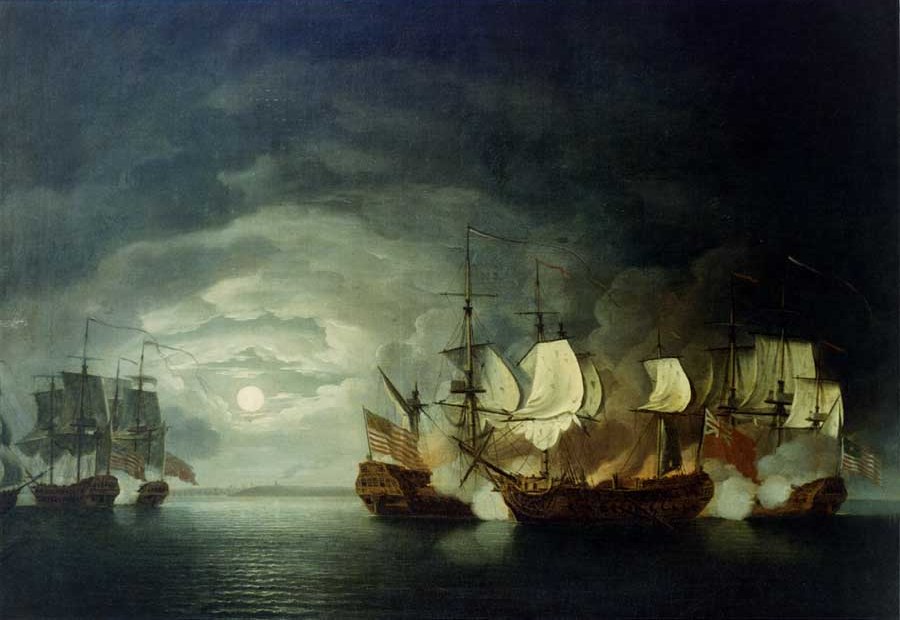
One of the most famous battles in the US Navy’s history occurred 233 years ago today on September 23, 1779. Captain John Paul Jones and his converted East Indiaman USS Bonhomme Richard along with USS Alliance attacked a British convoy protected by HMS Serapis and Countess of Scarborough. In what became known as the Battle of Flamborough Head, Jones and his crew engaged the Serapis in a ship-to-ship duel. Captain Pearson of the Serapis demanded Jones’ surrender and in reply he uttered the now famous words, “I have not yet begun to fight.”

Though outgunned, Jones’ superior  fighting skills carried the day and the Serapis eventually struck its colors. Despite having defeated the British forces (Countess of Scarborough struck her colors as well), the Bonhomme Richard sank the next morning and Jones transferred his flag to the Serapis. Jones’ victory was not the last in which an American naval force engaged British forces while penning a famous phrase

The wreck of the Bonhomme Richard is considered one of the crown jewels of shipwrecks and has been the subject of several discovery expeditions. Unfortunately none have been able to locate the wreck and its final resting place off Flamborough Head remains a mystery. John Paul Jones is considered the father of the American Navy and his words “I wish to have no connection with any ship that does not sail fast for I intend to go in harm’s way” are just as famous in naval circles as “I have not yet begun to fight.” Sadly, Jones never held a significant sea command in the US Navy after the Battle of Flamborough Head and died an Admiral in the Russian Navy.

polish palace

Kazimierz Palace
Photo: Wikimedia Commons

Polish archaeologists and police are exploiting historically low water levels on the Vistula River to recover dozens of marble and alabaster decorative elements looted from Polish landmarks in the 17th century. Utilizing a Mil Mi-8 police helicopter, archaeologists are carefully lifting the sculptures from the riverbed and transporting them to drier locales for conservation and restoration. The decorative elements were looted from Poland’s Royal Castle and the Kazimierz Palace by Swedish forces after they captured Warsaw during the mid-17th century. The loot was loaded onto barges and prepared for transit to Sweden via the Vistula and then the Baltic. At least one barge, though, sank en route and scattered its precious cargo along the riverbed. Polish archaeologists have known about the treasures, but river conditions have rarely cooperated such that they could retrieve the pieces. Efforts over the last 3 years have yielded some results, but nothing like the finds archaeologists are making now.

Today, Sweden is most often associated with IKEA furniture, safe cars (cb radio optional), cars born from jets and ABBA, but the Swedish Empire once encompassed 1.1 million square kilometers and dominated its northern European rivals. By comparison, the Holy Roman Empire was 1 million sq. km. and modern Sweden is 450,000 sq. km. The Empire was founded in 1611 by Gustavus Adolphus, a brilliant military commander, who defeated his rivals in the Thirty Years War and began the expansion of Sweden’s borders. Between 1600 and 1721, the Poles and the Swedes clashed no fewer than 6 times in conflicts lasting up to 11 years. It was during one of these wars that the decorative structures being recovered today were looted from Poland’s Royal Castle and the Kazimierz Palace. In addition to waging war against the Poles, the Swedes also attacked and occupied territory in modern day Denmark, Estonia, Finland, Germany, Latvia, Lithuania, Norway, and Russia. The Great Northern War which concluded in 1721 marked the end of Sweden’s status as a great power and the empire’s territorial breadth began to slowly recede.

littoral combat ship

USS Forth Worth during sea trials
Photo: US Navy

Tomorrow the US Navy is set to christen the USS Fort Worth in Galveston, Texas. The Fort Worth is the second vessel of Lockheed Martin’s Freedom class Littoral Combat Ships which are designed to operate in a multi-mission role in shallow waters. The Littoral Combat Ship was first devised in the 1990s when the US Navy recognized the need for a multi-purpose vessel to operate in the littoral zone where either deeper draft vessels couldn’t operate or the dangers of the zone (i.e. missile boats, mines, shore launched missiles, etc.) prohibited the exposure of more expensive ships. After the solicitation of various proposals, two designs were chosen for production – Lockheed Martin’s conventional Freedom-class and General Dynamics/Austal’s trimaran Independence class. Despite cost-overruns and serious criticism, the program has forged ahead and, for good or bad, the ships are entering service.

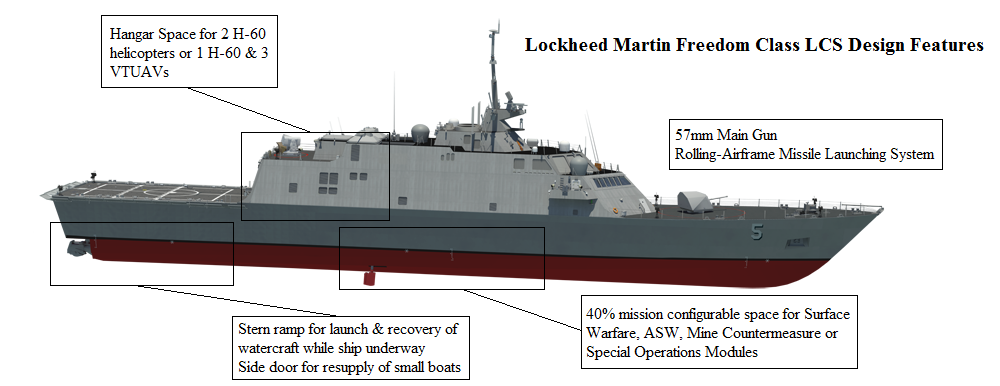
The Freedom class variant utilizes a conventional monohull and Lockheed Martin was assisted in its design by veritable naval architecture firm Gibbs & Cox. Gibbs & Cox, founded by America’s greatest naval architect, has designed more than 60% of the US Navy’s surface ships as well as ships for 15 other world navies. Among the Freedom-class’ notable features is its jet propulsion system which allows it to reach speeds of 40 knots/hour, its 12.8 foot draft which enables it to operate in shallower water than most US Navy vessels, the ability to launch and recover watercraft while underway and its 40% re-configurable space.

littoral combat ship

Freedom class LCS Diagram

The LCS ships are intended to fulfill the roles previously performed by Oliver Hazard Perry guided missile frigates, MCM Avenger class mine countermeasure vessels and Osprey class coastal mine hunters. In order to perform to possess this flexibility, the ship and its crew must rely on interchangeable mission modules that are installed based on mission needs. These plug and play modules include an anti-submarine warfare (ASW) module, surface warfare module, and mine countermeasures module. The ship can also be configured to support special operations.

The thinking behind the modules is that if the Iranians mine the Straits of Hormuz, then the ship’s mine countermeasure module is quickly swapped in (projected time is a couple days) and the ship deployed to sweep the Strait clean. Discounting the fact that much of the mission modules’ substance has yet to be created, this is where the biggest criticism of the ships come into play. As any military officer will attest, you fight with what you’ve got on the battlefield. An LCS outfitted with its surface warfare module is largely ineffective against a diesel submarine strike. Unfortunately, “time out I’ve got to go change modules before we can fight” will never work on the battlefield. Ultimately, the Navy’s LCS fleet will most likely spend most of its time equipped with a single module and 3 or more LCS kept on station to perform dedicated roles. For a more detailed discussion of the LCS’ origins see here.

Titanic & Olympic

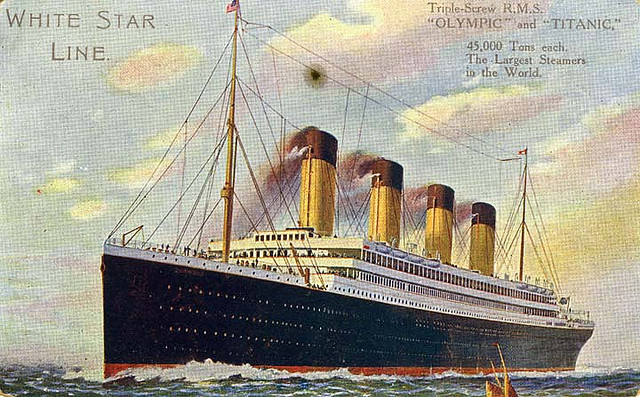
Much like the Apostle Paul, Violet Jessop survived a trio of maritime disasters, including the sinking of RMS Titanic. Jessop began work as a stewardess for White Star Line in early 1911. White Star is best remembered in history as the owner and operator of the Titanic, but in the late 19th and early 20th century the company ferried thousands of immigrants from Europe to the United States. Jessop first assignment was aboard Titanic’s sister ship RMS Olympic. While cruising off the Firth of Forth on September 20, 1911, the Olympic and the Royal Navy armored cruiser HMS Hawke collided resulting in significant damage to both ships. Neither Jessop nor any of the other passengers and crew aboard either ship were injured even though two of Olympic’s watertight compartments were flooded and the Hawke nearly capsized.

Jessop’s next brush with death occurred merely 7 months later on April 14, 1912 when Titanic sank after its infamous collision with an iceberg. For four years Jessop enjoyed smooth sailing aboard her employer’s ships until November 1916. RMS Brittanic, which had been converted to a hospital ship, struck a mine on November 12, 1916 and once again Jessop found herself scrambling for the lifeboats. Despite her three near-death experiences, Jessop continued to work aboard passenger liners and retired to England where she passed away in 1971.

jolly roger

CC Image Pirated From Scott Vandehey on Flickr

To recognize International Talk Like a Pirate Day, here are a few piratical items of note…

Captain Morgan, the Diageo owned rum distiller, funded excavations at the site of the real Admiral Morgan’s shipwreck this summer. No word if any rum has been found aboard the wreck or if the salvage crew were cited for operating an ROV under the influence.

Excavations continue on both Captain Sam Bellamy’s Whydah and Blackbeard’s Queen Anne’s Revenge. Artifacts from both wrecks can be viewed at their respective museums in Provincetown, Massachusetts and Beaufort, North Carolina.

According to the Maritime Executive, there were 17 pirate attacks just last month. This month, pirates even fired upon an Italian naval helicopter. A map of pirate attacks in 2012 can be viewed here.

Last year, 35 people lost their lives while being held hostage by Somali pirates. As of August 30, there were 11 vessels and 188 hostages being held by Somali pirates. In addition to the human costs of piracy, experts estimate that the financial costs of piracy was around $6.6 – 6.9 billion in 2011 alone.

Piracy along the coast of Somalia has become such a problem that one of the primary reasons for the 2007 creation of the US’s Africa Command (AFRICOM) was the fighting of piracy. It’s rumored that the servicemen of AFRICOM will star in Disney’s upcoming film Pirates of the Caribbean: On Somali Tides.

civil war navy

Pulitzer Prize winning author James M. McPherson’s latest book, War on the Waters, is a concise naval history of the American Civil War. Most authors and historians focus on the great generals (Lee, Jackson, Grant, Sherman, etc.) or the great battles (Antietam, Chancellorsville, Gettysburg, Shiloh etc.) and often ignore the vital role the navies played in the conflict both on the rivers of the western Confederacy and the high seas. Entire books have been written on various aspects of the naval war – riverine warfare in the west, blockade running, Confederate merchant raiders, foreign intrigue in Europe and the innovations that made their debut in the conflict. McPherson neatly summarizes each of these topics and arranges them in easily digestible chapters that proceed in chronological order.

McPherson’s organization and writing style allow both the uninitiated reader and the Civil War buff to understand the ebb and flow of the conflict and the various personalities, events and inventions that influenced the war. Perhaps most importantly, McPherson accompanies his chapters with strategic or tactical level maps that enable the reader to understand the events which occur in the chapter. McPherson understands the unwritten rule that the inclusion of a relevant map is worth multiple pages of text in helping a reader establish an awareness of the events being described. Along with the maps, various etchings and photos accompany each chapter and neither maps nor illustrations are confined to a few pages in the center or the beginning of the book. This allows the reader to visually grasp the crux of each chapter and makes both the maps and the illustrations more relevant to the narrative being told.

Overall, War on the Waters is a fantastic single volume history of the Civil War’s naval history. McPherson hits all of the highlights of the Civil War – CSS Virginia vs. USS Monitor, blockade running, William B. Cushing’s daring raid on the CSS Albemarle, and the first successful attack by a submarine – in only 225 pages. War on the Waters is a welcome addition to the naval literature of the Civil War and will be enjoyed by anyone interested in American history, naval history or the Civil War.