shipwreck

Wreck of Savonmaa
Photo: http://www.wrecksite.eu

On January 20, 1937, the Finnish steamer Savonmaa and twenty-six of her crew met an untimely end when she ran aground in the Skaggerak during a heavy storm. The ship was bound for the UK with a cargo of paper and pitprops and undoubtedly caused much angst for UK paper-pushers.

For All the Tea in China

January 17, 2013 — 1 Comment
clipper ship

Tea Clipper Hallowe’en Aground
Photo: http://www.wrecksite.eu

The ghostly image above resulted from the wreck of the record breaking clipper ship Hallowe’en on January 17, 1887. The Hallowe’en was loaded with 1600 tons of tea from Shanghai, China and she ran aground in a storm off Soar Mill Cove in the United Kingdom. Tea clippers were designed to quickly bring the latest crop of tea leaves from China to western markets. The Hallowe’en briefly held the record for fastest voyage from Shanghai to London in 1874 when she made the voyage in a mere 91 days. The ship eventually sank and can now be visited by divers.

confederate fort

Fort Fisher
CC Photo Courtesy of NC Culture on Flickr

At the beginning of 1865, General Winfield Scott’s Anaconda Plan was slowly suffocating the Confederacy and only one major port, Wilmington, NC, remained open in defiance of the Yankee invaders. Wilmington’s location made it one of the South’s most successful ports for blockade runners. The city itself lay 30 miles up the Cape Fear River from the Atlantic Ocean and blockade runners had two islets from which to enter the Atlantic and evade the Union blockade fleet.

Early in the war, Confederate forces recognized the importance of securing the mouth of the Cape Fear. By 1865, what had begun life as a small artillery battery had become Fort Fisher, one of the largest coastal emplacements of the 19th century, and had been dubbed the Gibraltar of the South. Fort Fisher was shaped in the form of an L with a northern land face and a westward facing sea face.

In addition to its fearsome batteries of heavy guns, the fort’s commander, Colonel William Lamb, created a roving artillery unit equipped with advanced breech-loading Whitworth cannon. Colonel Lamb utilized the squadron to drive off Union warships that sought to attack blockade runners steaming through the surf zone or beached during an unsuccessful run.

On December 24, 1864 the Union Army and Navy attempted a combined operations attack on the fort, but were driven off thanks to the effective command of Colonel Lamb and the incompetence of the Union ground commander, Major General Benjamin “Spoons” Butler. Less than a month later, on January 12, 1865 a larger, better equipped Union force arrived off Fort Fisher determined to carry the fort regardless of the cost. On January 15, after a 60 hour bombardment, 8,000 Union troops surged forward and captured the fort after a fierce 6 hour battle. Fort Fisher’s capture sealed the fate of Wilmington and ensured that no more foreign war material would reach General Robert E. Lee’s beleaguered troops in Petersburg, Virginia.

Today the sea has claimed much of the fort and what little remains is a museum and historic site run by the state of North Carolina. Visitors to the museum should be sure to stop in at the world-class Fort Fisher Aquarium just down the road.

goshen

Maury River Flowing Through Goshen Pass
Photo: Brightman Thomas

Matthew Fontaine Maury is relatively unknown today, but his contributions to oceanography continue to impact modern mariners. Maury was born in Spotsylvania County, Virginia on January 14, 1806, but spent his formative years in Tennessee. Seeking to follow in the footsteps of his older brother, Lieutenant John Minor Maury, Maury attended the Naval Academy through an appointment by US Senator Sam Houston. Upon graduation, Maury was assigned to various ships throughout the Navy and was aboard the USS Vincennes when it became the first US naval vessel to circumnavigate the globe.

Maury quickly developed an interest in the scientific aspects of sailing and became even more engrossed in the subject when a leg injury rendered him unfit for duty at sea. Appointed to command the US Naval Observatory in 1842, Maury published several seminal navigational works including Wind and Current Chart of the North Atlantic, Sailing Directions and Physical Geography of the Seas and its Meteorology. Many of Maury’s achievements came through his collecting of data from whalers, merchant captains and naval warship logs.

Maury became internationally recognized for his work in the field that became known as oceanography, but unfortunately his research was interrupted by the coming of the American Civil War. Maury, considering himself a loyal Virginian, volunteered his services to the fledgling Confederate Navy. Appointed Chief of Sea Coast, River and Harbor Defences, Maury applied his brilliant mind to the protection of the Confederacy and developed a torpedo (forerunners to today’s naval mines) that wreaked devastation on invading Union ships. Maury also leveraged his international reputation and worked abroad on behalf of the Confederacy’s diplomatic efforts to procure weapons and foreign recognition.

Following the war, Maury retired to sleepy Lexington, VA where he chaired the Virginia Military Institute’s physics department. Around the same time, General Robert E. Lee arrived next door,and began his transformative presidency of struggling Washington College. Maury continued his contributions to scientific advancement with the publication of a book categorizing the mineral deposits of Virginia and how best to exploit them. Maury passed away in 1873 and was buried in Richmond. Today, Washington & Lee students (and VMI cadets when they can get off post) enjoy lazy Spring Term spring days tubing along the Maury River which was named in his honor.

Operation Gratitude

January 12, 2013 — Leave a comment
cam ranh bay

Photo: US Navy

As war loomed between the United States and Imperial Japan, the US Navy began laying the groundwork for a network of coast watching and weather stations throughout the coasts and inland areas of China and Southeast Asia. Following Pearl Harbor, the US Navy dispatched Captain Milton Miles, an officer with pre-war experience in China, to establish what became known as the Sino-American Cooperation Organization (SACO). The organization contributed greatly to the war effort, but one of its biggest successes didn’t come until January 12, 1945.

SACO’s coast watchers observed a 26 ship convoy drop anchor in Cam Ranh Bay in French Asia. The convoy joined numerous other Japanese vessels and SACO quickly informed Admiral Bull Halsey and his Task Force 38 who were conducting operations (Operation Gratitude) in the South China Sea. Halsey worked up an assault plan and dispatched 82 TBM Avenger bombers to destroy the Japanese convoy. By the end of the day, more than 40 ships and 120,000 tons of enemy shipping lay at the bottom of Cam Ranh Bay. Thanks to a handful of American and Chinese SACO coast watchers, thousands of tons of much needed war material were destroyed and the noose tightened ever so tighter around Japan’s home islands.

Nuclear Ship Savannah

January 10, 2013 — Leave a comment

nuclear powered merchant ship

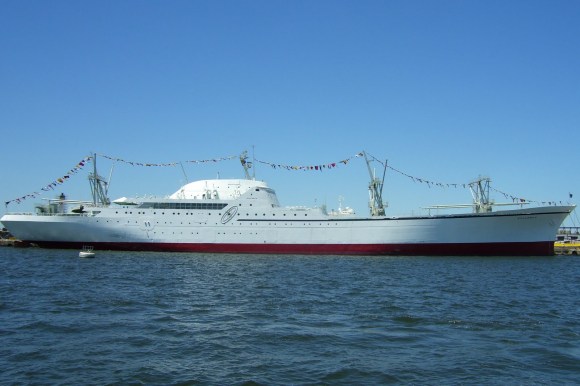
The early 1950s were the glory days of the Atomic Age as scientists and the public eagerly sought to apply atomic technology to as many uses as possible. Unlike today when there are enough anti-nuclear groups to populate a mid-size state, atomic energy was embraced as the wave of the future. Among the applications atomic power was devoted to was that of merchant shipping. In 1955, President Dwight D. Eisenhower ordered the construction of what was to become the NS Savannah as part of his “Atoms for Peace” initiative.

The Savannah was conceived as a proof of concept ship that could transport both cargo and passengers and sailed on her maiden voyage on August 20, 1962. It’s Babcock & Wilcox nuclear reactor was more than 50% of the cost of the $49.6 million ship and she could cruise at full power for 2 years before needing to re-fuel. Unfortunately, high operating costs made her unable to compete against oil-burning ships with oil at only a few dollars a barrel. Additionally, the cost of infrastructure required to support the ship couldn’t be spread across multiple vessels and her cargo holds weren’t designed for load efficiency. Thus, on January 10, 1972 the ship was taken out of active service.

Today the ship is moored in Baltimore, Maryland where it is hoped she can become a museum ship after her nuclear reactor is decommissoined. Savannah stands as a memorial to a time when Americans dreamed big and stood as a beacon of freedom in a squall of socialism and devastation wrought by world war.

USMC

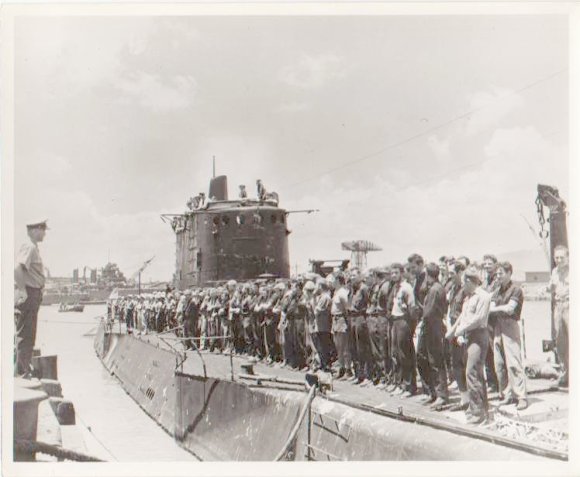
Marine Raiders embarked aboard US Navy submarine

Today marks the 69th anniversary of the disbandment of the US Marine Corps’ four Marine Raider Battalions. The Battalions were initially formed to conduct operations behind enemy lines in the Pacific Theater during World War II. The Raiders are perhaps most famous for their operation in August 1942 against Japanese forces on tiny Makin Atoll in the Gilbert Islands.

In order to gather intelligence on enemy forces in the area and to sow confusion in the Japanese command as to where the main Allied thrusts would occur, Admiral Chester Nimitz ordered the 2nd Marine Raiders Battalion, better known as Carlson’s Raiders, to assault Makin Atoll on August 17, shortly after the initial invasion of the Lower Solomons by US forces. On August 8, companies A and B of Carlson’s Raiders were embarked aboard two submarines, USS Nautilus and USS Argonaut, and stealthily made their way to Makin Atoll.

Going ashore in small combat rubber raiding craft, the two companies quickly became intermingled in heavy surf and lost the element of surprise shortly after landing. Over two days of fighting, though, the Raiders annihilated the Japanese ground force and fended off multiple air attacks – all while losing only eighteen dead and twelve missing. Additionally, their supporting submarines sank several small craft with fire from their deck guns. Carlson’s Raiders then re-embarked and made their way to Pearl Harbor to a hero’s welcome. Unfortunately, in the chaos of combat, nine Raiders were left behind and later beheaded after they surrendered on August 30th.

During their brief existence, the men of the Marine Raider Battalions earned seven Medals of Honor and several dozen Navy Crosses and one member went on to earn the Medal of Honor in the Korean War. Today, the spirit of the Marine Raiders live on through their sister WWII unit, the Amphibious Reconnaissance Battalion, which has since become Force Recon; as well as through the MARSOC units stood up as part of the US Marine Corps contribution to SOCCOM. The Marine Raiders accomplisments are also remembered through the US Navy’s amphibious assault ship USS Makin Island. The units have also found their place in popular culture with Makin Atoll missions being featured in the wildly popular Call of Duty and Medal of Honor video game franchises.

amphibious assault ship

USS Makin Island
Photo: US Navy

wrecked ship

SS Knud Aground
Photo: Wrecksite

Some of the most impressive maritime images are derived from ships being found in places where they are completely out of their element. Blogger gCaptain compiled a grouping of photos the top ten maritime incidents of 2012 and many of them are ship’s aground in spectacular locations or angles. More than a century ago, the Danish steamer SS Knud created a similar image when it ran aground in Robin Hood’s Bay on January 2, 1900. The steamer had been launched on October 19, 1871 and was a Clyde built merchant steamship of 1,185 tons. When she ran aground she was loaded with a cargo of ballast, but thankfully none of her crew were lost in the debacle. The cargo was later salvaged and the ship sold for scrap.

Bering Strait

Vitus Bering

Today marks the 288th anniversary of Russian Tsar Peter I ordering Danish explorer Vitus Bering to explore the eastern reaches of the Russian Empire in the area of Kamchatka (“That place you can attack Alaska from” in Risk). This expedition, along with a second, gave the world a better understanding of the far eastern regions of Russia and western reaches of North America.

Vitus Jonassen Bering was born on August 5, 1681 in Denmark and first went to sea at age 18 which was relatively late for the time period. Bering joined the Russian Navy in 1704 and after twenty years of lackluster service, Bering was tapped by Peter the Great to lead the Kamchatka expedition described above. Due to his service in the Russian Navy, Bering also came to be known as Ivan Ivanovich Bering (not to be confused with Ivan Denisovich or Ivan Drago).

Bering and a team of 34 men embarked on their voyage of discovery in February of 1725 and spent the next five years searching for a land connection between Russia and North America. During their voyage, the expedition also prepared charts of the region and Bering was promoted to the noble rank of Captain Commander for his exploits.

Thirteen years later Bering set forth on yet another expedition to the area. During this second voyage, Bering was able to sail within sight of Alaska and discover part of the Aleutian Island chain. Sadly, Bering perished before the expedition could return to St. Petersburg and his remains were interred on what is now Bering Island. Even though Bering accomplished very few “firsts,” he was widely associated with the region which he explored and thus it is unsurprising that Captain James Cook named the strait between Alaska and Russia the Bering Strait.

german battleship

Scharnhorst fires on HMS Glorious
Photo: US Navy

The Nazi battleship Scharnhorst lived a charmed life from the early days of World War II until Christmas 1943. The ship was among the most powerful of the Kriegsmarine’s most powerful surface units and, until the launch of the Bismarck and the Tirpitz, she and her sister ship Gneisenau were the pride of the Kriegsmarine. Often operating as a pair, Scharnhorst and Gneisenau wreaked havoc on the Royal Navy. In the opening days of World War II, the ships sank the armed British merchant cruiser HMS Rawalpindi and later sank the aircraft carrier HMS Glorious (see photo above) during the 1940 invasion of Norway.

The sister ships also broke out into the North Atlantic and sent several Allied merchantmen to the bottom of the sea. After the loss of the Bismarck, the decision was made to withdraw Nazi surface ships from the French coast. In early February 1942, the ships, along with the heavy cruiser Prinz Eugen, made a daring dash up the length of the English Channel. The Scharnhorst was then re-deployed to the northern waters of Norway in order to threaten Allied convoys supplying the Soviet Union.

On Christmas Day 1943, the Scharnhorst along with several destroyer escorts set sail from Norway to intercept an Allied convoy. Unbeknownst to the Kriegsmarine, the Royal Navy had intercepted and decoded the Scharnhorst’s orders and therefore laid a trap for the ship. Three Royal Navy cruisers screened the convoy from Scharnhorst while a squadron led by the battleship Duke of York raced to cut off the Nazi force from safety in Norwegian waters. After a fruitless pursuit of the convoy, the Scharnhorst cut off contact and began to return to base on December 26. In a three hour battle, the Scharnhorst was battered by the Royal Navy squadron and finally sank with only 36 survivors out of a crew of 1,968.

The wreck of the Scharnhorst was discovered in 2000 by the Norwegian Navy and further investigation revealed the extent of the damage inflicted by the Royal Navy. A total of 2,195 shells were fired at the ship along with 55 torpedoes. Eleven of the torpedoes found their mark and the torpedo and shell damage was extensive. The entire bow section of the ship was blown off the ship, most likely the result of an explosion in a forward magazine. Go here for a gallery of images from the Norwegian Navy’s investigation as well as period photos of the Scharnhorst.