Archives For November 30, 1999

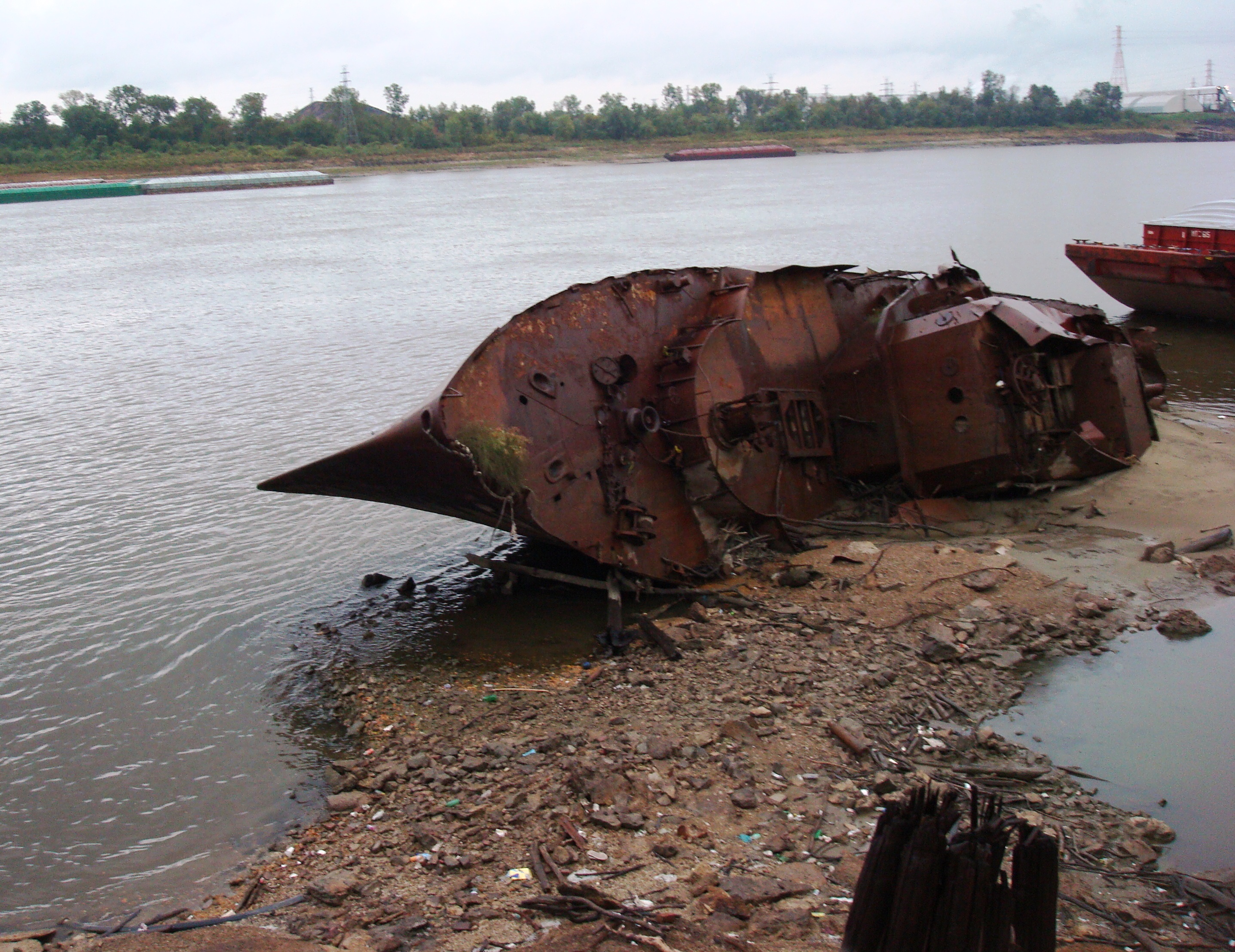
st. louis low water ship

Wreck of USS Inaugural
Photo: Dillon Fulcher

Low water levels on the Mississippi have revealed the wreck of the USS Inaugural, a World War II minesweeper which sank in the Great Flood of 1993. The Inaugural began life in Washington state where it was built for the US Navy during World War II. A member of the Admirable class of minesweepers, the ship was commissioned in December of 1944 and earned two battle stars for its service in the Pacific Theater. Inaugural and her crew fought in the Okinawa campaign and swept more than 80 Japanese mines from the Pacific.

Following World War 2, the ship was mothballed in Texas as a member of the Atlantic Reserve Fleet until an enterprising St. Louisan named Robert O’Brien discovered the ship in a military surplus catalog. O’Brien purchased the ship and moved it to St. Louis where he charged $1 per person to tour the Inaugural. The Inaugural changed hands several times throughout the intervening years until she was ripped from her moorings during the Great Flood of 1993. Efforts by the US Coast Guard and other vessels allowed the ship to be safely beached just south of downtown St. Louis, however, the ship sank a few days later in what some believe to be mysterious circumstances – possibly flowing out of the owner’s desire to collect insurance on the vessel and pay off looming creditors.

The ship now breaks the surface every time the river level is below average and under current conditions is almost completely above water. The Inaugural is not the only recent maritime oddity on the St. Louis riverfront as a cement barge sank while at anchor just last year and a fire claimed the steamboat Robert E. Lee in 2010.

Go here for more pictures of the wreck.

Coast Guard Cutter Ingham

CC Photo Courtesy of Kay Gaensler on Flickr

During a career spanning more than 50 years, the USCGC Ingham kept the shores of the United States safe for mariners in both war and peace. Commissioned in 1936, the cutter protected the Bering Sea and the fisheries of the Grand Banks until ordered to participate in neutrality patrols upon the outbreak of World War 2. After America’s entry to the war, Ingham helped convoy hundreds of Allied ships across the Atlantic. On December 15, 1942, during routine convoy operations, the Ingham detected and sank the German U-boat U-626. In late July 1944, the Ingham underwent alterations in the Charleston Navy Yard to prepare it to serve as a combined operations and headquarters and ship in the Pacific Theater. Ingham served briefly as a headquarters ship for General Douglas MacArthur prior to his landing in the Philippines.

Following World War 2, the ship returned to peacetime service and her missions included maritime rescue and oceanographic surveying. Ingham was called upon once again to serve in wartime during the Vietnam War. During the war she and her crew became the only Coast Guard cutter to earn 2 Presidential Unit Citations for her naval gunfire support and replenishment missions. Ingham responded to yet another crisis when Cuban dictator Fidel Castro allowed thousands of dissidents to flee his autocratic regime in what became known as the Mariel Boatlift. The Ingham rescued several boaters and towed half a dozen vessels to freedom in the United States. At the time of her decommissioning, the ship was the oldest and most decorated Coast Guard cutter in service. The ship now resides in Key West, Florida as a memorial to the 581 Coast Guardsmen killed in action during World War 2 and the Vietnam War. The ship is open for tours Monday thru Saturdays and more information can be found on their website.

submarine

Photo: US Navy

One wouldn’t expect to find a museum ship in Oklahoma, much less an American World War 2 submarine, but the USS Batfish has made its final resting place in Muskogee, Oklahoma just southeast of Tulsa. The Batfish, a Balao class submarine, was commissioned on August 21, 1943 and made 7 war patrols during the course of World War 2. She is officially credited with sinking 6 Japanese ships, however, her ship’s crew claimed 15 ships sunk and such discrepancies are not uncommon. Among those 6 ships were 3 Japanese submarinesgranting Batfish entry into the exclusive fraternity of submarines that have sent other submarines to the bottom. The Batfish and her crew earned a Presidential Unit Citation, 10 Bronze Stars, 4 Silver Stars and a Navy Cross for their actions in World War 2.

Following World War 2, the Batfish served as a training vessel in the Pacific Fleet and was decommissioned in 1969. In 1973, after much political wrangling by various parties, the Batfish made her final voyage up the Arkansas River to Muskogee where she now continues her service, this time as a museum and memorial to the valiant submariners who perished defending liberty and freedom in World War 2. The ship is open to visitors from March to November. 

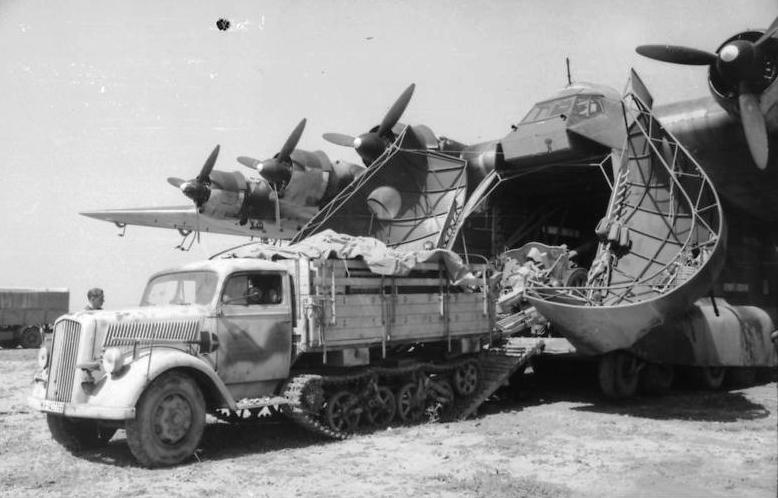
Me-323

Messerschmitt 323 Gigant Disgorging Cargo

A year of researching obscure World War 2 era archival materials has paid off for Italian diver Cristina Freghieri and her team of divers. Although looking for a different wreck, the group discovered the intact remains of a Messerschmitt 323 Gigant downed by a Royal Air Force Bristol Beaufighter on July 26, 1943. The wreck was discovered nearly intact approximately 8 miles off Italy’s Maddalena Islands. Only ~200 Me 323 Gigants were produced during World War 2 and none survive today, thus there is a distinct possibility that the plane will be recovered and restored. Earlier this year the German Navy recovered the remains of a Ju 88 from the Baltic Sea with plans to restore and display the plane at the German Historical Museum’s Air Force Museum.

The Me 323 Gigant was developed from a glider design the Luftwaffe had commissioned in October 1940. The plane could accommodate up to 100 assault troops or 10-12 tons of cargo (by comparison a C-130 can lift 22.5 tons) in the form of field artillery and its halftrack, two trucks or even the ubiquitous 88mm flak gun. By the time they were deployed in late 1942, the Luftwaffe had begun to lose air superiority and the Gigant often fell prey to Allied fighters due to its slow speed. Due to its low volume of production and Allied air superiority, the Gigant never lived up to its full potential.

Winter War

Photo: Wikimedia Commons

In November of 1939, Soviet forces invaded Finland with the intention of bringing additional territory into the communist fold. Even though the Soviet forces vastly outnumbered the Finns, Finnish troops put up a heroic resistance and the conflict was resolved 4 months later with the loss of ~11% of Finland’s pre-war territory. Thus when Nazi Germany launched its invasion of the Soviet Union on June 22, 1941 the Finns were quick to lend their support to the Nazis in an effort to regain their lost territory.

Flowing from this cooperation was the use of Finnish naval forces to screen against Soviet naval forces while German ground forces advanced through the Baltic states. In one such operation, Operation Nordwind, one of Finland’s two capital ships, the Ilmarinen, struck a mine and sank with 271 casualties. The loss of the Ilmarinen on September 13, 1941 was devastating to the tiny Finnish Navy. For a force consisting of only 3,800 officers and sailors, the loss represented  7% of Finnish naval forces. By comparison, less than .8% of the US Navy perished in the attack on Pearl Harbor.

The Ilmarinen had been built in the 1930s as a coastal defence ship for the purpose of defending the numerous islands and islets of Finland’s Baltic coastline. Video of the ship in 1938 can be seen here (the Ilmarinen is the first ship shown in the video). The ship saw service in the Winter War defending the Finnish coast against the Soviet invaders and later shelled Soviet forces after the beginning of the German invasion.

Even though the Finns initially sided with the Nazis, they fought not for ideology, but for self-preservation. In September 1944, the Finns established a separate peace with the Soviets and engaged the Nazis in open combat in the Lapland region until the Nazis withdrew to Norway in April 1945.

89 years ago today, air power advocate General Billy Mitchell sank the battleships USS New Jersey and USS Virginia in his third demonstration of the potential of air power in naval warfare. General Mitchell proved that only a handful of bombers and airmen could render impotent 2 former crown jewels of the US Navy.

Two years earlier, in July of 1921, General Mitchell had successfully sunk the former German dreadnought SMS Ostfriesland and vindicated his theory that precision bombing could sink naval vessels. General Mitchell followed up several months later with further tests on the USS Alabama. While tactical bombing had been performed on both sea and land during World War I, no naval vessel had yet fallen prey to air power until Mitchell’s successful tests off the Virginia coast.

After World War I, General Mitchell returned to the US convinced that air power could fundamentally change the way naval warfare was waged. Facing opponents both within the military and in the halls of Congress, Mitchell’s tests on the Alabama, New Jersey, Ostfriesland and Virginia helped pave the way for the age of the aircraft carrier and the obsolescence of the big-gun battleship. General Mitchell was later court-martialed for statements he made about the competence of certain Army commanders. Although Mitchell passed away prior to World War II, his foresight proved prescient as numerous battleships succumbed to air power during the war, most notably HMS Prince of Wales & HMS Renown and the Japanese super-battleship Yamato. The North American B-25 Mitchell bomber was named for General Mitchell – 16 of which would later be launched from the USS Hornet in the Doolittle Raid against the Japanese home islands in 1942.

Merchant Navy Flag

UK Merchant Navy Ensign
CC Image courtesy of L2F1 on Flickr

Today the United Kingdom, along with Australia, Canada and New Zealand, remembers the sacrifices of their merchant marine from World War One to the present day. The Merchant Navy has served in WWI, WWI, Korea, the Suez Crisis, the Falklands War, and Gulf Wars I & II. More than 14,500 seamen lost their lives in World War I and another 30,000 perished during World War II. September 3rd was chosen as the date to honor the Merchant Navy because September 3, 1939 marked the first loss of British shipping in World War 2 – the SS Athenia. Two shipwrecks, SS Storaa and M/V Atlantic Conveyor, have subsequently been designated protected places under the UK Protection of Military Remains Act. Storaa was lost in World War One to a German u-boat while Atlantic Conveyor is the most recent Merchant Navy loss, having been sunk while supporting British efforts to free the Falkland Islands from their Argentinian invaders.

HMS Ajax

HMS Ajax
CC Image courtesy of Charles McCain on Flickr

Only two days after the Nazi invasion of Poland on September 1, Great Britain declared war on Germany and dispatched the Royal Navy to clear the seas of Germany’s merchant fleet and warships. Within hours of the commencement of hostilities, the light cruiser HMS Ajax encountered the German merchantman Olinda off the coast of Uruguay and promptly destroyed the ship with gunfire. Shortly thereafter, Ajax found and sank another Nazi freighter, the Carl Fritzen. Ajax continued to serve on the South American Station until February 1940 when it returned to the UK for a refit. While on station, Ajax along with HMS Exeter and HMS Achilles accounted for the destruction of several more German merchant ships. Additionally, Ajax, Exeter and Achilles engaged the German pocket battleship Graf Spee which was scuttled by her crew after the Battle of the River Plate. Thus began a nearly six year struggle between the Royal Navy and the Kriegsmarine, Regia Marina, the Imperial Japanese Navy and even the Vichy French Navy.

Peter Stevens

Reporter Peter Stevens’ latest book, Fatal Dive, is an engaging and easy to read work about the disappearance of the US sub USS Grunion off the coast of Alaska during World War II. Launched only a few weeks after the Japanese attack on Pearl Harbor, the Grunion’s first combat deployment was against Japanese shipping in the Aleutian Islands. Commanded by Lieutenant Commander Jim Abele, Grunion and her 70 man crew successfully sank 2 Japanese sub-chasers, survived a depth charge attack by a Japanese destroyer and then disappeared with all hands after crippling the Japanese merchantman Kano Maru. Apart from Western Union telegrams declaring the crew members Missing In Action, the relatives of the crew were largely kept in the dark as to the causes of the sub’s loss.

Stevens’ straightforward writing style and the book’s relatively short-length of 175 pages (plus a 60 page appendix containing short bios of each crew member) make it a quick, but thoroughly enjoyable read. Fatal Dive chronicles the life of Lt. Commander Abele, the Grunion’s first combat cruise and subsequent loss, and the dramatic story of her discovery by Lt. Commander Abele’s sons 65 years later. Stevens’ avoids getting bogged down in historical minutiae and instead focuses on the characters in the story from both sides of the conflict. His writing effectively conveys the sense of excitement and danger faced by the Abele brothers and their crew as they work to locate the ship in the treacherous waters of the Bering Sea. Stevens concludes the book with a discussion of the causes of the ship’s sinking and why the US Navy subsequently chose to torpedo any explanation of her loss. Fatal Dive is a great choice for a quick weekend read for any history or mystery buff.

Wilhelm Gustloff

Photo: German Federal Archive

The worst maritime disaster in recorded human history occurred in the closing days of World War II and is little known in popular history. The torpedoing of the M/V Wilhelm Gustloff claimed ~9,000 lives including as many as 4,000 children. By comparison the RMS Titanic disaster cost 1,517 lives. In the waning days of World War II, the once vaunted German Wehrmacht was pressed into ever shrinking pockets of territory by advancing Soviet armies. Admiral Karl Donitz, desperate to evacuate 2 million German personnel and civilians from isolated pockets of German territory on the Baltic Coast, initiated Operation Hannibal – an evacuation almost six times the size of Dunkirk.

Among the ships used in the evacuation was the Wilhelm Gustloff, a former luxury liner built in 1938 to provide holiday excursions as part of Hitler’s “Strength Through Joy” program. Confiscated by the Kriegsmarine at the outbreak of hostilities in September, 1939, the ship served as a hospital ship and floating barracks. The Wilhelm Gustloff departed Gotenhafen on January 30, 1945 with more than 10,000 refugees and military personnel. Less than 9 hours after leaving Gotenhafen, the ship was spotted by the Soviet submarine S-13 which loosed a four torpedo salvo. Three of the four torpedoes (the fourth jammed in the tube) found their mark and within 70 minutes the Wilhelm Gustloff lay 150 feet beneath the Baltic Sea. More than 9,000 souls perished in the sinking, but for propaganda reasons the Nazi regime kept news of the sinking from spreading within the crumbling Third Reich. For numerous reasons, most importantly the overshadowing of the tragedy by the ending of the war and the exposure of Nazi death camps, the disaster is not a pop culture icon like the sinking of the RMS Titanic or the RMS Lusitania.

Some historians have speculated that the looted Amber Room might have been aboard and the Soviets allegedly launched an expedition to the wreck site during the Cold War. Evidence pointing to the Amber Room being aboard is circumstantial at best. The last known sighting of the room was in nearby Konigsberg Castle just days before the ship sailed. The room had been packaged into 27 crates and eyewitnesses report the moving of similar sized crates from trucks to the ship prior to its departure. In the most thorough analysis of the fate of the Amber Room to date, authors Catherine Scott-Clark and Adrian Levy posit that the Amber Room was destroyed on land sometime during the frantic evacuations from East Prussia and has been forever lost.