Archives For November 30, 1999

german battleship

Scharnhorst fires on HMS Glorious
Photo: US Navy

The Nazi battleship Scharnhorst lived a charmed life from the early days of World War II until Christmas 1943. The ship was among the most powerful of the Kriegsmarine’s most powerful surface units and, until the launch of the Bismarck and the Tirpitz, she and her sister ship Gneisenau were the pride of the Kriegsmarine. Often operating as a pair, Scharnhorst and Gneisenau wreaked havoc on the Royal Navy. In the opening days of World War II, the ships sank the armed British merchant cruiser HMS Rawalpindi and later sank the aircraft carrier HMS Glorious (see photo above) during the 1940 invasion of Norway.

The sister ships also broke out into the North Atlantic and sent several Allied merchantmen to the bottom of the sea. After the loss of the Bismarck, the decision was made to withdraw Nazi surface ships from the French coast. In early February 1942, the ships, along with the heavy cruiser Prinz Eugen, made a daring dash up the length of the English Channel. The Scharnhorst was then re-deployed to the northern waters of Norway in order to threaten Allied convoys supplying the Soviet Union.

On Christmas Day 1943, the Scharnhorst along with several destroyer escorts set sail from Norway to intercept an Allied convoy. Unbeknownst to the Kriegsmarine, the Royal Navy had intercepted and decoded the Scharnhorst’s orders and therefore laid a trap for the ship. Three Royal Navy cruisers screened the convoy from Scharnhorst while a squadron led by the battleship Duke of York raced to cut off the Nazi force from safety in Norwegian waters. After a fruitless pursuit of the convoy, the Scharnhorst cut off contact and began to return to base on December 26. In a three hour battle, the Scharnhorst was battered by the Royal Navy squadron and finally sank with only 36 survivors out of a crew of 1,968.

The wreck of the Scharnhorst was discovered in 2000 by the Norwegian Navy and further investigation revealed the extent of the damage inflicted by the Royal Navy. A total of 2,195 shells were fired at the ship along with 55 torpedoes. Eleven of the torpedoes found their mark and the torpedo and shell damage was extensive. The entire bow section of the ship was blown off the ship, most likely the result of an explosion in a forward magazine. Go here for a gallery of images from the Norwegian Navy’s investigation as well as period photos of the Scharnhorst.

Graf Spee sinking

Sinking of the Graf Spee

At the outset of World War II, the Nazi Kriegsmarine didn’t just deploy their merchant raiders and U-boats, but also tasked capital ships with the destruction of Allied shipping. One such ship was the Graf Spee, a pocket battleship constructed during the 1930s before Nazi Germany renounced the provisions of the Versailles Treaty. Germany’s pocket battleships were designed as a re-incarnation of the World War I battlecruiser concept – better armed than heavy cruisers and faster than battleships. The strategic concept was that each ship could operate independently against Allied merchant shipping and choose fight or flight when faced with the threat of engaging a warship.

The Graf Spee was named for Admiral Graf von Spee who had defeated a British squadron at the Battle of Coronel (November 1, 1914) only to have his squadron destroyed by a superior British force a month later at the Battle of the Falklands. Admiral von Spee was lauded by both sides of the conflict as a brilliant tactician and consummate naval officer and gentleman. After his death at the Battle of the Falklands, Admiral von Spee was quickly enshrined in the then small pantheon of Germany’s naval heroes. In addition to the Graf Spee, Germany built two other pocket battleships – the Deutschland and Admiral Scheer – both of which ended the war as floating artillery batteries and were destroyed in the waning weeks of the war.

Commanded by Captain Hans Langsdorff, the Graf Spee found herself in the South Atlantic at the outbreak of the war. Captain Langsdorff and his crew quickly got to work dispatching Allied shipping and sank 50,000 tons of British shipping before being engaged on December 13, 1939 by a trio of British cruisers – Achilles, Ajax, and Exeter. In the subsequent battle, dubbed the Battle of the River Plate, the Graf Spee seriously damaged the Exeter but was herself damaged and Captain Langsdorff sought shelter to perform repairs in Montevideo, Uruguay. Fearing a superior British force had gathered outside Montevideo, Captain Langsdorff and a skeleton crew sailed the Graf Spee into the river estuary on December 18 and scuttled the ship to prevent her from falling into Allied hands. Captain Langsdorff then committed suicide and the crew were interned in Uruguary.

The destruction of the Graf Spee and her limited contributions to the war effort enraged Adolf Hitler who instructed the commander of the Kriegsmarine, Admiral Raeder, to issue an order stating, “The German warship and her crew are to fight with all their strength to the last shell; until they win or go down with their flag flying.” For the Allies, the victory provided a healthy morale boost after the loss of Poland earlier in the year.

soviet submarine baltic sea

Wreckage of Soviet WWII Submarine S-6
Photo: Försvarsmakten

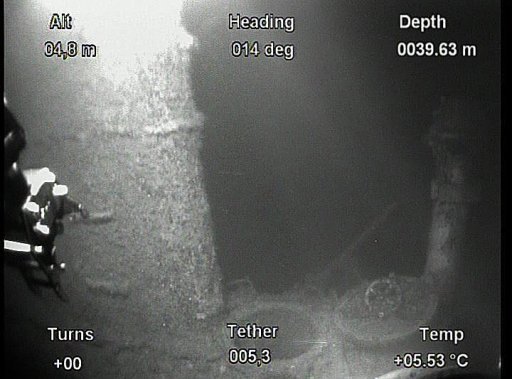
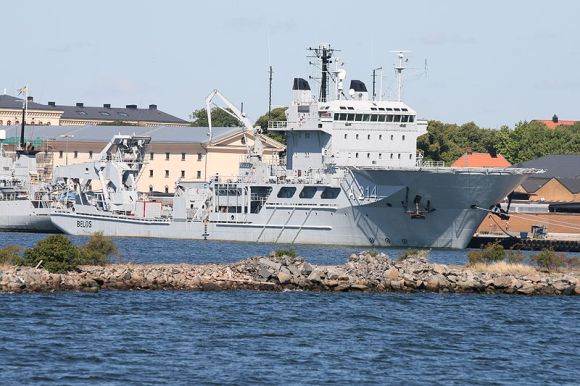
Earlier this summer civilian divers reported discovering what they believed to be a sunken submarine in 130 feet of water near Sweden’s island of Oland in the Baltic Sea. The Swedish Navy returned to the site with its submarine salvage ship HSWMS Belos to further inspect the wreck and determine its identity. Swedish news site The Local reports that the Swedish military believes the vessel is the Soviet submarine S-6 which never returned from its September 1941 patrol. Cyrillic text and a Soviet hammer and sickle are visible on the wreck providing evidence that the wreck is indeed a Soviet sub.

The Swedish military further believes that while cruising on the surface of the Baltic the sub struck a Nazi mine and was blown to pieces. This hypothesis flows from the fact that a hatch (seen above) was open on the vessel and it was found in multiple pieces on the sea floor. The large size of the debris field rules out the possibility the sub struck a mine below the surface and that the crew were able to make an attempt at escape. Thus it is most likely the sub was cruising on the surface, possibly re-charging its batteries at night, with hatches open to circulate air within the boat when it struck the mine.

submarine salvage ship

HSWMS Belos
Photo: Wikimedia

Canada WWII Navy

HMCS Sackville
CC Image Courtesy of Paul B on Flickr

The HMCS Sackville was laid down in early 1940 and was 1 of 267 Flower-class Corvettes built for the Allied navies during World War II. The U-boat threat to the Atlantic shipping lanes required hundreds of small, nimble ocean going warships to fend off U-boat and Luftwaffe bomber attacks on Allied convoys. The Flower-class were intended to fulfill this role and helped get American and Canadian men and war material across the Atlantic safely.

The Sackville first saw service in early 1942 when she was deployed to the Northern Atlantic to protect convoys off the coast of Newfoundland. The ship damaged several U-boats during her wartime patrols and even forced two U-boats to completely break off their attacks and return to occupied Europe for extensive repairs. Unfortunately, the Sackville was herself damaged in August 1944 when a massive explosion damaged one of her boilers. The cause of the explosion is still unknown, but was most likely the result of one of her depth charges exploding a Nazi torpedo close to the Sackville’s hull.

Relegated to harbor duty the ship was later converted into a research vessel for use by the Canadian Department of Marine and Fisheries. Finally retired in 1982, the Sackville avoided the scrap heap and is now the last remaining Flower-class corvette in the world. She now continues in service as a museum ship and Canada’s Naval Memorial in Halifax, Nova Scotia. The ship can be visited during the summer months and more information can be found here.

French Navy World War II

Aerial View of the Vichy French Fleet Scuttled in Toulon

Despite the overwhelming success of Nazi Germany’s Blitzkrieg assault on France in May 1940, Adolf Hitler chose not to occupy the entirety of the country. Along with a small zone occupied by Italy, a significant slice of southern France was allowed to remain nominally free. Dubbed Vichy France and headed by Marshall Petain, the “country” effectively functioned as a satellite state of Nazi Germany. In November 1942, Adolf Hitler ordered the occupation of Vichy France after the Allies landed in Vichy French North Africa.

One of the highest value targets in the Vichy French zone was the Vichy French fleet stationed in Toulon. Consisting of 3 battleships, 7 cruisers, 18 destroyers and 21 submarines, the addition of the Vichy French fleet to Italy’s Regia Marina or Germany’s Kriegsmarine could have had a significant effect on the balance of power in the Mediterranean theater. Aiming to deprive the Allies of the Vichy French fleet, Hitler ordered Operation Lila as a part of the larger takeover of Vichy France. Lila was intended to capture the Vichy French fleet at their anchorage in Toulon and turn the ships over to the Regia Marina.

At the same time Nazi forces were setting in motion Operation Lila, Vichy French forces were planning to either flee to North Africa or, in the event they couldn’t escape, scuttle their ships at anchor. Unfortunately for the Vichy French and for the greater Allied war effort, only a handful of submarines and a single surface vessel were able to escape the clutches of the advancing Nazi war machine. Instead, the majority of the fleet was scuttled in Toulon and rendered combat ineffective to the Nazis and Italians. In total, 77 ships were scuttled including all of the French capital ships and, while 30+ small vessels were captured, Operation Lila was essentially a complete failure for the Axis.

BB-55

USS North Carolina
CC Image Courtesy of Jay Turner on Flickr

Although today the USS North Carolina floats peacefully in Wilmington, NC, the ship was once at the tip of the US Navy’s spear in the Pacific during World War II. The North Carolina had originally been planned for construction in the 1920’s and her keel was even laid down, however, the approval of the Washington Naval Treaty caused the ship to be scrapped to honor the United States’ treaty commitments. Not until the gradual re-armament of the 1930s was the ship brought back off the drawing board. The ship was finally commissioned on April 9, 1941 and bristled from end to end with nine 16-inch guns, twenty 5-inch dual purpose guns and dozens of 20mm and 40mm anti-aircraft guns.

The North Carolina first tasted blood in the Guadalcanal campaign of August 1942 and participated in every major naval offensive of the war. Nicknamed the Showboat, the North Carolina earned 15 battle stars during World War II, survived being torpedoed, sank a Japanese troopship, participated in 9 shore bombardments and downed 24 enemy aircraft. Additionally, the pilots of her Kingfisher aircraft assisted in the rescue of numerous Allied pilots and aircrew and on one occasion Lt. John Burns used his Kingfisher to rescue 10 airmen.

Following the war, the North Carolina was placed in the Inactive Reserve Fleet and, after a fundraising effort by North Carolina schoolchildren, was dedicated as a museum ship in 1962. As the most decorated battleship of World War II, the USS North Carolina now serves as a memorial to North Carolina’s World War II service men and women. The ship is open for tours and even hosts an annual 5-K and 1/2 Marathon.

HMAS Sydney

CC Image courtesy of Horatio Kookaburra on Flickr

German naval strategy during World War II was similar to that employed in World War I – strangle the United Kingdom by sinking or disrupting its merchant shipping. In addition to the ubiquitous U-boat, the Kriegsmarine utilized surface warships and camouflaged merchant vessels to target Allied shipping in all theaters of the war. One such camouflaged merchant vessel was the HSK Kormoran. Formerly the merchantman Steiermark, the ship was converted in 1940 to carry mines and hidden armaments as well as two float planes. Departing Germany in December 1940, Kormoran captured or sunk 11 merchant ships as it cruised through the Atlantic and Indian Oceans.

The Kormoran’s luck ran out, though, when it happened upon the Australian cruiser HMAS Sydney on November 19, 1941. Sydney was returning to port from escorting a troopship and decided to investigate what appeared to be a suspicious vessel. The two ships exchanged signals until the Kormoran, posing as the Dutch ship Straat Malaka, failed to identify itself by the Straat Malaka’s secondary secret signal. Realizing he could no longer keep up the ruse, Kormoran’s captain ordered the Dutch ensign struck, raised the German naval ensign and opened fire. The two ships engaged in their deadly duel for about an hour at which point the heavily damaged Sydney, struck by hundreds of rounds of 5.9 inch shells as well as several torpedoes, drifted off to the southwest.

The Sydney disappeared with its entire crew complement of 645 officers and sailors. The Kormoran, irreparably damaged by Sydney’s broadsides, was ordered scuttled by her captain and the crew took to the lifeboats. Only 317 of the Kormoran’s 400 man crew were rescued. While Sydney’s sinking of the Kormoran was a pyrrhic victory for her crew, it helped eliminate the threat of continued predation on Allied merchant shipping and the lives of Sydney’s crew were not lost in vain. On March 12, 2008, searchers from the Finding Sydney Foundation located the wreck of the Kormoran in 2,500 meters of water. Five days later, the wreck of the Sydney was finally located approximately 11 miles from the Kormoran. Today, a new HMAS Sydney proudly serves the Royal Australian Navy and its replacement will be christened with the same name when it enters service in 2017.

Arkansas Inland Maritime Museum

USS Razorback
CC Image Courtesy of thomas23 on Flickr

Much like in Muskogee, Oklahoma, one would not expect to find a submarine museum ship in Little Rock, Arkansas. Beginning in 1963, though, the US Army Corps of Engineers embarked on a project that opened the Arkansas River in 1971 to commercial traffic from Tulsa, Oklahoma to its confluence with the Mississippi. Thus arose the opportunity for museum ships such as the USS Batfish in Muskogee and the USS Razorback in Little Rock to be created.

The Razorback has the unique distinction of being one of the longest serving submarines in the world. The boat served from 1944 to 1970 with the US Navy and from 1971 to 2001 with the Turkish Navy. Commissioned in April 1944, the Razorback was not named after the University of Arkansas’ mascot, but rather a species of whale. During her 5 war patrols, the sub sank over half a dozen Japanese merchant and warships, rescued multiple Allied airmen, participated in the surrender ceremony in Tokyo Bay and earned 5 battle stars.

Following the war, the Razorback continued her service and received upgrades from 1952 to 1954 based on knowledge derived from captured Nazi U-boats. The boat patrolled the waters of the South China Sea during the Vietnam War and earned an additional 4 battle stars before being decommissioned in 1970. Following decommissioning, the Razorback was transferred to the Turkish Navy where she was renamed TCG Muratreis.

In 2001, the boat was sold to the city of North Little Rock and opened as a museum ship at the Arkansas Inland Maritime Museum. If visiting, also be sure to take a stroll across the Big Dam Bridge, the longest pedestrian bridge in the US never having been open to vehicle traffic. Today the USS Razorback stands as a silent sentinel guarding Little Rock and the Arkansas River.

japanese submarine

Japanese Midget Submarine HA-19
CC Image Courtesy of Brian Bennett on Flickr

Located in Fredericksburg, Texas, the National Museum of the Pacific War honors the sacrifices made by American and Allied Coast Guardsmen, Marines, sailors and soldiers during World War II. Surrounded by picturesque ranches, Fredericksburg is in the heart of Hill Country and the hometown of Admiral Chester W. Nimitz, the Commander in Chief of the Pacific Theater during World War II. Among the Museum’s artifacts is the HA-19, a Japanese midget submarine that ran aground during the attack on Pearl Harbor on December 7, 1941.

HA-19 was only one of several midget submarines deployed by the Japanese to torpedo American ships at anchor in Pearl Harbor during the air raid. The submarine was discovered and depth charged by the USS Helm and subsequently wrecked on a reef near Waimānalo. Recent photographic analysis has led some to suspect that one of HA-19’s sister ships successfully launched her torpedoes at the USS Oklahoma or USS West Virginia on Battleship Row. US forces later recovered HA-19 and paraded it around the US during war bond drives.

Unlike modern SEAL Delivery Vehicles, the Royal Navy’s X type submarinesor the Kriegsmarine’s Seehund subs, the Japanese Navy’s midget submarine program was largely unsuccessful and is today a minor footnote in the greater story of World War II. For more information on planning a visit to the National Museum of the Pacific War, go to their website here.

hms dasher

Ardrossan, Scotland
CC Image Courtesy of Gordon Cowan on Flickr

Next week British archaeologists will excavate a possible mass grave of British sailors in Ardrossan, Scotland. The sailors believed buried there served aboard HMS Dasher, a British escort carrier which sunk in 1943 during World War II. Some have alleged that the mass grave is the result of a government cover-up.

Dasher was originally laid down as the merchant vessel Rio de Janiero, however, the exigent circumstances of wartime prompted her conversion into an escort carrier. Escort carriers were small aircraft carriers designed to provide air cover for convoys as they crossed the North Atlantic. Additionally, the diminutive carriers saw action in the Pacific Theater, most notably during the Battle of Leyte Gulf.

Dasher could embark 15 aircraft which helped substantially lessen the risk of attack by U-boats or the Luftwaffe. The ship sank under mysterious circumstances on March 27, 1943 and 379 of her 528 man crew lost their lives. Various theories have been put forth as to what caused the ship to sink among them design defects or a plane wrecking upon landing. Following the sinking, the British government acted quickly to prevent news of the ship’s loss from spreading and weakening wartime morale. Among the actions taken were the burying of the majority of the sailors in a mass grave and a gag order being issued to the local press.

Earlier this year the British government announced it would make public documents surrounding the loss of the Dasher. Hopefully the release of these documents along with the excavation and reburial of the sailors will lay to rest a tragic and controversial event in the history of the Royal Navy. Today, a new HMS Dasher serves the Royal Navy as a coastal training vessel.