Archives For November 30, 1999

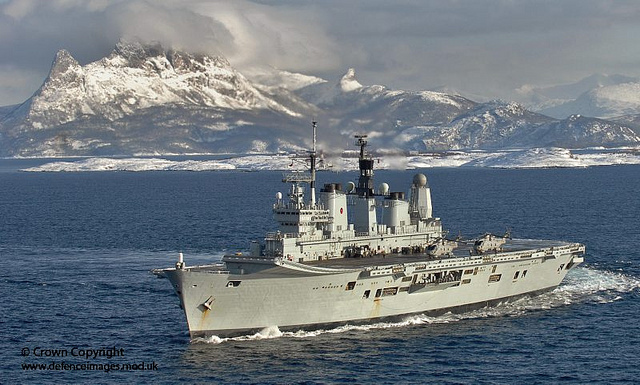
British aircraft carrier

HMS Ark Royal off Norway in 2008
Photo: MOD

The Telegraph is reporting that the HMS Ark Royal, the Royal Navy’s only remaining aircraft carrier, is finally being sold for scrap. The ship was originally to remain in service until 2016 or 2017 when it would have been replaced by HMS Queen Elizabeth, the first of the Queen Elizabeth class aircraft carriers. Budgetary issues, though, caused the Ministry of Defence to rethink their time table and remove the ship from service early. The Ark Royal was decommissioned in March of 2011 and an internal debate within the UK government about its final disposal has caused delays in the decision. Among the various scenarios considered for the Ark Royal’s ultimate fate were it being sunk as a wreck site for divers, converted to use as a London heliport, converted into a Hong Kong casino, refitted for hotel use (much like the former Soviet carrier Kiev) or sold for scrap. Ultimately the Ministry of Defence chose to scrap the vessel for £3 million.

The Ark Royal was laid down in 1978 and commissioned in 1985. She was the third and final ship of the Invincible class carriers and was designed to operate short take-off and vertical landing (STOVL) aircraft and helicopters from her flight deck. Her sister ship HMS Invincible saw service in the Falklands War and was sold for scrap earlier last year. Her other sister ship HMS Illustrious served in the Balkans conflict of the 1990s and has since joined HMS Ocean as a helicopter carrier. Ark Royal was the fifth Royal Navy ship to carry the name with previous ships having fought against the Spanish Armada, the German High Seas Fleet, the Nazi Kriegsmarine (lost to a u-boat in 1941) and in post-World War 2 service. The current Ark Royal provided air cover for operations in the Balkans in 1993 – 1994 and in the invasion of Iraq in 2003.

Following the retirement of the the Ark Royal in March 2011, the UK Ministry of Defence sold its remaining Harrier STOVL jets to the US Marine Corps to be used for spare parts. This decision has left the Royal Navy with only 1 fixed wing aircraft until the entry of the F-35 into service. While the Ministry of Defence is much better prepared to resist an invasion of the Falklands than it was in the 1980s, the loss of its seaborne fixed-wing aircraft capability until 2016 has left the UK increasingly reliant on allies (such as the French in their agreement to jointly operate the Charles de Gaulle) in the shaping of its foreign policy. Gone are the days when an enlightened British citizenry could call for the outlawing of the slave trade and the Royal Navy unilaterally enforce the prohibition. This further erosion of British autonomy has most assuredly set Lord Nelson and Winston Churchill to spinning in their graves.

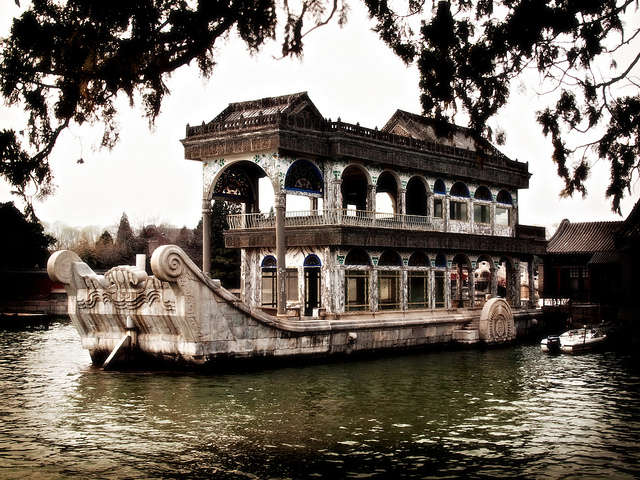
Ci Xi Marble Boat

CC Image courtesy of Kevin Poh on Flickr

Today marks the 111th anniversary of the end of the Boxer Rebellion. Inspired by anti-imperialist sentiment and religious mysticism, the Boxers were a nationalist Chinese group which rose up against Westerners across China in late 1899. Thousands of Chinese Christian converts, Western missionaries and other Western ex-pats were slaughtered in the ensuing violence. The Rebellion culminated in a 55 day siege of the foreign embassies in Peking which was finally lifted when 20,000 troops from Austria-Hungary, Germany, Great Britain, France, Italy, Japan, Russia and the US fought their way into Peking.

In a strange twist, the Boxer Rebellion owes much to the marble edifice pictured above – the Marble Boat on the grounds of the Summer Palace in Peking. Originally built in 1755, the structure was renovated in 1893 by order of the Empress Dowager Ci Xi with funds intended for modernizing the Chinese navy. Instead of funding the construction of a modern navy that could have kept Western forces at bay and prevented the further divvying up of China between competing Western nations, the Chinese built a ship useful only for delighting courtesans and guests of the Empress.

Blackbeard

Edward Teach, aka Blackbeard
Photo: Wiki Commons

An archaeological team from the North Carolina Underwater Archaeology Branch will spend eight weeks excavating the Queen Anne’s Revenge, the flagship of famous pirate Blackbeard. The vessel was discovered in 1996 near Beaufort, NC and several excavations have been conducted by the state’s Underwater Archaeology Branch over the past few years. Numerous cannons, the ship’s anchor and approximately 16,000 artifacts have been recovered thus far. A permanent exhibit at the Beaufort branch of NC’s Maritime Museum opened in June 2011 to display the artifacts and educate visitors about the life of a pirate. Blackbeard’s name has become synonymous with 18th century piracy even though his career lasted a mere two years before he was killed in 1718 during a fight with Royal Navy forces near Ocracoke, North Carolina. The Queen Anne’s Revenge is only the second pirate ship to be discovered and excavated, with the other being the Whydah off the Massachusetts coast.

Korean Rescue Ship

Photo: Naval Open Source INTelligence

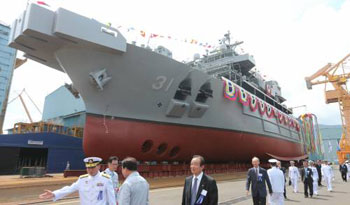
Yesterday, South Korea launched the Tongyeong, its first domestic manufactured rescue and salvage ship. The Tongyeong was laid down in October of 2010 and will join the ROK Navy next year after final fitting out and trials are completed. The ship is intended to broaden the ROK Navy’s salvage and rescue capabilities which are currently served by two former US Navy Vessels.  Both vessels are nearing the end of their service lives and the ROK Navy will now be able to respond in half the time to disasters in far-reaching islands.

The Tongyeong displaces 3,500 tons and is capable of 21 knots. Armed with an ROV, side-scan sonar, a dynamic position system and various winches, the Tongyeong can search on and below the seas for wrecked vessels and is capable of towing vessels displacing up to 15,000 tons. The ship has onboard medical facilities for treating survivors at sea and can medevac patients via its helipad. With South Korean shipyards now some of the largest in the world, it is only fitting that the ROK Navy can benefit from domestically produced ships and not rely on second-hand ships for rescuing stranded mariners.

89 years ago today, air power advocate General Billy Mitchell sank the battleships USS New Jersey and USS Virginia in his third demonstration of the potential of air power in naval warfare. General Mitchell proved that only a handful of bombers and airmen could render impotent 2 former crown jewels of the US Navy.

Two years earlier, in July of 1921, General Mitchell had successfully sunk the former German dreadnought SMS Ostfriesland and vindicated his theory that precision bombing could sink naval vessels. General Mitchell followed up several months later with further tests on the USS Alabama. While tactical bombing had been performed on both sea and land during World War I, no naval vessel had yet fallen prey to air power until Mitchell’s successful tests off the Virginia coast.

After World War I, General Mitchell returned to the US convinced that air power could fundamentally change the way naval warfare was waged. Facing opponents both within the military and in the halls of Congress, Mitchell’s tests on the Alabama, New Jersey, Ostfriesland and Virginia helped pave the way for the age of the aircraft carrier and the obsolescence of the big-gun battleship. General Mitchell was later court-martialed for statements he made about the competence of certain Army commanders. Although Mitchell passed away prior to World War II, his foresight proved prescient as numerous battleships succumbed to air power during the war, most notably HMS Prince of Wales & HMS Renown and the Japanese super-battleship Yamato. The North American B-25 Mitchell bomber was named for General Mitchell – 16 of which would later be launched from the USS Hornet in the Doolittle Raid against the Japanese home islands in 1942.

HMS Hood

CC Image courtesy of Patrick McDonald on Flickr

An expedition led by Microsoft co-founder Paul Allen aboard his mega-yacht Octopus has been forced to abandon their efforts to recover the ship’s bell of the Royal Navy battlecruiser HMS Hood. Allen and his team have been operating out of Reykjavik, Iceland for the last two weeks, but a combination of weather and mechanical issues with their ROV have caused the team to end its efforts on the Hood this recovery season. Named for Admiral Samuel Hood, the Hood was the second ship to bear his name. The ship entered service in 1920 and is best known for its role in the hunt for the German battleship Bismarck.

HMS Hood and the battleship HMS Prince of Wales intercepted the Bismarck on May 24, 1941 as the Bismarck and heavy cruiser Prinz Eugen attempted to break out into the North Atlantic in hunt of British merchantmen. In a running battle lasting less than 20 minutes, the Bismarck sank the Hood and damaged the Prince of Wales. The Hood took with it 1,415 of her 1,418 man crew. The engagement became known as the Battle of the Denmark Straits and was merely the opening act of a massive 3 day manhunt culminating in the sinking of the Bismarck on May 27th. The Prince of Wales went on to serve in the Pacific Theater where it, along with the battleship HMS Repulse, was sunk by a Japanese air attack. Prinz Eugen survived the war and was later used as a target ship by the US Navy for atomic bomb tests.

HMS Ajax

HMS Ajax
CC Image courtesy of Charles McCain on Flickr

Only two days after the Nazi invasion of Poland on September 1, Great Britain declared war on Germany and dispatched the Royal Navy to clear the seas of Germany’s merchant fleet and warships. Within hours of the commencement of hostilities, the light cruiser HMS Ajax encountered the German merchantman Olinda off the coast of Uruguay and promptly destroyed the ship with gunfire. Shortly thereafter, Ajax found and sank another Nazi freighter, the Carl Fritzen. Ajax continued to serve on the South American Station until February 1940 when it returned to the UK for a refit. While on station, Ajax along with HMS Exeter and HMS Achilles accounted for the destruction of several more German merchant ships. Additionally, Ajax, Exeter and Achilles engaged the German pocket battleship Graf Spee which was scuttled by her crew after the Battle of the River Plate. Thus began a nearly six year struggle between the Royal Navy and the Kriegsmarine, Regia Marina, the Imperial Japanese Navy and even the Vichy French Navy.

USNS Spearhead

Joint High Speed Vessel Concept Rendering

Despite Hurricane Isaac disrupting Austal’s Mobile, AL shipyard operations for two days, the USNS Spearhead has now completed its performance and acceptance trials for the US Navy. Successful completion of the trials means the Navy should soon be accepting the first of 9 Joint High Speed Vessels (JHSV) into service. The second ship in its class, USNS Vigilant, is set to be christened September 15th.

The JHSVs were designed to act as fast transports for deploying US servicemen throughout the world in support of combat and humanitarian missions. Austal, the winner of the Navy contract for design and construction of the vessels, drew upon its experience building civilian catamaran ferries to produce the ship. The JHSV can embark 312 troops in airline style seating and has on-board berthing for 150 plus 41 crew. Its rear loading ramp can accommodate vehicles up to the size of an M1A Abrams tank and can operate a single helicopter off of its landing pad. The JHSVs are designed to operate in austere conditions and can disembark their troops and cargo without advanced port facilities. A single JHSV can move a Marine or Army company with all of their equipment or an entire battalion if operating solely as a troop transport. Additionally, the vessel can transport troops and equipment 25% cheaper than an airlift operation and around 50% faster than current seaborne options.

Russian submarine

CC Image courtesy of The Bellona Foundation on Flickr

Nine years ago today the Russian Navy lost the nuclear powered submarine K-159 when it foundered in the Barents Sea . The sub had recently been slated for scrapping and was en route to a date with the breakers yard. Commissioned in 1963, the K-159 served in the Soviet Northern Fleet (the same fleet as Tom Clancy’s Red October) and suffered a reactor accident in 1965. Reports vary on the extent of repairs to the reactor, but the ship returned to active service and was retired in 1989. The K-159 lay derelict in a Russian naval yard for fourteen years with minimal maintenance until the decision was made to scrap the ship in 2003. Due to extensive rusting of the ship’s outer hull, pontoons were secured to the K-159 to provide additional flotation.

Manned with a 10 man skeleton crew, the sub was taken under tow to a Russian scrapyard. While under tow, a storm ripped away the K-159’s pontoons and the sub began to take on water. Within a few hours the K-159 dipped below the waves of the Barents Sea and came to rest in 781 feet of water. In addition to killing 9 of her crew members, the sub took with it 1,760 pounds of radioactive spent fuel. Plans for salvage have continually been postponed, however the Scottish salvage company Adus located the sub and published sonar scan images of it resting on the sea floor in 2010. The Dutch salvage company Smit & Mammoet (the same firm which salvaged the Russian sub Kursk) submitted a salvage proposal in 2011, but salvage work has yet to begin. While the wreck generated initial concerns of radioactive contamination of the Barents Sea, to date there has been no documented increase in radiation levels in the area.

Robert Ballard Cyprus

CC Image courtesy of Erik Charlton on Flickr

Legendary underwater explorer Robert Ballard has added two more shipwrecks to his already incredible list of discoveries (RMS TitanicBismarck, USS Yorktown and John F. Kennedy’s PT 109). Ballard and his team spent two weeks off the Cypriot coast exploring the Erastosthenes Seamount, a 120km by 80km undersea mountain that was previously above water. The expedition’s chief goal was to survey the seamount’s geology through the use of submersibles and high definition cameras. Ballard plans to return in several weeks after the Nautilus is equipped with a new sonar system that will allow him and his team to map the seamount. Previously the seamount was believed to contain only limestone, but the expedition located a formation of volcanic rock that doesn’t fit the area’s geologic profile. Additionally, the team found a curious methane source on the formation which requires further investigation.

It was in the process of completing their geologic mapping that the team discovered the two wrecks. One ship is believed to have sunk 2,300 to 2,500 years ago and carried cargoes between Greece and Cyprus. Among the artifacts photographed at the scene are a variety of ceramics, two anchors, a possible bun ingot and several other unidentified objects. The second ship appears to be an Ottoman war galley and an 18th century flintlock pistol and black rum bottles were located amongst the wreckage. One question left unanswered by the expedition is the speculation that Ballard’s team was searching for a WWII-era wreck containing a gold cargo. There exists little grounds for such speculation, though, as Ballard is known for not seeking to directly profit from his underseas exploration.

Prior to this month’s expedition, Ballard helped Turkey locate the two Turkish pilots lost when their F-4 crashed under mysterious circumstances near the Syrian border.