Archives For November 30, 1999

Bonhomme Richard

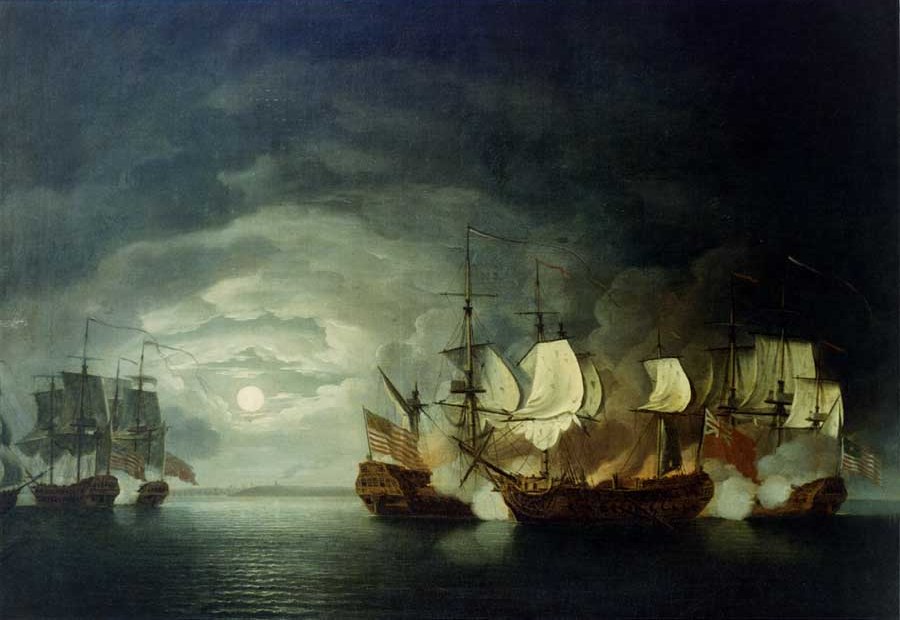
Battle of Flamborough Head
Photo: US Navy, Painting by Thomas Mitchell

One of the most famous battles in the US Navy’s history occurred 233 years ago today on September 23, 1779. Captain John Paul Jones and his converted East Indiaman USS Bonhomme Richard along with USS Alliance attacked a British convoy protected by HMS Serapis and Countess of Scarborough. In what became known as the Battle of Flamborough Head, Jones and his crew engaged the Serapis in a ship-to-ship duel. Captain Pearson of the Serapis demanded Jones’ surrender and in reply he uttered the now famous words, “I have not yet begun to fight.”

Though outgunned, Jones’ superior  fighting skills carried the day and the Serapis eventually struck its colors. Despite having defeated the British forces (Countess of Scarborough struck her colors as well), the Bonhomme Richard sank the next morning and Jones transferred his flag to the Serapis. Jones’ victory was not the last in which an American naval force engaged British forces while penning a famous phrase

The wreck of the Bonhomme Richard is considered one of the crown jewels of shipwrecks and has been the subject of several discovery expeditions. Unfortunately none have been able to locate the wreck and its final resting place off Flamborough Head remains a mystery. John Paul Jones is considered the father of the American Navy and his words “I wish to have no connection with any ship that does not sail fast for I intend to go in harm’s way” are just as famous in naval circles as “I have not yet begun to fight.” Sadly, Jones never held a significant sea command in the US Navy after the Battle of Flamborough Head and died an Admiral in the Russian Navy.

littoral combat ship

USS Forth Worth during sea trials
Photo: US Navy

Tomorrow the US Navy is set to christen the USS Fort Worth in Galveston, Texas. The Fort Worth is the second vessel of Lockheed Martin’s Freedom class Littoral Combat Ships which are designed to operate in a multi-mission role in shallow waters. The Littoral Combat Ship was first devised in the 1990s when the US Navy recognized the need for a multi-purpose vessel to operate in the littoral zone where either deeper draft vessels couldn’t operate or the dangers of the zone (i.e. missile boats, mines, shore launched missiles, etc.) prohibited the exposure of more expensive ships. After the solicitation of various proposals, two designs were chosen for production – Lockheed Martin’s conventional Freedom-class and General Dynamics/Austal’s trimaran Independence class. Despite cost-overruns and serious criticism, the program has forged ahead and, for good or bad, the ships are entering service.

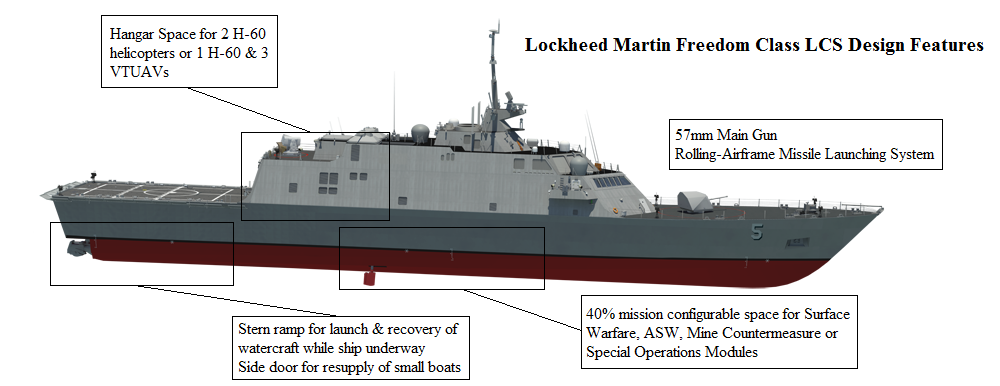
The Freedom class variant utilizes a conventional monohull and Lockheed Martin was assisted in its design by veritable naval architecture firm Gibbs & Cox. Gibbs & Cox, founded by America’s greatest naval architect, has designed more than 60% of the US Navy’s surface ships as well as ships for 15 other world navies. Among the Freedom-class’ notable features is its jet propulsion system which allows it to reach speeds of 40 knots/hour, its 12.8 foot draft which enables it to operate in shallower water than most US Navy vessels, the ability to launch and recover watercraft while underway and its 40% re-configurable space.

littoral combat ship

Freedom class LCS Diagram

The LCS ships are intended to fulfill the roles previously performed by Oliver Hazard Perry guided missile frigates, MCM Avenger class mine countermeasure vessels and Osprey class coastal mine hunters. In order to perform to possess this flexibility, the ship and its crew must rely on interchangeable mission modules that are installed based on mission needs. These plug and play modules include an anti-submarine warfare (ASW) module, surface warfare module, and mine countermeasures module. The ship can also be configured to support special operations.

The thinking behind the modules is that if the Iranians mine the Straits of Hormuz, then the ship’s mine countermeasure module is quickly swapped in (projected time is a couple days) and the ship deployed to sweep the Strait clean. Discounting the fact that much of the mission modules’ substance has yet to be created, this is where the biggest criticism of the ships come into play. As any military officer will attest, you fight with what you’ve got on the battlefield. An LCS outfitted with its surface warfare module is largely ineffective against a diesel submarine strike. Unfortunately, “time out I’ve got to go change modules before we can fight” will never work on the battlefield. Ultimately, the Navy’s LCS fleet will most likely spend most of its time equipped with a single module and 3 or more LCS kept on station to perform dedicated roles. For a more detailed discussion of the LCS’ origins see here.

jolly roger

CC Image Pirated From Scott Vandehey on Flickr

To recognize International Talk Like a Pirate Day, here are a few piratical items of note…

Captain Morgan, the Diageo owned rum distiller, funded excavations at the site of the real Admiral Morgan’s shipwreck this summer. No word if any rum has been found aboard the wreck or if the salvage crew were cited for operating an ROV under the influence.

Excavations continue on both Captain Sam Bellamy’s Whydah and Blackbeard’s Queen Anne’s Revenge. Artifacts from both wrecks can be viewed at their respective museums in Provincetown, Massachusetts and Beaufort, North Carolina.

According to the Maritime Executive, there were 17 pirate attacks just last month. This month, pirates even fired upon an Italian naval helicopter. A map of pirate attacks in 2012 can be viewed here.

Last year, 35 people lost their lives while being held hostage by Somali pirates. As of August 30, there were 11 vessels and 188 hostages being held by Somali pirates. In addition to the human costs of piracy, experts estimate that the financial costs of piracy was around $6.6 – 6.9 billion in 2011 alone.

Piracy along the coast of Somalia has become such a problem that one of the primary reasons for the 2007 creation of the US’s Africa Command (AFRICOM) was the fighting of piracy. It’s rumored that the servicemen of AFRICOM will star in Disney’s upcoming film Pirates of the Caribbean: On Somali Tides.

civil war navy

Pulitzer Prize winning author James M. McPherson’s latest book, War on the Waters, is a concise naval history of the American Civil War. Most authors and historians focus on the great generals (Lee, Jackson, Grant, Sherman, etc.) or the great battles (Antietam, Chancellorsville, Gettysburg, Shiloh etc.) and often ignore the vital role the navies played in the conflict both on the rivers of the western Confederacy and the high seas. Entire books have been written on various aspects of the naval war – riverine warfare in the west, blockade running, Confederate merchant raiders, foreign intrigue in Europe and the innovations that made their debut in the conflict. McPherson neatly summarizes each of these topics and arranges them in easily digestible chapters that proceed in chronological order.
McPherson’s organization and writing style allow both the uninitiated reader and the Civil War buff to understand the ebb and flow of the conflict and the various personalities, events and inventions that influenced the war. Perhaps most importantly, McPherson accompanies his chapters with strategic or tactical level maps that enable the reader to understand the events which occur in the chapter. McPherson understands the unwritten rule that the inclusion of a relevant map is worth multiple pages of text in helping a reader establish an awareness of the events being described. Along with the maps, various etchings and photos accompany each chapter and neither maps nor illustrations are confined to a few pages in the center or the beginning of the book. This allows the reader to visually grasp the crux of each chapter and makes both the maps and the illustrations more relevant to the narrative being told.

Overall, War on the Waters is a fantastic single volume history of the Civil War’s naval history. McPherson hits all of the highlights of the Civil War – CSS Virginia vs. USS Monitor, blockade running, William B. Cushing’s daring raid on the CSS Albemarle, and the first successful attack by a submarine – in only 225 pages. War on the Waters is a welcome addition to the naval literature of the Civil War and will be enjoyed by anyone interested in American history, naval history or the Civil War.

submarine

Photo: US Navy

One wouldn’t expect to find a museum ship in Oklahoma, much less an American World War 2 submarine, but the USS Batfish has made its final resting place in Muskogee, Oklahoma just southeast of Tulsa. The Batfish, a Balao class submarine, was commissioned on August 21, 1943 and made 7 war patrols during the course of World War 2. She is officially credited with sinking 6 Japanese ships, however, her ship’s crew claimed 15 ships sunk and such discrepancies are not uncommon. Among those 6 ships were 3 Japanese submarinesgranting Batfish entry into the exclusive fraternity of submarines that have sent other submarines to the bottom. The Batfish and her crew earned a Presidential Unit Citation, 10 Bronze Stars, 4 Silver Stars and a Navy Cross for their actions in World War 2.

Following World War 2, the Batfish served as a training vessel in the Pacific Fleet and was decommissioned in 1969. In 1973, after much political wrangling by various parties, the Batfish made her final voyage up the Arkansas River to Muskogee where she now continues her service, this time as a museum and memorial to the valiant submariners who perished defending liberty and freedom in World War 2. The ship is open to visitors from March to November. 

Merchant submarine

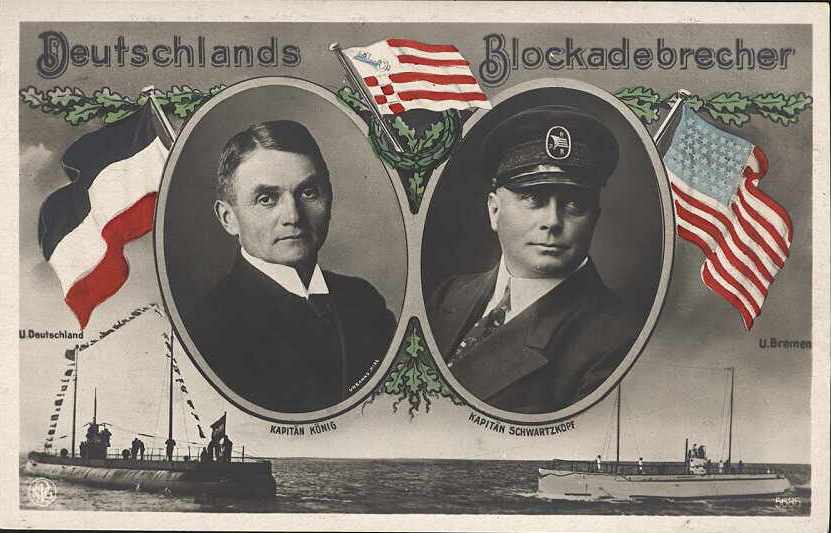
German Merchant Submarines Deutschland & Bremen
Photo: Kevin Heath

During World War I, the Royal Navy blockaded Germany’s North Sea ports and cut off all imports into the country. Desperate for imports of rubber, tin, nickel and other resources unavailable within their borders, the German merchant marine took a page from Jules Verne’s 20,000 Leagues Under the Sea and developed blockade running merchant submarines. The subs were built for the North German Lloyd Line and were designed to maximize cargo carrying capacity – unusual for vessels normally viewed as tools of war and not of trade.

The first sub, Deutschland, made her maiden voyage in June of 1916 and arrived in Baltimore, Maryland a month later carrying dyes, gemstones and pharmaceuticals. Deutschland had successfully threaded the needle of the Royal Navy blockade without even being detected. Returning with a load of valuable nickel, tin and rubber, the Deutschland’s maiden voyage not only paid for itself, but it netted a massive profit for her North German Lloyd Line owners.

The Deutschland made one more voyage to the United States before deteriorating relations between the US and Germany precluded further trade. Deutschland was later converted to u-boat use by the Imperial German Navy, sank 42 vessels and was turned over to the Royal Navy after the Armistice. The Deutschland’s sister ship, Bremen, sailed for the US in September of 1916, however, she never arrived and was presumed lost at sea. One of Bremen’s oil stained life preservers was discovered near Cape Elizabeth, Maine indicating the ship may have made its way as far the American coast. The ship’s disappearance, though, remains a mystery. Various reports indicate she might have been depth charged or mined by Royal Navy vessels, but perhaps Bremen felt drawn to her Jules Verne origins and fell prey, like Captain Nemo and the Nautilus, to the Moskstraumen.

helicopter carrier

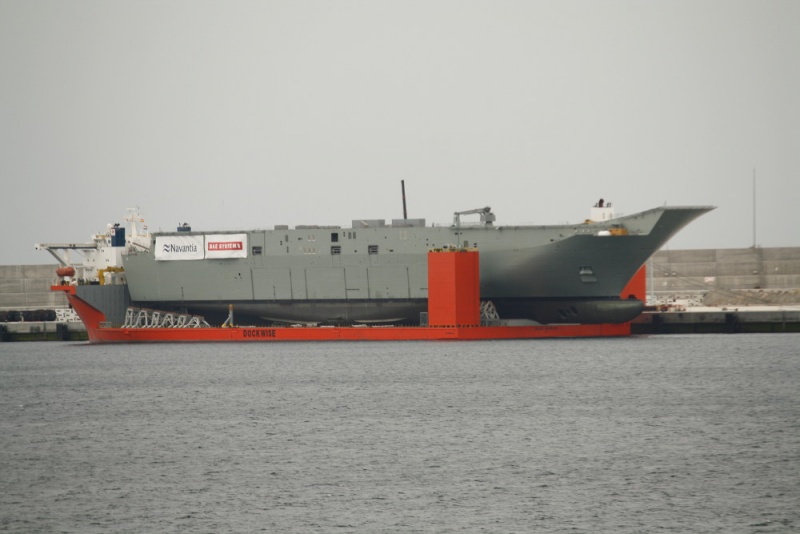
Hull of LHD Canberra aboard heavy lift ship MV Blue Marlin
Photo: Royal Australian Navy

The first of the Royal Australian Navy’s new Landing Helicopter Dock ships is ~1/3 of its way to Australia. Launched in February 2011, the LHD Canberra is the first of two Canberra class Landing Helicopter Dock ships being built for the Royal Australian Navy. The ships are based on the design of Spain’s SPS Juan Carlos I which entered service in the Spanish Navy in 2010. The hull and flight deck were built in a Spanish shipyard and are being transported to Australia via heavy lift ship. The same lift ship was used to transport the USS Cole back to the United States after it was bombed by Islamic fundamentalists on October 12, 2000. Upon arrival in Australia in November, the Canberra’s final fitting out will be performed by BAE Systems. Once commissioned in 2014, the Canberra will be the largest warship to ever serve in the Royal Australian Navy.

Australian helicopter carrier

LHD Canberra Cutaway
Photo: Royal Australian Navy

Depending upon mission needs, the Canberra class LHDs can accomodate up to 1,000 troops and 110 vehicles in its multiple decks. The Canberra’s welldeck can hold and launch 4 landing craft and RHIBs. Air capabilities include 6 medium helicopter launch spaces and room for 26 medium-helicopters (up to CH-47 Chinook size) in its hanger and light vehicle deck. The ship is approximately the same size as the United States’ Wasp class amphibious assault ships and as such could most likely operate V-22 Ospreys as well as the F-35B if/when it becomes available. Additionally, the ship was designed with the lightest draft possible so as to be able to operate in the littorals and secondary ports. The addition of the Canberra and her sister ship Adelaide in 2015 will give the Royal Australian Navy further power projection capabilities and help maintain the balance of power in a region increasingly under the influence of Chinese autocracy.

Winter War

Photo: Wikimedia Commons

In November of 1939, Soviet forces invaded Finland with the intention of bringing additional territory into the communist fold. Even though the Soviet forces vastly outnumbered the Finns, Finnish troops put up a heroic resistance and the conflict was resolved 4 months later with the loss of ~11% of Finland’s pre-war territory. Thus when Nazi Germany launched its invasion of the Soviet Union on June 22, 1941 the Finns were quick to lend their support to the Nazis in an effort to regain their lost territory.

Flowing from this cooperation was the use of Finnish naval forces to screen against Soviet naval forces while German ground forces advanced through the Baltic states. In one such operation, Operation Nordwind, one of Finland’s two capital ships, the Ilmarinen, struck a mine and sank with 271 casualties. The loss of the Ilmarinen on September 13, 1941 was devastating to the tiny Finnish Navy. For a force consisting of only 3,800 officers and sailors, the loss represented  7% of Finnish naval forces. By comparison, less than .8% of the US Navy perished in the attack on Pearl Harbor.

The Ilmarinen had been built in the 1930s as a coastal defence ship for the purpose of defending the numerous islands and islets of Finland’s Baltic coastline. Video of the ship in 1938 can be seen here (the Ilmarinen is the first ship shown in the video). The ship saw service in the Winter War defending the Finnish coast against the Soviet invaders and later shelled Soviet forces after the beginning of the German invasion.

Even though the Finns initially sided with the Nazis, they fought not for ideology, but for self-preservation. In September 1944, the Finns established a separate peace with the Soviets and engaged the Nazis in open combat in the Lapland region until the Nazis withdrew to Norway in April 1945.

Shi Lang

Former Soviet Carrier Varyag
Photo: Information Dissemination

China’s first aircraft carrier is finally getting an official name.  Blogger Andrew S. Erickson, an expert in Chinese naval affairs, is reporting that an official state media outlet has stated that the ship’s name will be Liaoning, in honor of the province where the ship was recently re-built. The ship’s name has been the source of much speculation with it often being referred to as Shi Lang in Western news reports. While many might scoff at the hubbub surrounding the naming of the carrier, its name will carry some significance regarding Chinese attitudes towards other countries in the region. Shi Lang was a Qing general who subdued Taiwan through a seaborne invasion and the naming of the ship after him would have had sinister overtones for Chinese-Taiwanese relations. Another name choice reportedly debated within government circles was Diaoyu Dao which is an island group controlled by Japan, but disputed by both China and Taiwan. Either of those names would have indicated a bellicose attitude towards Japan and/or Taiwan.

Liaoning was originally launched as the Varyag in 1988 by the Soviet Union and remained unfinished at the time of the collapse of the Soviet Union. China purchased the Varyag from the Ukraine in 1998 and the ship sat derelict for several years until the decision was made to rebuild the carrier to fulfill its original role. Re-building of the ship was completed earlier last year and she has undergone multiple sea trials since. Naval experts have differed as to whether China intends to use the carrier for belligerent purposes or merely as a training vessel. It takes years to hone the skills necessary to effectively conduct the air-sea ballet that is carrier operations and it is most likely that the Liaoning will serve merely to train the crew and officers of the follow-on carriers China intends to build. The Chinese have even built a mock-up of the ship on dry land to get a head-start on training its newest generation of naval aviators.

Oliver Hazard Perry

CC Image courtesy of Archives de la Ville de Montreal on Flickr

Today marks the 199th anniversary of the Battle of Lake Erie fought between American and British forces for control of the Great Lakes region on September 10, 1813. After British forces captured Detroit, MI, American military planners decided to build a small fleet near Presque Isle to wrest back control of Lake Erie and allow the recapture of Detroit. A force of 9 ships were quickly hewn from local forests and Master Commandant Oliver Hazard Perry sent to take command of the force.

On the morning of September 10, 1813, 6 ships under the command of Royal Navy Commander Robert Heriot Barclay moved to sweep the American force from the lake. While outnumbered 6 to 9, the Royal Navy squadron possessed more cannons (63) than the Americans (54) and the British cannons had a longer range than the Americans which had primarily equipped their ship with close-range carronades.

In a tribute to Captain James Lawrence who had lost his life aboard the USS Chesapeake earlier that year, Perry’s battle flag stated “Don’t Give Up the Ship.” At the outset of the battle, Barclay’s squadron had the advantage over the American vessels as possession of the weather gauge allowed his ships to outmaneuver the Americans and use their longer range fire power to pound the Americans. The British used their advantage to batter Perry’s flagship USS Lawrence into a hulking wreck, but undeterred, Perry transferred his flag from the Lawrence to the USS Niagara where he continued the action. Perry’s fleet had not let the British escape unscathed, though, as Commander Barclay and several of his officers had been wounded, putting command of the ships in the hands of less experienced officers. The British attempted to wear-to in order to bring their opposite broadsides to bear on Perry’s bruised fleet, but miscommunication and poor seamanship caused two of the British vessels to collide. Perry then split the British column, a maneuver even more deadly than “crossing the T,” allowing his ships to pour fire from both broadsides into the British squadron. This effective maneuver by Perry and his squadron devastated the British ships and one by one the squadron surrendered, giving Perry and his squadron the greatest American naval victory of the War of 1812.

Perry’s victory at the Battle of Lake Erie opened the door for an American invasion of Canada and the recapture of Detroit. It also was the first time an entire British squadron had surrendered in battle. Oliver Hazard Perry became an overnight American hero and his notification of victory, “We have met the enemy and they are ours,” has been forever written in American naval history. More than half a dozen ships, including a class of modern-day frigates, have been named in his honor and the latest ship to bear his name is currently under construction in Perry’s home state of Rhode Island.