Archives For November 30, 1999

CSS Florida

November 28, 2012 — 1 Comment
Confederate merchant raider

CSS Florida
19th Century Phototype Print by F. Gutekunst

During the American Civil War, an integral piece of Confederate naval strategy was the deployment of numerous unconventional merchant raiders to devastate Yankee shipping. Utilizing seaborne tactics closely akin to those employed by guerrillas such as Colonel John Singleton Mosby, Confederate raiders played a deadly game of hide and seek with Union warships and merchantmen. One of the more successful raiders was the CSS Florida, a twin-stacked ship built in the United Kingdom and commissioned into the Confederate Navy in August 1862.

Captained by Lieutenant John Newland Maffitt, the Florida preyed on Yankee shipping throughout the North and South Atlantic. Under Maffitt, the Florida and her crew captured or sank 22 ships until she sought safe harbor in Brest, France for a re-fit during the winter of 1863. In addition to the 22 ships Maffitt directly captured, he was also indirectly responsible for another 23 captures performed by CSS Tacony and CSS Clarence – both prizes Maffitt had equipped as raiders.

In February 1864, the ship sailed again, this under the command of First Lieutenant John M. Morris. Morris and his crew captured another 11 ships before anchoring in Bahia, Brazil. While in Bahia on October 7, 1864, Florida was boarded and towed out to sea by the USS Wachusetts. The captain of the Wachusetts, Commander Napoleon Collins, had acted in clear violation of Brazilian neutrality by capturing the ship in Brazilian territorial waters. Even though convicted by courts-martial, Collins was cleared by  Secretary of the Navy Gideon Welles and became a hero in the North. Less than 8 weeks after capture, on November 28, the Florida sank under mysterious circumstances after a collision with a troop transport in Hampton Roads, Virginia. Had the ship not mysteriously sunk, international law would have required for her to be handed back over to Brazil and eventually back to her Confederate crew.

BB-55

USS North Carolina
CC Image Courtesy of Jay Turner on Flickr

Although today the USS North Carolina floats peacefully in Wilmington, NC, the ship was once at the tip of the US Navy’s spear in the Pacific during World War II. The North Carolina had originally been planned for construction in the 1920’s and her keel was even laid down, however, the approval of the Washington Naval Treaty caused the ship to be scrapped to honor the United States’ treaty commitments. Not until the gradual re-armament of the 1930s was the ship brought back off the drawing board. The ship was finally commissioned on April 9, 1941 and bristled from end to end with nine 16-inch guns, twenty 5-inch dual purpose guns and dozens of 20mm and 40mm anti-aircraft guns.

The North Carolina first tasted blood in the Guadalcanal campaign of August 1942 and participated in every major naval offensive of the war. Nicknamed the Showboat, the North Carolina earned 15 battle stars during World War II, survived being torpedoed, sank a Japanese troopship, participated in 9 shore bombardments and downed 24 enemy aircraft. Additionally, the pilots of her Kingfisher aircraft assisted in the rescue of numerous Allied pilots and aircrew and on one occasion Lt. John Burns used his Kingfisher to rescue 10 airmen.

Following the war, the North Carolina was placed in the Inactive Reserve Fleet and, after a fundraising effort by North Carolina schoolchildren, was dedicated as a museum ship in 1962. As the most decorated battleship of World War II, the USS North Carolina now serves as a memorial to North Carolina’s World War II service men and women. The ship is open for tours and even hosts an annual 5-K and 1/2 Marathon.

Arkansas Inland Maritime Museum

USS Razorback
CC Image Courtesy of thomas23 on Flickr

Much like in Muskogee, Oklahoma, one would not expect to find a submarine museum ship in Little Rock, Arkansas. Beginning in 1963, though, the US Army Corps of Engineers embarked on a project that opened the Arkansas River in 1971 to commercial traffic from Tulsa, Oklahoma to its confluence with the Mississippi. Thus arose the opportunity for museum ships such as the USS Batfish in Muskogee and the USS Razorback in Little Rock to be created.

The Razorback has the unique distinction of being one of the longest serving submarines in the world. The boat served from 1944 to 1970 with the US Navy and from 1971 to 2001 with the Turkish Navy. Commissioned in April 1944, the Razorback was not named after the University of Arkansas’ mascot, but rather a species of whale. During her 5 war patrols, the sub sank over half a dozen Japanese merchant and warships, rescued multiple Allied airmen, participated in the surrender ceremony in Tokyo Bay and earned 5 battle stars.

Following the war, the Razorback continued her service and received upgrades from 1952 to 1954 based on knowledge derived from captured Nazi U-boats. The boat patrolled the waters of the South China Sea during the Vietnam War and earned an additional 4 battle stars before being decommissioned in 1970. Following decommissioning, the Razorback was transferred to the Turkish Navy where she was renamed TCG Muratreis.

In 2001, the boat was sold to the city of North Little Rock and opened as a museum ship at the Arkansas Inland Maritime Museum. If visiting, also be sure to take a stroll across the Big Dam Bridge, the longest pedestrian bridge in the US never having been open to vehicle traffic. Today the USS Razorback stands as a silent sentinel guarding Little Rock and the Arkansas River.

ironclad sinking

Lt. Cushing Sinks the CSS Albemarle

Before there were the Navy’s UDT, SEAL or SWCC units, there was Lieutenant William B. Cushing. Only a few days before his 22nd birthday, Cushing led 15 men in a daring raid behind Confederate lines against the ironclad CSS Albemarle. The Albemarle had been built by the Confederate Navy in a cornfield astride the Roanoke River in eastern North Carolina. Shortly after her launch in April 1864, the Albemarle sortied down the Roanoke River in a combined operation with General Robert F. Hoke’s infantry brigade. Hoke’s brigade retook the town of Plymouth, North Carolina while Albemarle sank the USS Southfield and drove the remaining US Navy forces downriver.

The re-capture of Plymouth and the presence of Albemarle on the Roanoke River threatened Union dominance of the North Carolina coast. A successful sally by the ironclad could break the blockade then strangling the economic lifeblood of the dying Confederacy. Desperate to destroy the threat of the Albemarle, Union commanders entertained a unique proposal by young Lt. Cushing. Cushing proposed piloting a small picket boat up the Roanoke River and destroying the Albemarle with a spar torpedo. Spar torpedoes, the forerunners of modern self-propelled torpedoes, were a new innovation consisting of crude explosive devices mounted to a long wooden pole that were detonated either manually or on impact.

On the night of October 27, 1864, Cushing and his men silently steamed up the Roanoke River. Protecting the Albemarle was a barrier of chained logs and several sentries. Cushing maneuvered his boat to strike the Albemarle and opened the throttle to full speed. As the launch struck the log boom and rode up over it, Cushing detonated the spar torpedo and blew a massive hole in the Albemarle’s hull. Two of Cushing’s men perished in the attack, 11 were captured and Cushing and another escaped. The Albemarle settled on the river bottom and, unable to raise her, the Confederates quickly lost control of the Roanoke River and were forced to cede back to the Yankees. The Albemarle was raised by the Union and later sold for scrap in 1867.

Cushing continued his exploits with the capture of 3 blockade runners after the fall of Fort Fisher in January of 1865. The blockade runners, unaware Fort Fisher had fallen, were lured into Cushing’s trap when he continued to operate the fort’s signal lights as if it were still in Confederate hands.

japanese submarine

Japanese Midget Submarine HA-19
CC Image Courtesy of Brian Bennett on Flickr

Located in Fredericksburg, Texas, the National Museum of the Pacific War honors the sacrifices made by American and Allied Coast Guardsmen, Marines, sailors and soldiers during World War II. Surrounded by picturesque ranches, Fredericksburg is in the heart of Hill Country and the hometown of Admiral Chester W. Nimitz, the Commander in Chief of the Pacific Theater during World War II. Among the Museum’s artifacts is the HA-19, a Japanese midget submarine that ran aground during the attack on Pearl Harbor on December 7, 1941.

HA-19 was only one of several midget submarines deployed by the Japanese to torpedo American ships at anchor in Pearl Harbor during the air raid. The submarine was discovered and depth charged by the USS Helm and subsequently wrecked on a reef near Waimānalo. Recent photographic analysis has led some to suspect that one of HA-19’s sister ships successfully launched her torpedoes at the USS Oklahoma or USS West Virginia on Battleship Row. US forces later recovered HA-19 and paraded it around the US during war bond drives.

Unlike modern SEAL Delivery Vehicles, the Royal Navy’s X type submarinesor the Kriegsmarine’s Seehund subs, the Japanese Navy’s midget submarine program was largely unsuccessful and is today a minor footnote in the greater story of World War II. For more information on planning a visit to the National Museum of the Pacific War, go to their website here.

America's Cup

America Replica
CC Image Courtesy of Greg Bishop on Flickr

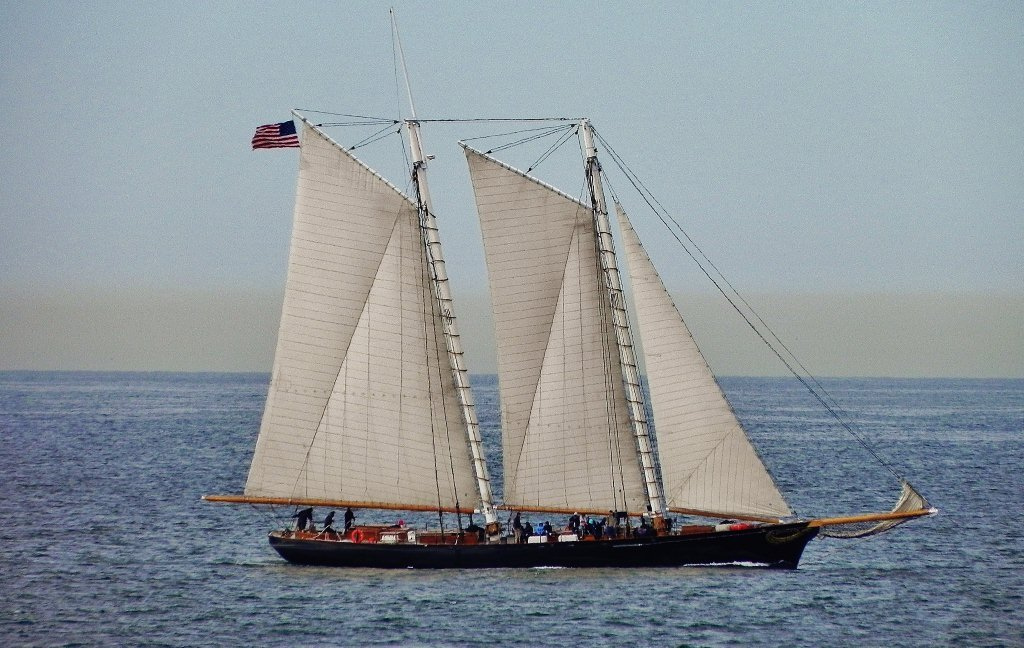
The America’s Cup yacht race has a storied history including a connection to the American Civil War. The race traces its origins to 1851 when the newly built American yacht America bested Britain’s finest yachts in the Royal Yacht Squadron’s annual 100 Guinea Cup.  Bringing the trophy back to the New York Yacht Club, America became the namesake for the America’s Cup – a race that is older than even the modern-era Olympics. Today the race is held in various port cities around the world.

Following the 100 Guinea Cup, the America was sold between various parties and eventually found itself in the hands of the Confederate Navy. Instead of using the ship as a blockade runner or merchant raider, the Confederates scuttled the ship as a block ship to prevent the Union Navy’s capture of Jacksonville, Florida. Despite their efforts, the Union captured Jacksonville and raised and repaired the yacht. Intending to utilize the yacht’s immense speed, the Union armed the ship as a blockader and assigned her to patrol the approaches to Charleston harbor. The yacht was successful on October 12, 1862 when it captured the blockade runner David Crockett.

In March 1863, America caught the CSS Georgiana attempting to run the blockade and helped direct other vessels into a chase that ended with the grounding and destruction of the Georgiana. Historians continue to dispute whether the Georgiana was intended to be fitted out as a merchant raider or was merely another blockade runner. Georgiana’s remains were re-discovered in 1965 and limited excavations have been carried out on the site. America completed her wartime service, slid into obscurity and was eventually scrapped in 1945. Today a replica of the yacht offers guests sailing trips throughout the San Diego bay area and is berthed at the San Diego Maritime Museum.

st. louis low water ship

Wreck of USS Inaugural
Photo: Dillon Fulcher

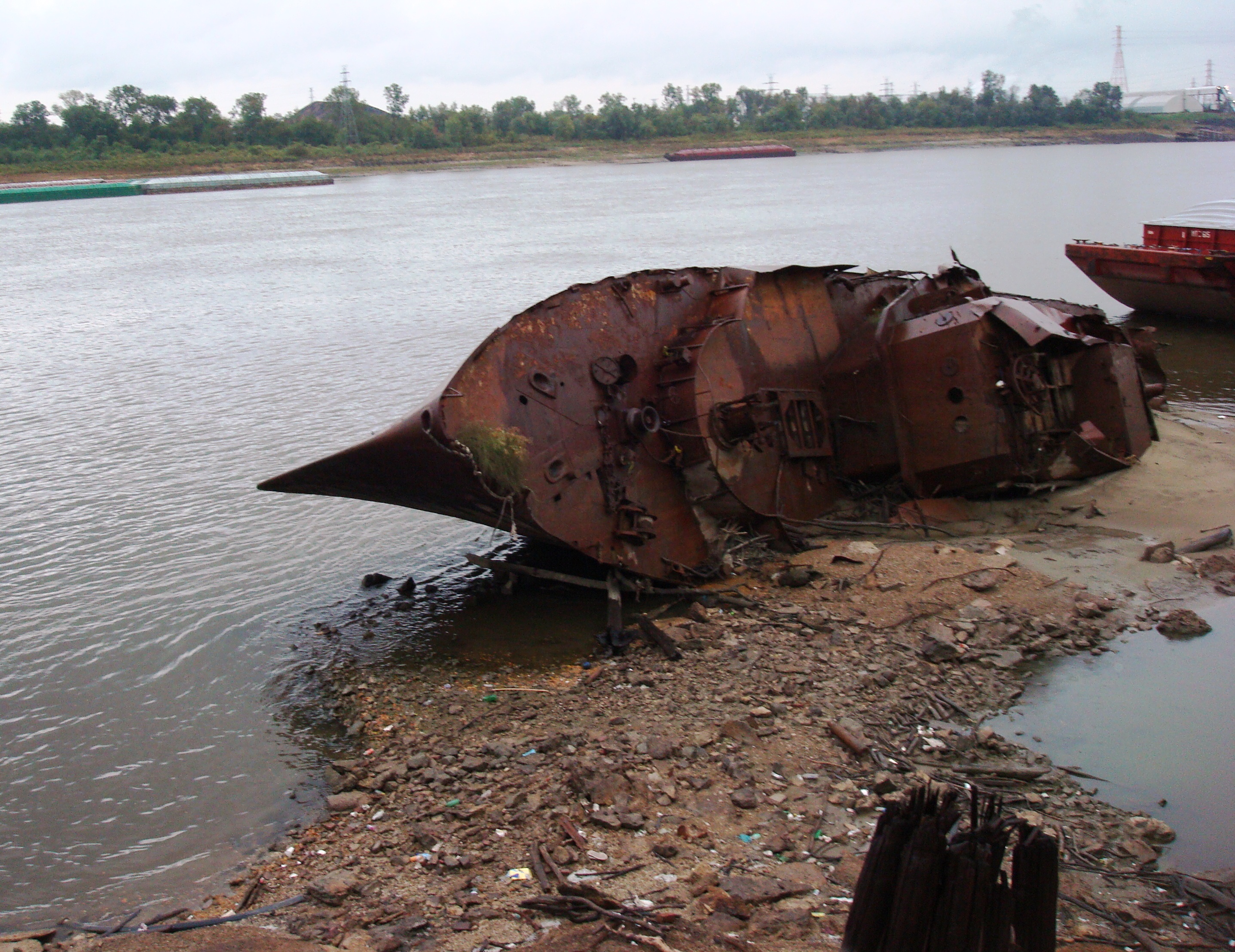
Low water levels on the Mississippi have revealed the wreck of the USS Inaugural, a World War II minesweeper which sank in the Great Flood of 1993. The Inaugural began life in Washington state where it was built for the US Navy during World War II. A member of the Admirable class of minesweepers, the ship was commissioned in December of 1944 and earned two battle stars for its service in the Pacific Theater. Inaugural and her crew fought in the Okinawa campaign and swept more than 80 Japanese mines from the Pacific.

Following World War 2, the ship was mothballed in Texas as a member of the Atlantic Reserve Fleet until an enterprising St. Louisan named Robert O’Brien discovered the ship in a military surplus catalog. O’Brien purchased the ship and moved it to St. Louis where he charged $1 per person to tour the Inaugural. The Inaugural changed hands several times throughout the intervening years until she was ripped from her moorings during the Great Flood of 1993. Efforts by the US Coast Guard and other vessels allowed the ship to be safely beached just south of downtown St. Louis, however, the ship sank a few days later in what some believe to be mysterious circumstances – possibly flowing out of the owner’s desire to collect insurance on the vessel and pay off looming creditors.

The ship now breaks the surface every time the river level is below average and under current conditions is almost completely above water. The Inaugural is not the only recent maritime oddity on the St. Louis riverfront as a cement barge sank while at anchor just last year and a fire claimed the steamboat Robert E. Lee in 2010.

Go here for more pictures of the wreck.

Coast Guard Cutter Ingham

CC Photo Courtesy of Kay Gaensler on Flickr

During a career spanning more than 50 years, the USCGC Ingham kept the shores of the United States safe for mariners in both war and peace. Commissioned in 1936, the cutter protected the Bering Sea and the fisheries of the Grand Banks until ordered to participate in neutrality patrols upon the outbreak of World War 2. After America’s entry to the war, Ingham helped convoy hundreds of Allied ships across the Atlantic. On December 15, 1942, during routine convoy operations, the Ingham detected and sank the German U-boat U-626. In late July 1944, the Ingham underwent alterations in the Charleston Navy Yard to prepare it to serve as a combined operations and headquarters and ship in the Pacific Theater. Ingham served briefly as a headquarters ship for General Douglas MacArthur prior to his landing in the Philippines.

Following World War 2, the ship returned to peacetime service and her missions included maritime rescue and oceanographic surveying. Ingham was called upon once again to serve in wartime during the Vietnam War. During the war she and her crew became the only Coast Guard cutter to earn 2 Presidential Unit Citations for her naval gunfire support and replenishment missions. Ingham responded to yet another crisis when Cuban dictator Fidel Castro allowed thousands of dissidents to flee his autocratic regime in what became known as the Mariel Boatlift. The Ingham rescued several boaters and towed half a dozen vessels to freedom in the United States. At the time of her decommissioning, the ship was the oldest and most decorated Coast Guard cutter in service. The ship now resides in Key West, Florida as a memorial to the 581 Coast Guardsmen killed in action during World War 2 and the Vietnam War. The ship is open for tours Monday thru Saturdays and more information can be found on their website.

british destroyer

HMS Edinburgh Firing Sea Dart Missiles
© UK MOD/Crown Copyright 2012

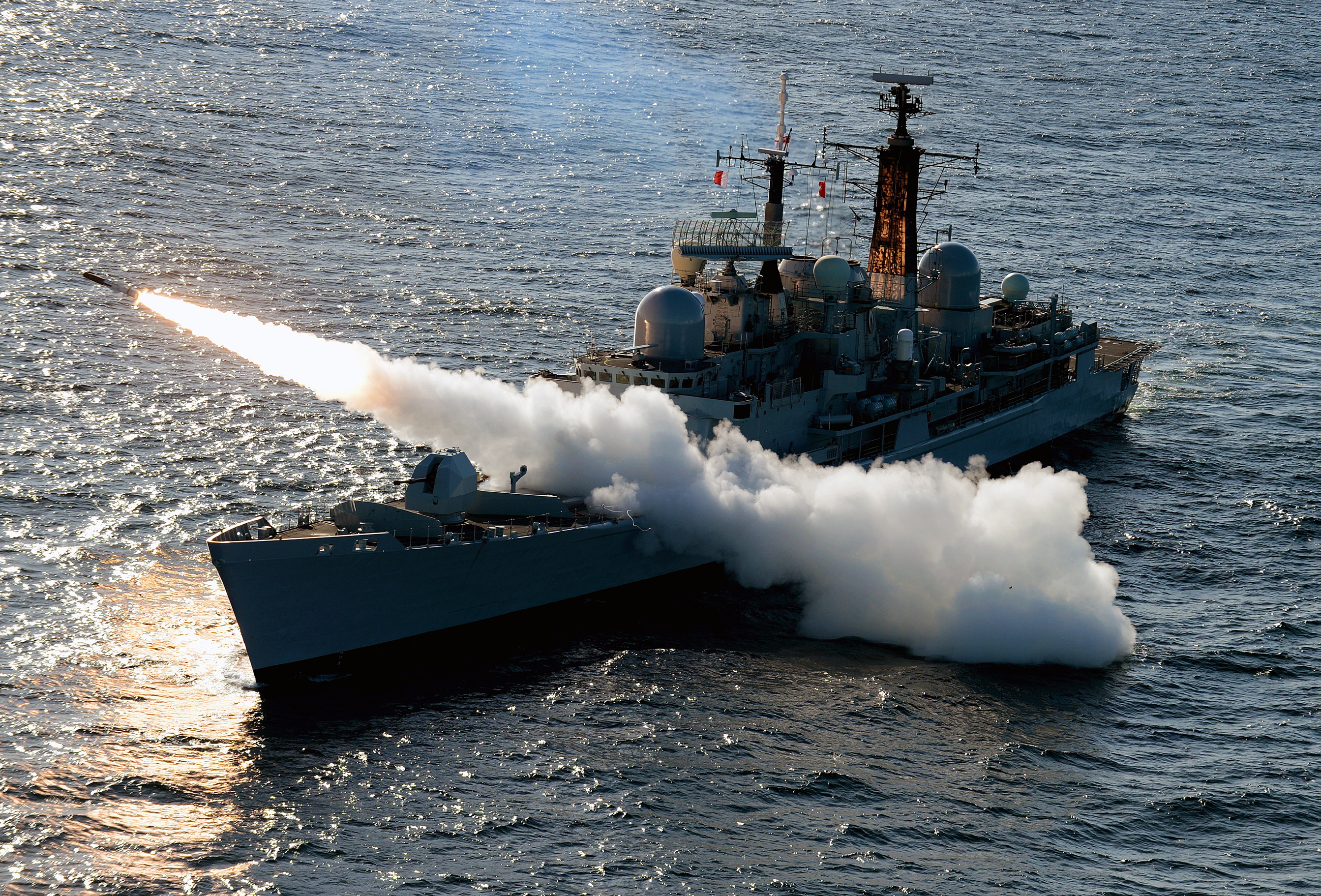
Today the Royal Navy retired the HMS York, its second to last Type 42 destroyer. Its last Type 42, HMS Edinburgh, sailed on its final deployment earlier this week and will be retired upon its return. The Type 42 destroyer class has served the Royal Navy since the 1970s and two were lost in the Falklands War. York and Edinburgh will soon be replaced by new Type 45 destroyers which are among the most powerful and sophisticated anti-aircraft vessels in the world.

During her long career, York sailed 750,000 miles in defense of British interests and saw service in Iraq (2003), Lebanon (2006) and most recently Libya (2011). Her sister ship Edinburgh also served in the 2003 Iraq conflict and has deployed on numerous anti-terrorism and narcotics interdiction missions around the globe. Both ships are currently for sale on the UK MoD’s disposal site and their sale will be used as a diplomatic tool to further relations with another nation(s). Another notable warship sale occurred earlier this year when the US Navy sold for scrap the Sea Shadow, a copy of which appeared in the James Bond film Tomorrow Never Dies.

The last vessel to bear the Edinburgh name was a Town-class cruiser lost in World War 2 in the Arctic Sea. The ship fell prey to Nazi sea and air forces while escorting a convoy from Murmansk, Russia to Great Britain. Aboard the vessel was 465 bars of gold bullion weighing 4.5 tons. Several salvage efforts were launched but it wasn’t until September 1981 that the first bar of gold was recovered. Over the course of two dive seasons, 460 of the 465 bars were successfully recovered. The recovery operations were performed under a contract similar to that between the UK government and Odyssey Marine for the Gairsoppa and Mantola recoveries in 2012.

research vessel

Photo: Woods Hole Oceanographic Institute

The US Navy has announced that their newest Auxiliary General Oceanographic Research (AGOR) class of vessels will be named after naval aviator and astronaut Neil Armstrong who passed away last month. The class will be composed of two vessels and construction on the lead ship, R/V Neil Armstrong, began in August. Neil Armstrong is set to enter service in summer 2015.

The Neil Armstrong class of vessels will displace 3,200 tons, stretch 238 feet in length and have a cruising range of 11,500 nautical miles at 12 knots. Neil Armstrong’s 1,800 square feet of dry, wet and computer labs will give its 24 embarked scientists plenty of space to conduct research and exploration operations throughout the globe. In addition to its lab and staging spaces, the Neil Armstrong will be able to launch and recover various ROVs and mini-submersibles with its stern and main cranes. Among the innovations included in the ship’s design is a hull optimized to divert bubbles from the sonar area for enhanced sonar performance.

The ships are funded by the Office of Naval Research, but will be operated by non-profit oceanographic institutes. The yet unnamed second vessel of the class (AGOR 28) will be operated by the Scripps Institution of Oceanography in San Diego, California. Neil Armstrong will be based at the Woods Hole Institute of Robert Ballard fame and conduct most of her operations in the Atlantic.