Archives For November 30, 1999

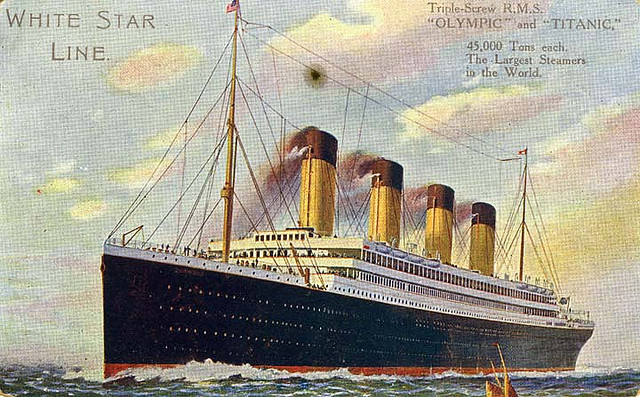
Titanic & Olympic

Much like the Apostle Paul, Violet Jessop survived a trio of maritime disasters, including the sinking of RMS Titanic. Jessop began work as a stewardess for White Star Line in early 1911. White Star is best remembered in history as the owner and operator of the Titanic, but in the late 19th and early 20th century the company ferried thousands of immigrants from Europe to the United States. Jessop first assignment was aboard Titanic’s sister ship RMS Olympic. While cruising off the Firth of Forth on September 20, 1911, the Olympic and the Royal Navy armored cruiser HMS Hawke collided resulting in significant damage to both ships. Neither Jessop nor any of the other passengers and crew aboard either ship were injured even though two of Olympic’s watertight compartments were flooded and the Hawke nearly capsized.

Jessop’s next brush with death occurred merely 7 months later on April 14, 1912 when Titanic sank after its infamous collision with an iceberg. For four years Jessop enjoyed smooth sailing aboard her employer’s ships until November 1916. RMS Brittanic, which had been converted to a hospital ship, struck a mine on November 12, 1916 and once again Jessop found herself scrambling for the lifeboats. Despite her three near-death experiences, Jessop continued to work aboard passenger liners and retired to England where she passed away in 1971.

One of the most unusual clashes in naval history occurred on September 14, 1914 when two former passenger liners fought one another off the coast of Brazil’s Trinidada Island. At the outbreak of World War 1, both the British and German navies put into effect plans calling for the arming of certain ships as auxiliary cruisers to act as wartime supplements to their naval forces. Two such ships were the SS Cap Trafalgar and RMS Carmania.

The SS Cap Trafalgar had been built in 1913 and operated between Hamburg, Germany and South American ports. Following the declaration of war, her civilian crew was replaced by officers and seaman of the German Imperial Navy and she was armed with 2 4.1in. guns. Thus she became SMS Cap Trafalgar and was charged with hunting down and sinking Allied shipping in the South Atlantic. SMS Cap Trafalgar’s opponent, RMS Carmania, was a British mail liner built in 1905 for the Cunard line’s Liverpool to New York route. Similar to SMS Cap TrafalgarRMS Carmania was commandeered by the British Admiralty and became HMS Carmania on August 8, 1914 when she was armed with 8 4.7 in. guns. Unlike Germany’s auxiliary cruisers, Britain utilized its cruisers to protect merchantmen or assist in the hunt for Germany’s merchant raiders.

The two ships were destined to come across one another after each were given orders to proceed to Trindade Island – the Germans were to rendezvous with colliers and the British suspected the island was being used by the Germans as a supply point. Caught with two colliers in broad daylight, the Cap Trafalgar at first fled from the pursuit of the Carmania, however, the Germans reversed course and turned to engage the Carmania. After a brisk 70 minute battle, with both ships ablaze and holed below the waterline the Cap Trafalgar capsized and sank with the loss of 51 officers and crew. While the Cap Trafalgar had been sunk, it had inflicted serious damage on the Carmania and she required extensive repairs at Gibraltar’s dry dock. The Carmania finished out the war in British service and was eventually scrapped in 1932. Even though it involved two of the largest, fastest and most expensive ships in the world, the engagement was of little strategic consequence and is now merely a strange footnote in naval history.

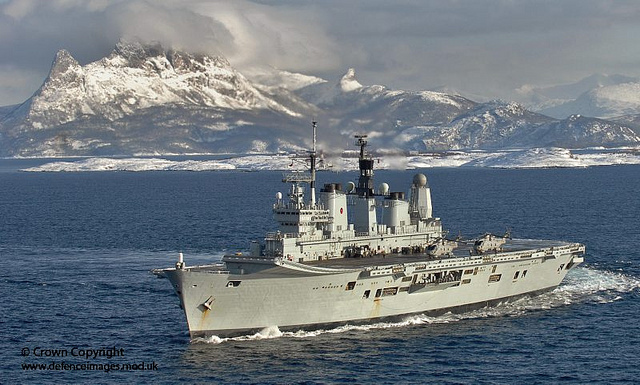
British aircraft carrier

HMS Ark Royal off Norway in 2008
Photo: MOD

The Telegraph is reporting that the HMS Ark Royal, the Royal Navy’s only remaining aircraft carrier, is finally being sold for scrap. The ship was originally to remain in service until 2016 or 2017 when it would have been replaced by HMS Queen Elizabeth, the first of the Queen Elizabeth class aircraft carriers. Budgetary issues, though, caused the Ministry of Defence to rethink their time table and remove the ship from service early. The Ark Royal was decommissioned in March of 2011 and an internal debate within the UK government about its final disposal has caused delays in the decision. Among the various scenarios considered for the Ark Royal’s ultimate fate were it being sunk as a wreck site for divers, converted to use as a London heliport, converted into a Hong Kong casino, refitted for hotel use (much like the former Soviet carrier Kiev) or sold for scrap. Ultimately the Ministry of Defence chose to scrap the vessel for £3 million.

The Ark Royal was laid down in 1978 and commissioned in 1985. She was the third and final ship of the Invincible class carriers and was designed to operate short take-off and vertical landing (STOVL) aircraft and helicopters from her flight deck. Her sister ship HMS Invincible saw service in the Falklands War and was sold for scrap earlier last year. Her other sister ship HMS Illustrious served in the Balkans conflict of the 1990s and has since joined HMS Ocean as a helicopter carrier. Ark Royal was the fifth Royal Navy ship to carry the name with previous ships having fought against the Spanish Armada, the German High Seas Fleet, the Nazi Kriegsmarine (lost to a u-boat in 1941) and in post-World War 2 service. The current Ark Royal provided air cover for operations in the Balkans in 1993 – 1994 and in the invasion of Iraq in 2003.

Following the retirement of the the Ark Royal in March 2011, the UK Ministry of Defence sold its remaining Harrier STOVL jets to the US Marine Corps to be used for spare parts. This decision has left the Royal Navy with only 1 fixed wing aircraft until the entry of the F-35 into service. While the Ministry of Defence is much better prepared to resist an invasion of the Falklands than it was in the 1980s, the loss of its seaborne fixed-wing aircraft capability until 2016 has left the UK increasingly reliant on allies (such as the French in their agreement to jointly operate the Charles de Gaulle) in the shaping of its foreign policy. Gone are the days when an enlightened British citizenry could call for the outlawing of the slave trade and the Royal Navy unilaterally enforce the prohibition. This further erosion of British autonomy has most assuredly set Lord Nelson and Winston Churchill to spinning in their graves.

HMS Hood

CC Image courtesy of Patrick McDonald on Flickr

An expedition led by Microsoft co-founder Paul Allen aboard his mega-yacht Octopus has been forced to abandon their efforts to recover the ship’s bell of the Royal Navy battlecruiser HMS Hood. Allen and his team have been operating out of Reykjavik, Iceland for the last two weeks, but a combination of weather and mechanical issues with their ROV have caused the team to end its efforts on the Hood this recovery season. Named for Admiral Samuel Hood, the Hood was the second ship to bear his name. The ship entered service in 1920 and is best known for its role in the hunt for the German battleship Bismarck.

HMS Hood and the battleship HMS Prince of Wales intercepted the Bismarck on May 24, 1941 as the Bismarck and heavy cruiser Prinz Eugen attempted to break out into the North Atlantic in hunt of British merchantmen. In a running battle lasting less than 20 minutes, the Bismarck sank the Hood and damaged the Prince of Wales. The Hood took with it 1,415 of her 1,418 man crew. The engagement became known as the Battle of the Denmark Straits and was merely the opening act of a massive 3 day manhunt culminating in the sinking of the Bismarck on May 27th. The Prince of Wales went on to serve in the Pacific Theater where it, along with the battleship HMS Repulse, was sunk by a Japanese air attack. Prinz Eugen survived the war and was later used as a target ship by the US Navy for atomic bomb tests.

Merchant Navy Flag

UK Merchant Navy Ensign
CC Image courtesy of L2F1 on Flickr

Today the United Kingdom, along with Australia, Canada and New Zealand, remembers the sacrifices of their merchant marine from World War One to the present day. The Merchant Navy has served in WWI, WWI, Korea, the Suez Crisis, the Falklands War, and Gulf Wars I & II. More than 14,500 seamen lost their lives in World War I and another 30,000 perished during World War II. September 3rd was chosen as the date to honor the Merchant Navy because September 3, 1939 marked the first loss of British shipping in World War 2 – the SS Athenia. Two shipwrecks, SS Storaa and M/V Atlantic Conveyor, have subsequently been designated protected places under the UK Protection of Military Remains Act. Storaa was lost in World War One to a German u-boat while Atlantic Conveyor is the most recent Merchant Navy loss, having been sunk while supporting British efforts to free the Falkland Islands from their Argentinian invaders.

Richard Montgomery

The remains of SS Richard Montgomery
CC Image courtesy of tomylees on Flickr

Today marks the 68th anniversary of the abandonment and beginnings of salvage on the SS Richard Montgomery. The ship ran aground near an approach channel to the Thames River on August 20, 1944 and salvage operations began on August 23rd after it was determined the ship could not be saved. Named after Revolutionary War General Richard Montgomery, the SS Richard Montgomery was a Liberty Ship carrying a cargo of ammunition from the United States to the UK. Liberty Ships were designed by William Francis Gibbs to be cheap, mass-produced cargo haulers for the Allied powers during World War Two. Over 2,500 were built and only two survive today, carrying on service as museum ships – SS Jeremiah O’Brien and SS John W. Brown.

Salvage operations were unable to remove all of its deadly cargo and according to a survey performed in 2010 by the UK Maritime and Coastguard Agency, the wreck has 1,500 tons of high explosives still aboard. Due to the presence of so many tons of TNT, the ship remains a serious hazard to navigation and is closely monitored with yearly surveys by UK authorities. A detonation of the ship’s cargo could occur from natural deterioration, a collision with another vessel or even an act of terrorism and would result in an explosion 1/12th the size of the atomic bombs dropped on Hiroshima and Nagasaki. The BBC reported in 2004 that UK authorities believe an explosion could cause a 1,000 x 10,000 foot column of debris and water as well as a 16 foot high wave that would swamp low lying coastal areas.

In death, the SS Richard Montgomery has taken on a pop culture life of its own and has been featured in numerous novels and tv shows. It was even the centerpiece of the fictionalized plot of a 1970s novel wherein terrorists attempted to use speedboats to detonate the ship’s explosives and wreak havoc on the English coast.

Shackleton’s Whiskey

August 22, 2012 — 1 Comment
Shackleton's Whisky

CC Image courtesy of sandwichgirl on Flickr

Two years ago, three bottles of whisky were recovered from the base camp Sir Ernest Shackleton used during his British Antarctic Expedition (1907 – 1909). Shackleton and his team approached to within ~100 miles of the South Pole and turned back after Shackelton decided it would be too risky to continue. Two years later Captain Robert Scott’s Terra Nova expedition would return to successfully reach the South Pole (although they were beaten by a month by Norwegian Roald Amundsen), but perished on the return journey. Shackleton had been on Captain Scott’s Discovery Expedition in 1904 and later returned to the South Pole as commander of the Imperial Trans-Antarctic Expedition (1914 – 1917). The Imperial Trans-Antarctic Expedition is most famous for the loss of the ship Endurance and the subsequent account of the travails of the crew.

Fast-forward to 2010 and the recovery of the three bottles of whisky by the Antarctic History Trust. Although the whisky was not frozen due to its alcohol content, the bottles were slowly thawed in a New Zealand conservation lab. In 2011, they were then turned over to Whyte & Mackay, the distillery that succeeded the originally producer of the whisky. Using a painstaking process chronicled here and here, scientists at Whyte & Mackay discerned the whisky’s recipe and the distillery has released a limited run of 50,000 bottles of the whisky for sale.

Last week, researchers announced the discovery of the famous polar exploration vessel SS Terra Nova in waters off the southern coast of Greenland. SS Terra Nova was discovered during routine tests of mapping equipment aboard the Schmidt Ocean Institute’s R/V Falcor. The ship is lying in less than 160M of water, but its exact location has not been disclosed by Schmidt Ocean Institute.

Lost in 1943 after a collision with an ice pack, the SS Terra Nova was built in 1884 to withstand the rigors of operating as a whaler and sealer in polar regions. Following a ten year commercial career, the ship served the Jackson-Harmsworth Arctic Expedition from 1894 – 1897. Terra Nova is most famous, though, for its role in Captain Robert Scott’s doomed Terra Nova Expedition (1910 – 1912).  Captain Scott and his team of British explorers sought to become the first humans to reach the South Pole; however they were beaten by a Norwegian team led by Roald Amundsen. Amundsen’s party reached the South Pole on December 14, 1911, beating Scott by approximately 30 days. Scott’s team perished on their return trek and their bodies were not discovered until nearly 8 months later. In death, Scott was mythologized throughout his native Britain and has been the subject of numerous books and articles. Historians continue to debate his legacy – historian Roland Huntford’s The Last Place on Earth is a stinging critique of Captain Scott while polar explorer Sir Ranulph Fienne’s Captain Scott defends Scott and the choices he made during the expedition.

As this year’s recovery season winds down, noted exploration company Odyssey Marine is wrapping up two deep water recoveries (the SS Gairsoppa and SS Mantola) and currently on hold with the excavation of HMS Victory.  The 2012 season marked several firsts for Odyssey – the completion of a shipwreck salvage under government contract, the validation of their deepwater recovery methods and the beginnings of legitimacy for their role in “academic” archaeology with their efforts on the HMS Victory. What lies ahead for Odyssey is a question of much debate.  Below are five of the most discussed targets for Odyssey along with pros and cons for each.

1.  Merchant Royal – widely believed to be the target of Odyssey’s “Atlas” search, the Merchant Royal went down in a storm off Great Britain in 1641 with a cargo of gold and silver valued around ~1 billion in current dollars. This is the Holy Grail of shipwrecks and would be an incredible find both for the monetary and publicity windfall. Apart from the difficulty involved in locating the wreck, there are no significant cons to recovering the Merchant Royal.

2.  Prins Frederik – sunk in 1890 after a collision with the Marpessa in the Bay of Biscay, this Dutch mail steamer carried 400,000 silver rijksdaalders in its bullion room. Disputes over the actual location of the ship (and thus who was to blame for the collision) have created a wide search area and significantly affect the depth of water it could be located in – 500 feet if where the captain of the Prins Frederik claimed or 6,000 feet if where the captain of the Marpessa claimed. A British company claimed to have found the wreck in shallow water in 1994 which could generate legal issues for Odyssey if it is indeed the Prins Frederik. Odyssey could also face legal claims from insurers who paid out on claims or the Dutch government as the cargo was for payment of colonial forces in Indonesia. The Prins Frederik would be an excellent target for an arrangement similar to the Gairsoppa and Mantola where the Dutch government receives a portion of the proceeds after expenses.

3.  I-52 – re-discovered in 1995 by Paul Tidwell, the I-52 was sunk by American naval forces in 1944 while en route from Japan to Nazi Germany. The I-52 was carrying 2.2 tons of gold and now sits in 17,000 feet of water. While Odyssey’s deepwater recovery methods would enable recovery of the wreck, apart from a multi-party agreement on salvage rights between Tidwell, the Japanese government and Odyssey no recovery is possible. Tidwell has also stated he is pursuing recovery of the sub and it is doubtful Odyssey would be brought in on the deal.

4.  Port Nicholson – a British freighter loaded with $3 billion in platinum, the Port Nicholson was torpedoed off the coast of Massachusetts in 1942 and was located in 2008 by Sub Sea Research.  Sub Sea Research gained title to the ship in 2009 and planned recovery in 2012. No word has emerged on whether or not the group has been successful in their salvage and there are doubts as to whether the platinum even exists onboard.  If Sub Sea is unable to recover the wreck due to a lack of expertise or funding, then a collaboration with Odyssey would benefit both parties and be the most valuable recovery yet, surpassing even Odyssey’s Black Swan recovery (and subsequent loss).

5.  Bonhomme Richard – John Paul Jones’ famous flagship went down after his epic battle with HMS Serapis. The past few years have seen renewed efforts to find the ship, but any recovery would be limited by the doctrine of sovereign immunity. Because the Bonhomme Richard was an American warship it cannot be salvaged without the permission of the US government. An arrangement with the US government similar to that of the HMS Victory one is a possibility, but doubtful because the upside isn’t nearly as high as it is for other wrecks.

There are dozens of other wrecks Odyssey could be pursuing – the company claims to have dozens of high value shipwreck targets in its proprietary database. Based on Odyssey’s stated business model of pursuing high value targets with easily ascertainable legal ownership and inaccessible to normal salvors, Odyssey will most likely pursue deepwater commodity shipwrecks where the cargo can be quickly monetized and not the storied Spanish Galleons of treasure hunting lore.

Disclosure: I am an Odyssey Marine shareholder.

A little known fact of the Revolutionary War is that Captain James Cook’s bark, HMB Endeavour, was purposely sunk by the Royal Navy in the waters off Providence, RI. British leaders ordered the ship, along with ~13 other transports, scuttled to prevent Continental and French forces from entering the harbor. The Rhode Island Marine Archaeology Project recently launched a $300,000 fundraising effort to finance operations to identify HMB Endeavour from among eight Revolutionary War era shipwrecks it has previously discovered.

HMB Endeavour is most widely associated with Captain James Cook’s 18th century expeditions throughout the Pacific Ocean and exploration of Australia.  A full-size replica was built in 1993 and serves as a floating exhibit of the Australian National Maritime Museum.  Also designed for exploration, NASA’s Space Shuttle Endeavour, was named in honor of Captain Cook and his ship.  Following Captain Cook’s voyages, the Royal Navy sold off the bark and it was renamed Lord Sandwich (incidentally, Captain Cook named what is today Hawaii as the Sandwich Islands in honor of the 4th Earl of Sandwich, the then First Lord of the Admiralty).  Lord Sandwich was contracted in 1776 by the Royal Navy as a transport and was employed as a prison ship prior to being scuttled in 1778.