Archives For November 30, 1999

german battleship

Scharnhorst fires on HMS Glorious
Photo: US Navy

The Nazi battleship Scharnhorst lived a charmed life from the early days of World War II until Christmas 1943. The ship was among the most powerful of the Kriegsmarine’s most powerful surface units and, until the launch of the Bismarck and the Tirpitz, she and her sister ship Gneisenau were the pride of the Kriegsmarine. Often operating as a pair, Scharnhorst and Gneisenau wreaked havoc on the Royal Navy. In the opening days of World War II, the ships sank the armed British merchant cruiser HMS Rawalpindi and later sank the aircraft carrier HMS Glorious (see photo above) during the 1940 invasion of Norway.

The sister ships also broke out into the North Atlantic and sent several Allied merchantmen to the bottom of the sea. After the loss of the Bismarck, the decision was made to withdraw Nazi surface ships from the French coast. In early February 1942, the ships, along with the heavy cruiser Prinz Eugen, made a daring dash up the length of the English Channel. The Scharnhorst was then re-deployed to the northern waters of Norway in order to threaten Allied convoys supplying the Soviet Union.

On Christmas Day 1943, the Scharnhorst along with several destroyer escorts set sail from Norway to intercept an Allied convoy. Unbeknownst to the Kriegsmarine, the Royal Navy had intercepted and decoded the Scharnhorst’s orders and therefore laid a trap for the ship. Three Royal Navy cruisers screened the convoy from Scharnhorst while a squadron led by the battleship Duke of York raced to cut off the Nazi force from safety in Norwegian waters. After a fruitless pursuit of the convoy, the Scharnhorst cut off contact and began to return to base on December 26. In a three hour battle, the Scharnhorst was battered by the Royal Navy squadron and finally sank with only 36 survivors out of a crew of 1,968.

The wreck of the Scharnhorst was discovered in 2000 by the Norwegian Navy and further investigation revealed the extent of the damage inflicted by the Royal Navy. A total of 2,195 shells were fired at the ship along with 55 torpedoes. Eleven of the torpedoes found their mark and the torpedo and shell damage was extensive. The entire bow section of the ship was blown off the ship, most likely the result of an explosion in a forward magazine. Go here for a gallery of images from the Norwegian Navy’s investigation as well as period photos of the Scharnhorst.

HMAS Sydney

CC Image courtesy of Horatio Kookaburra on Flickr

German naval strategy during World War II was similar to that employed in World War I – strangle the United Kingdom by sinking or disrupting its merchant shipping. In addition to the ubiquitous U-boat, the Kriegsmarine utilized surface warships and camouflaged merchant vessels to target Allied shipping in all theaters of the war. One such camouflaged merchant vessel was the HSK Kormoran. Formerly the merchantman Steiermark, the ship was converted in 1940 to carry mines and hidden armaments as well as two float planes. Departing Germany in December 1940, Kormoran captured or sunk 11 merchant ships as it cruised through the Atlantic and Indian Oceans.

The Kormoran’s luck ran out, though, when it happened upon the Australian cruiser HMAS Sydney on November 19, 1941. Sydney was returning to port from escorting a troopship and decided to investigate what appeared to be a suspicious vessel. The two ships exchanged signals until the Kormoran, posing as the Dutch ship Straat Malaka, failed to identify itself by the Straat Malaka’s secondary secret signal. Realizing he could no longer keep up the ruse, Kormoran’s captain ordered the Dutch ensign struck, raised the German naval ensign and opened fire. The two ships engaged in their deadly duel for about an hour at which point the heavily damaged Sydney, struck by hundreds of rounds of 5.9 inch shells as well as several torpedoes, drifted off to the southwest.

The Sydney disappeared with its entire crew complement of 645 officers and sailors. The Kormoran, irreparably damaged by Sydney’s broadsides, was ordered scuttled by her captain and the crew took to the lifeboats. Only 317 of the Kormoran’s 400 man crew were rescued. While Sydney’s sinking of the Kormoran was a pyrrhic victory for her crew, it helped eliminate the threat of continued predation on Allied merchant shipping and the lives of Sydney’s crew were not lost in vain. On March 12, 2008, searchers from the Finding Sydney Foundation located the wreck of the Kormoran in 2,500 meters of water. Five days later, the wreck of the Sydney was finally located approximately 11 miles from the Kormoran. Today, a new HMAS Sydney proudly serves the Royal Australian Navy and its replacement will be christened with the same name when it enters service in 2017.

coastal steamer

SS Robin
CC Image Courtesy of Paul Hudson on Flickr

Entering service in December 1890, the SS Robin is the world’s oldest coastal cargo steamer still in existence. Robin spent the first 10 years of her life shuttling between British, Irish and continental ports. In 1900, Robin was sold to Spanish owners, renamed the Maria and spent the next 72 years plying Spanish and French coastal waters. The ship survived the ravages of both World Wars as well as the Spanish Civil War and was destined for the breakers yard in the early 1970s when the Maritime Trust purchased the ship intending to restore her for use as a museum ship.

After extensive restoration from 1974-1975 the Robin was placed on display until 1991 when the ship was mothballed. The ship was purchased by the SS Robin Trust in 2002. Beginning in 2008 the Robin was subjected to a multi-million dollar exterior and interior restoration which is now nearing completion. The Robin now resides atop a custom built floating dock reminiscent of a heavy lift ship like the M/V Blue MarlinThe interior of the floating dock will house exhibits detailing Robin’s history as a coastal steamer. SS Robin’s website describes the ship as possessing True Grit for surviving as long as she has. On a slightly related note, Charles Portis, the author of the American novel True Gritresides in Little Rock, Arkansas – the location of last week’s featured museum ship. Even though the Robin won’t be open to visitors until next year, its website extensively documents the ship’s history and provides a 360 degree virtual tour of the area surrounding the vessel.

Falklands War

Captain Ian North
Photo: Commander Nick Messinger

This year marks the 30th anniversary of the Falklands War. A solitary remnant of the British Empire, the Falklands Islands have long been claimed by Argentina. In 1982 the Falklands were invaded by an Argentinian government looking to distract its citizens from deteriorating economic conditions at home. Faced with the possibility of ceding the Falklands (and their citizens who overwhelmingly identify as British subjects) to Argentina, the British government, led by Prime Minister Margaret Thatcher, organized a task force to re-take the islands.

Among the vessels selected for the mission was the container ship M/V Atlantic Conveyor, captained by Ian North, a 33 year veteran of the British Merchant Navy. Argentinian Super Etendard jets attacked the British task force several times and on May 25, 1982, the Argies were successful in striking the Atlantic Conveyor with a pair of Exocet missiles. Fires quickly spread throughout the ship and forced its evacuation. A dozen crew perished when the ship sank, among them Captain North.

The Atlantic Conveyor was loaded with the majority of the task force’s transport helicopters and as a result the assault forces encountered greater difficulties than expected in invading the islands. The Argentinian commander of the Super Etendard squadron eulogized Captain North, writing “Captain North was a real sea-dog with his snowy beard, he was a great and brave man.” For his superb service, Captain North was posthumously awarded the Distinguished Service Cross.

Trafalgar

Admiral Nelson’s Flagship HMS Victory
CC Image Courtesy of Nigel Swales on Flickr

Today marks the 207th anniversary of the Battle of Trafalgar – perhaps the most noted victory by the Royal Navy in its 400 year history. Fought during the Napoleonic Wars of the early 1800s, the battle was the result of Napoleon Bonaparte’s efforts to invade Great Britain. Napoleon dispatched a fleet to rendezvous with a Spanish fleet in the Caribbean and then return to France to provide an armed escort for Napoleon’s invasion fleet. The combined French and Spanish fleet numbered 41 ships and was commanded by Admiral Pierre-Charles Villeneuve. After the rendezvous in the Mediterranean, the fleet sailed to Cadiz, Spain where they were found by Admiral Horatio Nelson and his 33 ship fleet.

Napoleon had changed his plans for an invasion of Great Britain and decided instead to have Villeneuve sail to the Mediterranean to support his operations there. Eager to engage the enemy, Admiral Nelson kept only a few frigates on station close to Cadiz in order to lure Villeneuve into making a run for the Mediterranean. Sensing an opportunity to break out of Cadiz, Villeneuve ordered his ships to weigh anchor.

Upon receiving the signal that Villeneuve was setting sail, Nelson laid out a daring and audacious plan to his officers in the cabin of his flagship, HMS Victory. Instead of following the traditional tactics of the day and sailing abreast of the Franco-Spanish fleet, Nelson divided his fleet into two squadrons. Each squadron was to sail perpendicular to Villeneuve’s fleet and slice through their battle line. If successful, the plan would split Villeneuve’s fleet and allow Nelson’s fleet to riddle them with broadsides from both sides.

Before engaging the Franco-Spanish fleet, Nelson ordered the signal “England expects that every man will do his duty” to be raised from the Victory. Nelson’s plan worked brilliantly and before the day was over more than 21 ships of the Franco-Spanish fleet had been sunk or captured. Tragically, Nelson paid for his triumph with his life as a French marine mortally wounded him with a musket shot.

Today, Admiral Nelson is honored as one of, if not the, greatest admiral who ever served in the Royal Navy. His statute guards Trafalgar Square in London and the HMS Victory serves as the flagship of the First Sea Lord and as a museum ship alongside the Mary Rose.

HMS Cymric

Oil Painting by Kenneth King
National Maritime Museum of Ireland

Late in 2011, divers from Dark Star dive team discovered the wreck of the British submarine J6 off the Northumberland coast. While the discovery of a submarine may have surprised the team, what is even more surprising, and tragic, are the circumstances by which the J6 was sunk.

On October 15, 1918 the HMS Cymric was on patrol off the Northumberland coast in Northeastern England. The HMS Cymric was originally an Irish schooner launched in 1893. She was later converted by the Royal Navy for use as a Q-ship. Q-ships were modern-day Trojan Horses – camouflaged to look like innocent merchant ships in order to lure unsuspecting German u-boats and merchant raiders to attack. When attacked, the Q-ship crew would reveal a bristling array of hidden armaments and the hunter would become the hunted. Q-Ships claimed fourteen German u-boats destroyed and 60 damaged during World War I through the use of these tactics.

While on patrol, the Cymric’s crew spotted what appeared to be a German submarine with the markings U6 on its conning tower. The Cymric opened fire and sank the submarine. Unfortunately, the markings were in fact J6 and 15 Royal Navy sailors lost their lives to friendly fire. The Cymric’s captain was cleared after a court of inquiry and the matter remained classified until 1969. The Cymric returned to commercial service after the war, but her bad luck continued as she struck a tram with her bowsprit in 1927 in Dublin harbor and then disappeared with all hands while sailing from Scotland to Portugal in 1944. Dark Star divers plan to return to the wreck this year to lay a memorial plaque in honor of the lives lost aboard J6.

british warship

Mary Rose Museum & HMS Victory
CC Image Courtesy of Ian Stannard on Flickr

This week marks the 30th anniversary of the recovery of the 16th century English warship Mary Rose which sank on July 19, 1545 with nearly 500 officers and crew. Historians believe the ship was constructed around 1510 in Portsmouth and displaced 500 tons when it first entered service. The ship underwent two refits and during the second refit in 1536 the Mary Rose was strengthened and her displacement increased to 700 tons.

Mary Rose served the English Navy in wars against France and Scotland and it was during the Battle of Solent against a fleet of 200 French vessels that the Mary Rose was lost. Accounts differ as to the exact cause of the Mary Rose’s loss – the French believed they had sunk her while English accounts indicate that the ship most likely foundered due to poor seamanship by her crew.

Salvage efforts were launched immediately utilizing an age old technique used for recovery efforts the world over. Using two hulks and various winches, the salvors would straddle the ship with the two hulks, flood them, secure cables around the Mary Rose and then re-float the hulks. This process would be repeated until the ship reached water shallow enough where repairs could be made and the Mary Rose herself be re-floated. The salvors were unsuccessful in raising the ship and it remained hidden until 1965 when it was re-discovered by British diver Alexander McKee. The ship was finally recovered in 1982 and has been painstakingly preserved beneath a glassed-in drydock in Portsmouth. A permanent museum display is under construction and will be opened in early 2013. The museum is open to visitors during the transition period and visitors can also view Admiral Nelson’s flagship HMS Victory (not to be confused with Admiral Balchin’s HMS Victory) at the dockyard. More information can be found on the Mary Rose’s website.

 
hong kong ferry

CC Image Courtesy of Trey Menefee on Flickr

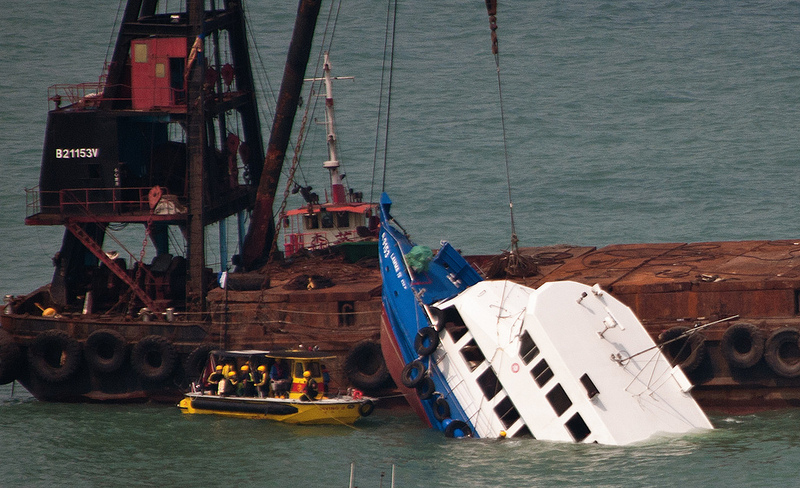
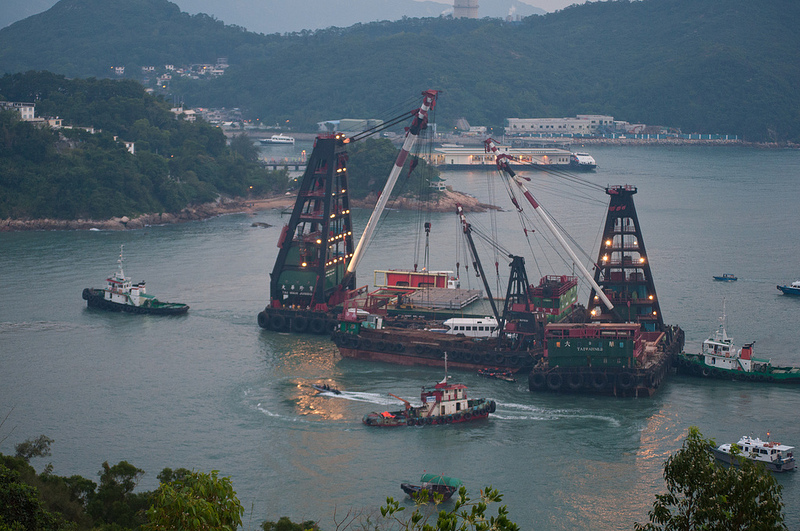
A commuter ferry and a boat full of Hongkong Electric Co. employees collided Monday night around 8:30pm. The Hongkong Electric boat, Lamma IV, was carrying 120 passengers on their way back from a tour of a power facility and were about to take in a fireworks display in Victoria Harbor. The ferry, Sea Smooth, collided with the Lamma IV’s stern and caused the Lamma IV to sink quickly by the stern, stranding dozens of passengers below deck.

So far 38 people have been declared dead of the 120 aboard while only minor wounds were suffered by the Sea Smooth‘s passengers and crew. Authorities have towed the Lamma IV to a nearby beach and discovered a large hole on the port side of the vessel’s stern. Both captains and several of the crew from each vessel have been arrested and released on bail. Hongkong Electric has already pledged to pay $25,800 to each victim’s family. The exact cause and responsibility for the wreck has yet to be determined.

hong kong ferry

CC Image Courtesy of Trey Menefee on Flickr

british destroyer

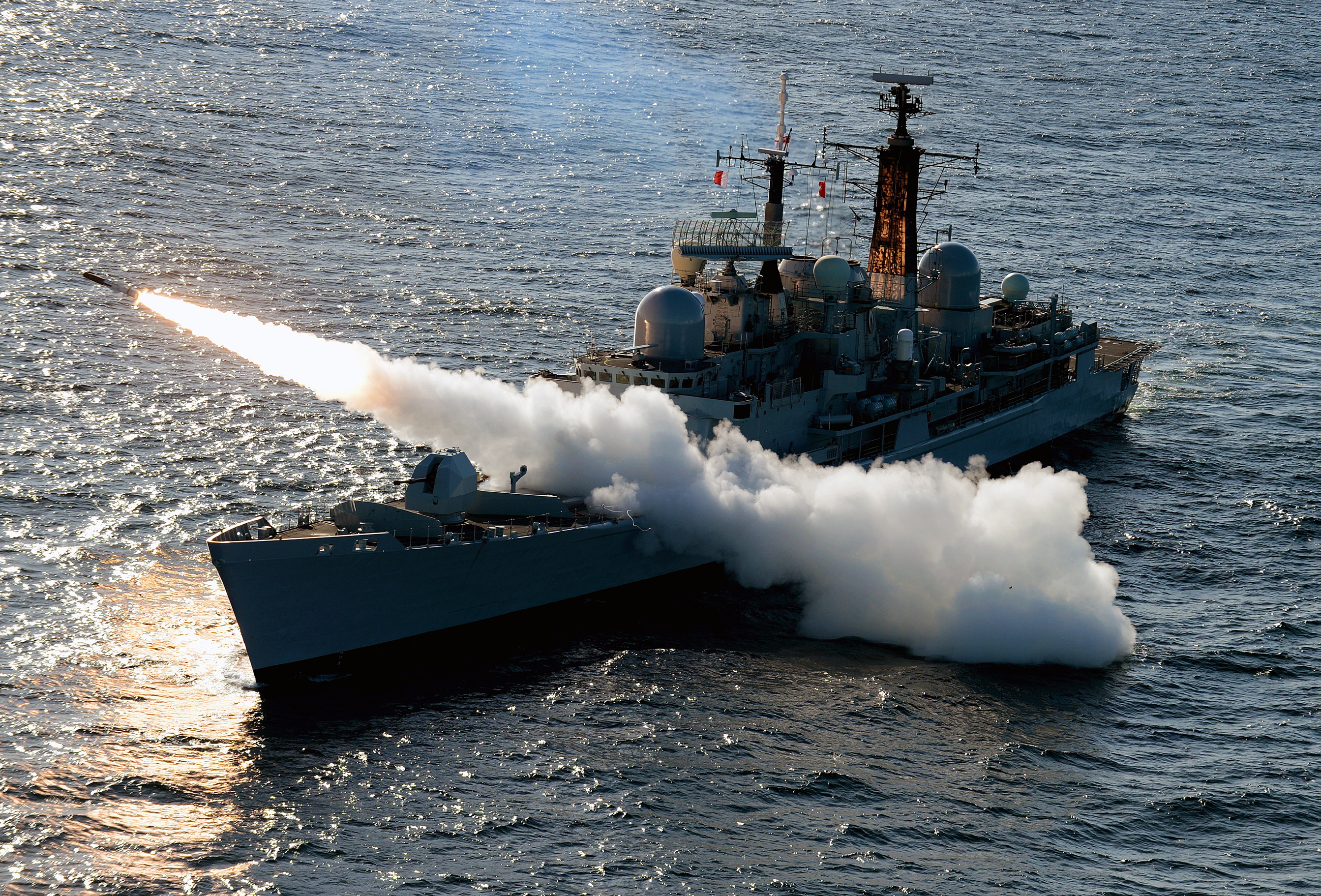
HMS Edinburgh Firing Sea Dart Missiles
© UK MOD/Crown Copyright 2012

Today the Royal Navy retired the HMS York, its second to last Type 42 destroyer. Its last Type 42, HMS Edinburgh, sailed on its final deployment earlier this week and will be retired upon its return. The Type 42 destroyer class has served the Royal Navy since the 1970s and two were lost in the Falklands War. York and Edinburgh will soon be replaced by new Type 45 destroyers which are among the most powerful and sophisticated anti-aircraft vessels in the world.

During her long career, York sailed 750,000 miles in defense of British interests and saw service in Iraq (2003), Lebanon (2006) and most recently Libya (2011). Her sister ship Edinburgh also served in the 2003 Iraq conflict and has deployed on numerous anti-terrorism and narcotics interdiction missions around the globe. Both ships are currently for sale on the UK MoD’s disposal site and their sale will be used as a diplomatic tool to further relations with another nation(s). Another notable warship sale occurred earlier this year when the US Navy sold for scrap the Sea Shadow, a copy of which appeared in the James Bond film Tomorrow Never Dies.

The last vessel to bear the Edinburgh name was a Town-class cruiser lost in World War 2 in the Arctic Sea. The ship fell prey to Nazi sea and air forces while escorting a convoy from Murmansk, Russia to Great Britain. Aboard the vessel was 465 bars of gold bullion weighing 4.5 tons. Several salvage efforts were launched but it wasn’t until September 1981 that the first bar of gold was recovered. Over the course of two dive seasons, 460 of the 465 bars were successfully recovered. The recovery operations were performed under a contract similar to that between the UK government and Odyssey Marine for the Gairsoppa and Mantola recoveries in 2012.
Bonhomme Richard

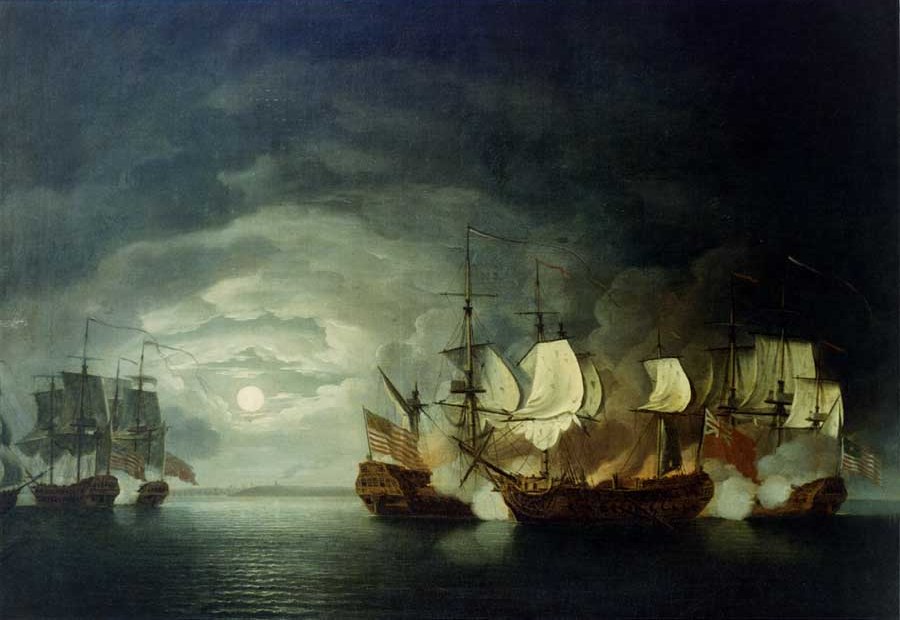
Battle of Flamborough Head
Photo: US Navy, Painting by Thomas Mitchell

One of the most famous battles in the US Navy’s history occurred 233 years ago today on September 23, 1779. Captain John Paul Jones and his converted East Indiaman USS Bonhomme Richard along with USS Alliance attacked a British convoy protected by HMS Serapis and Countess of Scarborough. In what became known as the Battle of Flamborough Head, Jones and his crew engaged the Serapis in a ship-to-ship duel. Captain Pearson of the Serapis demanded Jones’ surrender and in reply he uttered the now famous words, “I have not yet begun to fight.”

Though outgunned, Jones’ superior  fighting skills carried the day and the Serapis eventually struck its colors. Despite having defeated the British forces (Countess of Scarborough struck her colors as well), the Bonhomme Richard sank the next morning and Jones transferred his flag to the Serapis. Jones’ victory was not the last in which an American naval force engaged British forces while penning a famous phrase

The wreck of the Bonhomme Richard is considered one of the crown jewels of shipwrecks and has been the subject of several discovery expeditions. Unfortunately none have been able to locate the wreck and its final resting place off Flamborough Head remains a mystery. John Paul Jones is considered the father of the American Navy and his words “I wish to have no connection with any ship that does not sail fast for I intend to go in harm’s way” are just as famous in naval circles as “I have not yet begun to fight.” Sadly, Jones never held a significant sea command in the US Navy after the Battle of Flamborough Head and died an Admiral in the Russian Navy.