Archives For November 30, 1999

landing ship tank

Photo: US Navy

World War 2 saw the perfection of modern amphibious operations with successful landings in North Africa, Italy, Normandy and throughout the Pacific contributing to the demise of the Axis Powers. Among the innovations which made these operations successful was the Landing Ship, Tank (LST). LSTs were designed with massive bow doors and a bow ramp that enabled Allied forces to deliver tanks, half-tracks, deuce and a halfs and other vehicles directly to the beachhead. After disgorging their cargo, the LST’s crew could use a winch system to extricate the ship from the beachhead and return to port for another load. Of the 1,051 LSTs produced for Allied naval forces, most were scrapped or converted to use as merchant vessels after the war while a few saw service through the Vietnam War. One even served as a produce carrier for Los Angeles Mafioso Jack Dragna, hauling bananas between Latin America and California.

LST 393, one of only 2 surviving LSTs, now serves as a museum ship in Muskegon, Michigan. The ship delivered 9,000+ troops and 3,248 vehicles to the beaches of Salerno, Sicily, and Normandy. Following her wartime service, LST 393 was renamed M/V Highway 16 and plied the Great Lakes as an automobile carrier for decades. In 2000, a group began restoring the ship as a memorial to the officers and crew who served aboard these important vessels. The ship is open for tours and can be rented for special occasions. More information can be found at the ship’s website: http://www.lst393.org/

Bonhomme Richard

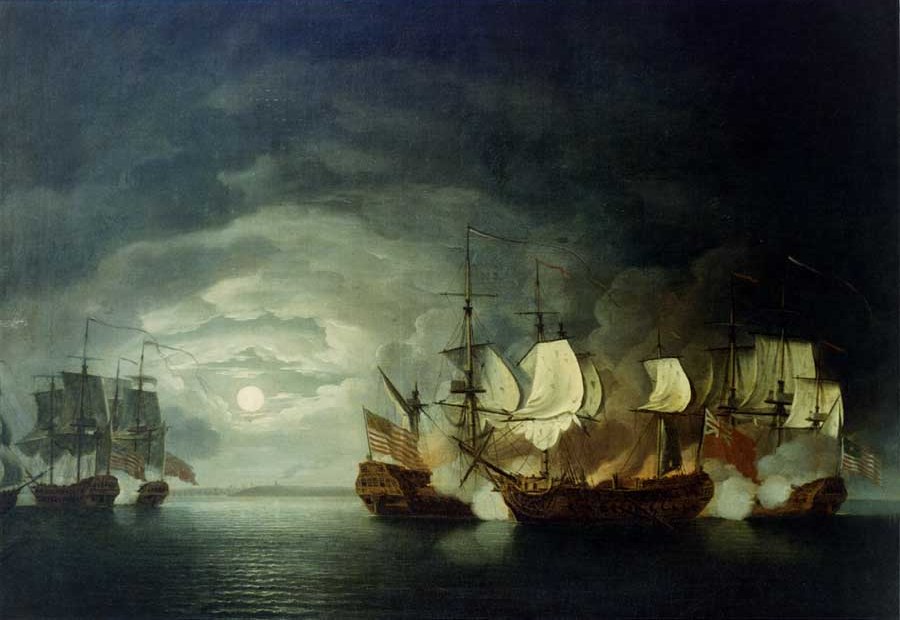
Battle of Flamborough Head
Photo: US Navy, Painting by Thomas Mitchell

One of the most famous battles in the US Navy’s history occurred 233 years ago today on September 23, 1779. Captain John Paul Jones and his converted East Indiaman USS Bonhomme Richard along with USS Alliance attacked a British convoy protected by HMS Serapis and Countess of Scarborough. In what became known as the Battle of Flamborough Head, Jones and his crew engaged the Serapis in a ship-to-ship duel. Captain Pearson of the Serapis demanded Jones’ surrender and in reply he uttered the now famous words, “I have not yet begun to fight.”

Though outgunned, Jones’ superior  fighting skills carried the day and the Serapis eventually struck its colors. Despite having defeated the British forces (Countess of Scarborough struck her colors as well), the Bonhomme Richard sank the next morning and Jones transferred his flag to the Serapis. Jones’ victory was not the last in which an American naval force engaged British forces while penning a famous phrase

The wreck of the Bonhomme Richard is considered one of the crown jewels of shipwrecks and has been the subject of several discovery expeditions. Unfortunately none have been able to locate the wreck and its final resting place off Flamborough Head remains a mystery. John Paul Jones is considered the father of the American Navy and his words “I wish to have no connection with any ship that does not sail fast for I intend to go in harm’s way” are just as famous in naval circles as “I have not yet begun to fight.” Sadly, Jones never held a significant sea command in the US Navy after the Battle of Flamborough Head and died an Admiral in the Russian Navy.

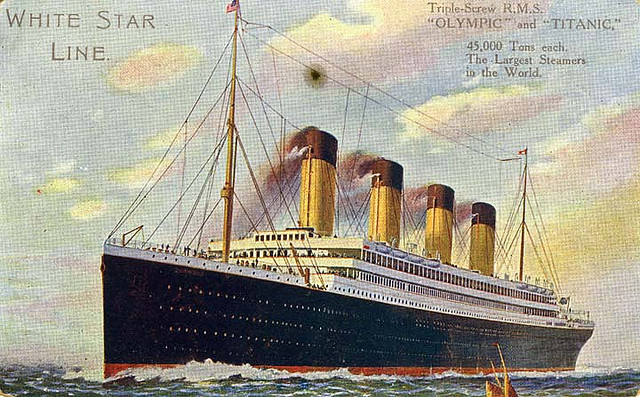
Titanic & Olympic

Much like the Apostle Paul, Violet Jessop survived a trio of maritime disasters, including the sinking of RMS Titanic. Jessop began work as a stewardess for White Star Line in early 1911. White Star is best remembered in history as the owner and operator of the Titanic, but in the late 19th and early 20th century the company ferried thousands of immigrants from Europe to the United States. Jessop first assignment was aboard Titanic’s sister ship RMS Olympic. While cruising off the Firth of Forth on September 20, 1911, the Olympic and the Royal Navy armored cruiser HMS Hawke collided resulting in significant damage to both ships. Neither Jessop nor any of the other passengers and crew aboard either ship were injured even though two of Olympic’s watertight compartments were flooded and the Hawke nearly capsized.

Jessop’s next brush with death occurred merely 7 months later on April 14, 1912 when Titanic sank after its infamous collision with an iceberg. For four years Jessop enjoyed smooth sailing aboard her employer’s ships until November 1916. RMS Brittanic, which had been converted to a hospital ship, struck a mine on November 12, 1916 and once again Jessop found herself scrambling for the lifeboats. Despite her three near-death experiences, Jessop continued to work aboard passenger liners and retired to England where she passed away in 1971.

jolly roger

CC Image Pirated From Scott Vandehey on Flickr

To recognize International Talk Like a Pirate Day, here are a few piratical items of note…

Captain Morgan, the Diageo owned rum distiller, funded excavations at the site of the real Admiral Morgan’s shipwreck this summer. No word if any rum has been found aboard the wreck or if the salvage crew were cited for operating an ROV under the influence.

Excavations continue on both Captain Sam Bellamy’s Whydah and Blackbeard’s Queen Anne’s Revenge. Artifacts from both wrecks can be viewed at their respective museums in Provincetown, Massachusetts and Beaufort, North Carolina.

According to the Maritime Executive, there were 17 pirate attacks just last month. This month, pirates even fired upon an Italian naval helicopter. A map of pirate attacks in 2012 can be viewed here.

Last year, 35 people lost their lives while being held hostage by Somali pirates. As of August 30, there were 11 vessels and 188 hostages being held by Somali pirates. In addition to the human costs of piracy, experts estimate that the financial costs of piracy was around $6.6 – 6.9 billion in 2011 alone.

Piracy along the coast of Somalia has become such a problem that one of the primary reasons for the 2007 creation of the US’s Africa Command (AFRICOM) was the fighting of piracy. It’s rumored that the servicemen of AFRICOM will star in Disney’s upcoming film Pirates of the Caribbean: On Somali Tides.

Merchant submarine

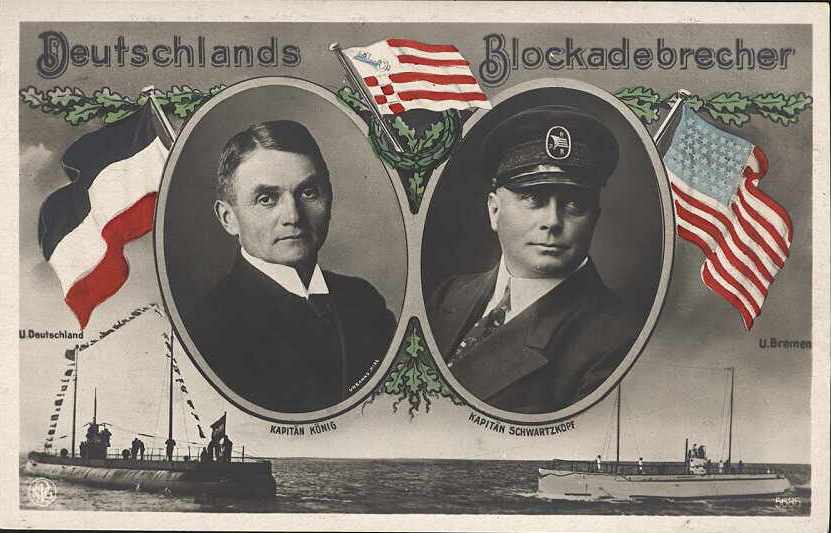
German Merchant Submarines Deutschland & Bremen
Photo: Kevin Heath

During World War I, the Royal Navy blockaded Germany’s North Sea ports and cut off all imports into the country. Desperate for imports of rubber, tin, nickel and other resources unavailable within their borders, the German merchant marine took a page from Jules Verne’s 20,000 Leagues Under the Sea and developed blockade running merchant submarines. The subs were built for the North German Lloyd Line and were designed to maximize cargo carrying capacity – unusual for vessels normally viewed as tools of war and not of trade.

The first sub, Deutschland, made her maiden voyage in June of 1916 and arrived in Baltimore, Maryland a month later carrying dyes, gemstones and pharmaceuticals. Deutschland had successfully threaded the needle of the Royal Navy blockade without even being detected. Returning with a load of valuable nickel, tin and rubber, the Deutschland’s maiden voyage not only paid for itself, but it netted a massive profit for her North German Lloyd Line owners.

The Deutschland made one more voyage to the United States before deteriorating relations between the US and Germany precluded further trade. Deutschland was later converted to u-boat use by the Imperial German Navy, sank 42 vessels and was turned over to the Royal Navy after the Armistice. The Deutschland’s sister ship, Bremen, sailed for the US in September of 1916, however, she never arrived and was presumed lost at sea. One of Bremen’s oil stained life preservers was discovered near Cape Elizabeth, Maine indicating the ship may have made its way as far the American coast. The ship’s disappearance, though, remains a mystery. Various reports indicate she might have been depth charged or mined by Royal Navy vessels, but perhaps Bremen felt drawn to her Jules Verne origins and fell prey, like Captain Nemo and the Nautilus, to the Moskstraumen.

helicopter carrier

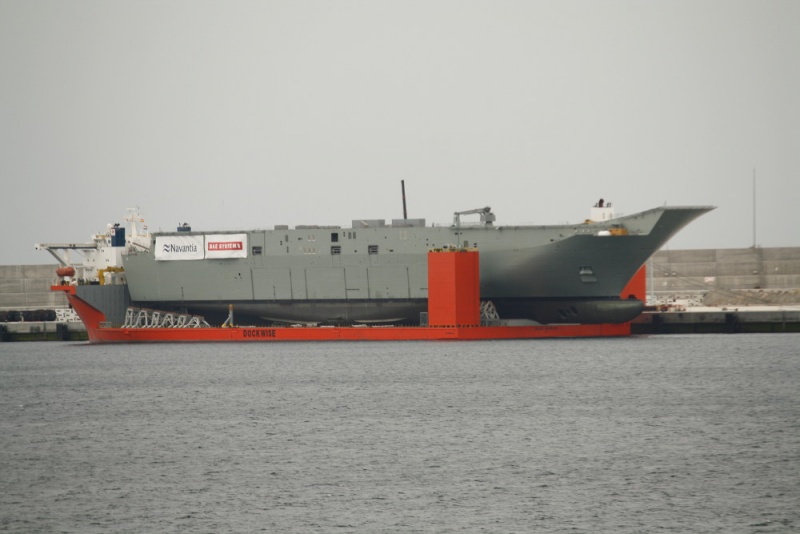
Hull of LHD Canberra aboard heavy lift ship MV Blue Marlin
Photo: Royal Australian Navy

The first of the Royal Australian Navy’s new Landing Helicopter Dock ships is ~1/3 of its way to Australia. Launched in February 2011, the LHD Canberra is the first of two Canberra class Landing Helicopter Dock ships being built for the Royal Australian Navy. The ships are based on the design of Spain’s SPS Juan Carlos I which entered service in the Spanish Navy in 2010. The hull and flight deck were built in a Spanish shipyard and are being transported to Australia via heavy lift ship. The same lift ship was used to transport the USS Cole back to the United States after it was bombed by Islamic fundamentalists on October 12, 2000. Upon arrival in Australia in November, the Canberra’s final fitting out will be performed by BAE Systems. Once commissioned in 2014, the Canberra will be the largest warship to ever serve in the Royal Australian Navy.

Australian helicopter carrier

LHD Canberra Cutaway
Photo: Royal Australian Navy

Depending upon mission needs, the Canberra class LHDs can accomodate up to 1,000 troops and 110 vehicles in its multiple decks. The Canberra’s welldeck can hold and launch 4 landing craft and RHIBs. Air capabilities include 6 medium helicopter launch spaces and room for 26 medium-helicopters (up to CH-47 Chinook size) in its hanger and light vehicle deck. The ship is approximately the same size as the United States’ Wasp class amphibious assault ships and as such could most likely operate V-22 Ospreys as well as the F-35B if/when it becomes available. Additionally, the ship was designed with the lightest draft possible so as to be able to operate in the littorals and secondary ports. The addition of the Canberra and her sister ship Adelaide in 2015 will give the Royal Australian Navy further power projection capabilities and help maintain the balance of power in a region increasingly under the influence of Chinese autocracy.

One of the most unusual clashes in naval history occurred on September 14, 1914 when two former passenger liners fought one another off the coast of Brazil’s Trinidada Island. At the outbreak of World War 1, both the British and German navies put into effect plans calling for the arming of certain ships as auxiliary cruisers to act as wartime supplements to their naval forces. Two such ships were the SS Cap Trafalgar and RMS Carmania.

The SS Cap Trafalgar had been built in 1913 and operated between Hamburg, Germany and South American ports. Following the declaration of war, her civilian crew was replaced by officers and seaman of the German Imperial Navy and she was armed with 2 4.1in. guns. Thus she became SMS Cap Trafalgar and was charged with hunting down and sinking Allied shipping in the South Atlantic. SMS Cap Trafalgar’s opponent, RMS Carmania, was a British mail liner built in 1905 for the Cunard line’s Liverpool to New York route. Similar to SMS Cap TrafalgarRMS Carmania was commandeered by the British Admiralty and became HMS Carmania on August 8, 1914 when she was armed with 8 4.7 in. guns. Unlike Germany’s auxiliary cruisers, Britain utilized its cruisers to protect merchantmen or assist in the hunt for Germany’s merchant raiders.

The two ships were destined to come across one another after each were given orders to proceed to Trindade Island – the Germans were to rendezvous with colliers and the British suspected the island was being used by the Germans as a supply point. Caught with two colliers in broad daylight, the Cap Trafalgar at first fled from the pursuit of the Carmania, however, the Germans reversed course and turned to engage the Carmania. After a brisk 70 minute battle, with both ships ablaze and holed below the waterline the Cap Trafalgar capsized and sank with the loss of 51 officers and crew. While the Cap Trafalgar had been sunk, it had inflicted serious damage on the Carmania and she required extensive repairs at Gibraltar’s dry dock. The Carmania finished out the war in British service and was eventually scrapped in 1932. Even though it involved two of the largest, fastest and most expensive ships in the world, the engagement was of little strategic consequence and is now merely a strange footnote in naval history.

Oliver Hazard Perry

CC Image courtesy of Archives de la Ville de Montreal on Flickr

Today marks the 199th anniversary of the Battle of Lake Erie fought between American and British forces for control of the Great Lakes region on September 10, 1813. After British forces captured Detroit, MI, American military planners decided to build a small fleet near Presque Isle to wrest back control of Lake Erie and allow the recapture of Detroit. A force of 9 ships were quickly hewn from local forests and Master Commandant Oliver Hazard Perry sent to take command of the force.

On the morning of September 10, 1813, 6 ships under the command of Royal Navy Commander Robert Heriot Barclay moved to sweep the American force from the lake. While outnumbered 6 to 9, the Royal Navy squadron possessed more cannons (63) than the Americans (54) and the British cannons had a longer range than the Americans which had primarily equipped their ship with close-range carronades.

In a tribute to Captain James Lawrence who had lost his life aboard the USS Chesapeake earlier that year, Perry’s battle flag stated “Don’t Give Up the Ship.” At the outset of the battle, Barclay’s squadron had the advantage over the American vessels as possession of the weather gauge allowed his ships to outmaneuver the Americans and use their longer range fire power to pound the Americans. The British used their advantage to batter Perry’s flagship USS Lawrence into a hulking wreck, but undeterred, Perry transferred his flag from the Lawrence to the USS Niagara where he continued the action. Perry’s fleet had not let the British escape unscathed, though, as Commander Barclay and several of his officers had been wounded, putting command of the ships in the hands of less experienced officers. The British attempted to wear-to in order to bring their opposite broadsides to bear on Perry’s bruised fleet, but miscommunication and poor seamanship caused two of the British vessels to collide. Perry then split the British column, a maneuver even more deadly than “crossing the T,” allowing his ships to pour fire from both broadsides into the British squadron. This effective maneuver by Perry and his squadron devastated the British ships and one by one the squadron surrendered, giving Perry and his squadron the greatest American naval victory of the War of 1812.

Perry’s victory at the Battle of Lake Erie opened the door for an American invasion of Canada and the recapture of Detroit. It also was the first time an entire British squadron had surrendered in battle. Oliver Hazard Perry became an overnight American hero and his notification of victory, “We have met the enemy and they are ours,” has been forever written in American naval history. More than half a dozen ships, including a class of modern-day frigates, have been named in his honor and the latest ship to bear his name is currently under construction in Perry’s home state of Rhode Island.

British aircraft carrier

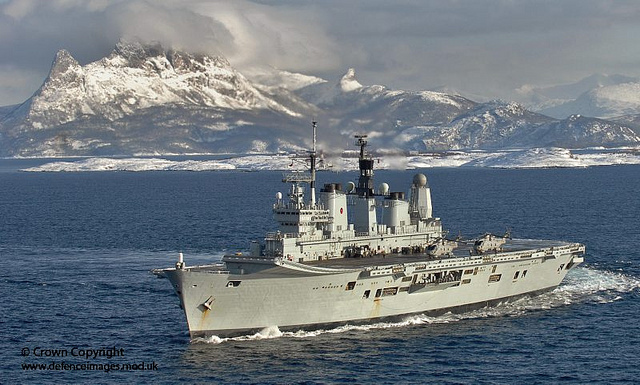
HMS Ark Royal off Norway in 2008
Photo: MOD

The Telegraph is reporting that the HMS Ark Royal, the Royal Navy’s only remaining aircraft carrier, is finally being sold for scrap. The ship was originally to remain in service until 2016 or 2017 when it would have been replaced by HMS Queen Elizabeth, the first of the Queen Elizabeth class aircraft carriers. Budgetary issues, though, caused the Ministry of Defence to rethink their time table and remove the ship from service early. The Ark Royal was decommissioned in March of 2011 and an internal debate within the UK government about its final disposal has caused delays in the decision. Among the various scenarios considered for the Ark Royal’s ultimate fate were it being sunk as a wreck site for divers, converted to use as a London heliport, converted into a Hong Kong casino, refitted for hotel use (much like the former Soviet carrier Kiev) or sold for scrap. Ultimately the Ministry of Defence chose to scrap the vessel for £3 million.

The Ark Royal was laid down in 1978 and commissioned in 1985. She was the third and final ship of the Invincible class carriers and was designed to operate short take-off and vertical landing (STOVL) aircraft and helicopters from her flight deck. Her sister ship HMS Invincible saw service in the Falklands War and was sold for scrap earlier last year. Her other sister ship HMS Illustrious served in the Balkans conflict of the 1990s and has since joined HMS Ocean as a helicopter carrier. Ark Royal was the fifth Royal Navy ship to carry the name with previous ships having fought against the Spanish Armada, the German High Seas Fleet, the Nazi Kriegsmarine (lost to a u-boat in 1941) and in post-World War 2 service. The current Ark Royal provided air cover for operations in the Balkans in 1993 – 1994 and in the invasion of Iraq in 2003.

Following the retirement of the the Ark Royal in March 2011, the UK Ministry of Defence sold its remaining Harrier STOVL jets to the US Marine Corps to be used for spare parts. This decision has left the Royal Navy with only 1 fixed wing aircraft until the entry of the F-35 into service. While the Ministry of Defence is much better prepared to resist an invasion of the Falklands than it was in the 1980s, the loss of its seaborne fixed-wing aircraft capability until 2016 has left the UK increasingly reliant on allies (such as the French in their agreement to jointly operate the Charles de Gaulle) in the shaping of its foreign policy. Gone are the days when an enlightened British citizenry could call for the outlawing of the slave trade and the Royal Navy unilaterally enforce the prohibition. This further erosion of British autonomy has most assuredly set Lord Nelson and Winston Churchill to spinning in their graves.

Blackbeard

Edward Teach, aka Blackbeard
Photo: Wiki Commons

An archaeological team from the North Carolina Underwater Archaeology Branch will spend eight weeks excavating the Queen Anne’s Revenge, the flagship of famous pirate Blackbeard. The vessel was discovered in 1996 near Beaufort, NC and several excavations have been conducted by the state’s Underwater Archaeology Branch over the past few years. Numerous cannons, the ship’s anchor and approximately 16,000 artifacts have been recovered thus far. A permanent exhibit at the Beaufort branch of NC’s Maritime Museum opened in June 2011 to display the artifacts and educate visitors about the life of a pirate. Blackbeard’s name has become synonymous with 18th century piracy even though his career lasted a mere two years before he was killed in 1718 during a fight with Royal Navy forces near Ocracoke, North Carolina. The Queen Anne’s Revenge is only the second pirate ship to be discovered and excavated, with the other being the Whydah off the Massachusetts coast.