Archives For November 30, 1999

HMAS Sydney

CC Image courtesy of Horatio Kookaburra on Flickr

German naval strategy during World War II was similar to that employed in World War I – strangle the United Kingdom by sinking or disrupting its merchant shipping. In addition to the ubiquitous U-boat, the Kriegsmarine utilized surface warships and camouflaged merchant vessels to target Allied shipping in all theaters of the war. One such camouflaged merchant vessel was the HSK Kormoran. Formerly the merchantman Steiermark, the ship was converted in 1940 to carry mines and hidden armaments as well as two float planes. Departing Germany in December 1940, Kormoran captured or sunk 11 merchant ships as it cruised through the Atlantic and Indian Oceans.

The Kormoran’s luck ran out, though, when it happened upon the Australian cruiser HMAS Sydney on November 19, 1941. Sydney was returning to port from escorting a troopship and decided to investigate what appeared to be a suspicious vessel. The two ships exchanged signals until the Kormoran, posing as the Dutch ship Straat Malaka, failed to identify itself by the Straat Malaka’s secondary secret signal. Realizing he could no longer keep up the ruse, Kormoran’s captain ordered the Dutch ensign struck, raised the German naval ensign and opened fire. The two ships engaged in their deadly duel for about an hour at which point the heavily damaged Sydney, struck by hundreds of rounds of 5.9 inch shells as well as several torpedoes, drifted off to the southwest.

The Sydney disappeared with its entire crew complement of 645 officers and sailors. The Kormoran, irreparably damaged by Sydney’s broadsides, was ordered scuttled by her captain and the crew took to the lifeboats. Only 317 of the Kormoran’s 400 man crew were rescued. While Sydney’s sinking of the Kormoran was a pyrrhic victory for her crew, it helped eliminate the threat of continued predation on Allied merchant shipping and the lives of Sydney’s crew were not lost in vain. On March 12, 2008, searchers from the Finding Sydney Foundation located the wreck of the Kormoran in 2,500 meters of water. Five days later, the wreck of the Sydney was finally located approximately 11 miles from the Kormoran. Today, a new HMAS Sydney proudly serves the Royal Australian Navy and its replacement will be christened with the same name when it enters service in 2017.

Edward Pellew

Stephen Taylor’s latest book, Commander, documents the life of Edward Pellew, a British naval officer who rose to fame during the Napoleonic Wars. Taylor builds on the work of two previous biographies to present the most complete and balanced description of a man considered to be the greatest frigate captain of the Royal Navy. Most Americans, and perhaps many British citizens, associate Pellew with the same-named fictional commander of HMS Indefatigable in C.S. Forester’s Horatio Hornblower novels. Pellew, though, is considered the inspiration (along with Sir Thomas Cochrane) for Forester’s Hornblower character as well as Patrick O’Brian’s Jack Aubrey character.

Taylor meticulously documents Pellew’s entire life including his youth in Cornwall, his path to the sea, and his early service in the American Revolution on the Great Lakes. Relying on personal correspondence and the efforts of Pellew’s son at preserving his father’s legacy, Taylor reconstructs for the reader Pellew’s various single ship commands and joint operations, including his most famous command, HMS Indefatigable. Especially noteworthy is the behind the scene squabbles that occurred between Pellew and various members of the British nobility and naval establishment.

For instance, while serving as commander of the Indian naval station, Pellew engaged in rigorous conflict with the Admiralty in England as well as another commander on station. Taylor highlights how this particular conflict not only hurt Pellew’s career, but also prevented the taking of the French island of Mauritius (an idea Pellew was pursuing) until later in the war. As a result, French privateers and men of war continued to operate from Mauritius at great cost to British shipping. Taylor concludes with Pellew’s masterful victory over the Barbary Pirates at Algiers in August 1816 and his retirement in England.

Overall, Taylor presents the reader with a well-documented and readable account of Pellew’s life. While some readers may wish for more swashbuckling tales a la Horatio Hornblower, Taylor’s intent was to present a well-rounded account of Pellew’s entire life and not just the daring exploits for which he became famous. Commander is an excellent read and anyone wishing to better understand the Napoleonic Wars and a central figure from them would do well to purchase and read it.

Falklands War

Captain Ian North
Photo: Commander Nick Messinger

This year marks the 30th anniversary of the Falklands War. A solitary remnant of the British Empire, the Falklands Islands have long been claimed by Argentina. In 1982 the Falklands were invaded by an Argentinian government looking to distract its citizens from deteriorating economic conditions at home. Faced with the possibility of ceding the Falklands (and their citizens who overwhelmingly identify as British subjects) to Argentina, the British government, led by Prime Minister Margaret Thatcher, organized a task force to re-take the islands.

Among the vessels selected for the mission was the container ship M/V Atlantic Conveyor, captained by Ian North, a 33 year veteran of the British Merchant Navy. Argentinian Super Etendard jets attacked the British task force several times and on May 25, 1982, the Argies were successful in striking the Atlantic Conveyor with a pair of Exocet missiles. Fires quickly spread throughout the ship and forced its evacuation. A dozen crew perished when the ship sank, among them Captain North.

The Atlantic Conveyor was loaded with the majority of the task force’s transport helicopters and as a result the assault forces encountered greater difficulties than expected in invading the islands. The Argentinian commander of the Super Etendard squadron eulogized Captain North, writing “Captain North was a real sea-dog with his snowy beard, he was a great and brave man.” For his superb service, Captain North was posthumously awarded the Distinguished Service Cross.

Trafalgar

Admiral Nelson’s Flagship HMS Victory
CC Image Courtesy of Nigel Swales on Flickr

Today marks the 207th anniversary of the Battle of Trafalgar – perhaps the most noted victory by the Royal Navy in its 400 year history. Fought during the Napoleonic Wars of the early 1800s, the battle was the result of Napoleon Bonaparte’s efforts to invade Great Britain. Napoleon dispatched a fleet to rendezvous with a Spanish fleet in the Caribbean and then return to France to provide an armed escort for Napoleon’s invasion fleet. The combined French and Spanish fleet numbered 41 ships and was commanded by Admiral Pierre-Charles Villeneuve. After the rendezvous in the Mediterranean, the fleet sailed to Cadiz, Spain where they were found by Admiral Horatio Nelson and his 33 ship fleet.

Napoleon had changed his plans for an invasion of Great Britain and decided instead to have Villeneuve sail to the Mediterranean to support his operations there. Eager to engage the enemy, Admiral Nelson kept only a few frigates on station close to Cadiz in order to lure Villeneuve into making a run for the Mediterranean. Sensing an opportunity to break out of Cadiz, Villeneuve ordered his ships to weigh anchor.

Upon receiving the signal that Villeneuve was setting sail, Nelson laid out a daring and audacious plan to his officers in the cabin of his flagship, HMS Victory. Instead of following the traditional tactics of the day and sailing abreast of the Franco-Spanish fleet, Nelson divided his fleet into two squadrons. Each squadron was to sail perpendicular to Villeneuve’s fleet and slice through their battle line. If successful, the plan would split Villeneuve’s fleet and allow Nelson’s fleet to riddle them with broadsides from both sides.

Before engaging the Franco-Spanish fleet, Nelson ordered the signal “England expects that every man will do his duty” to be raised from the Victory. Nelson’s plan worked brilliantly and before the day was over more than 21 ships of the Franco-Spanish fleet had been sunk or captured. Tragically, Nelson paid for his triumph with his life as a French marine mortally wounded him with a musket shot.

Today, Admiral Nelson is honored as one of, if not the, greatest admiral who ever served in the Royal Navy. His statute guards Trafalgar Square in London and the HMS Victory serves as the flagship of the First Sea Lord and as a museum ship alongside the Mary Rose.

hms dasher

Ardrossan, Scotland
CC Image Courtesy of Gordon Cowan on Flickr

Next week British archaeologists will excavate a possible mass grave of British sailors in Ardrossan, Scotland. The sailors believed buried there served aboard HMS Dasher, a British escort carrier which sunk in 1943 during World War II. Some have alleged that the mass grave is the result of a government cover-up.

Dasher was originally laid down as the merchant vessel Rio de Janiero, however, the exigent circumstances of wartime prompted her conversion into an escort carrier. Escort carriers were small aircraft carriers designed to provide air cover for convoys as they crossed the North Atlantic. Additionally, the diminutive carriers saw action in the Pacific Theater, most notably during the Battle of Leyte Gulf.

Dasher could embark 15 aircraft which helped substantially lessen the risk of attack by U-boats or the Luftwaffe. The ship sank under mysterious circumstances on March 27, 1943 and 379 of her 528 man crew lost their lives. Various theories have been put forth as to what caused the ship to sink among them design defects or a plane wrecking upon landing. Following the sinking, the British government acted quickly to prevent news of the ship’s loss from spreading and weakening wartime morale. Among the actions taken were the burying of the majority of the sailors in a mass grave and a gag order being issued to the local press.

Earlier this year the British government announced it would make public documents surrounding the loss of the Dasher. Hopefully the release of these documents along with the excavation and reburial of the sailors will lay to rest a tragic and controversial event in the history of the Royal Navy. Today, a new HMS Dasher serves the Royal Navy as a coastal training vessel.

HMS Cymric

Oil Painting by Kenneth King
National Maritime Museum of Ireland

Late in 2011, divers from Dark Star dive team discovered the wreck of the British submarine J6 off the Northumberland coast. While the discovery of a submarine may have surprised the team, what is even more surprising, and tragic, are the circumstances by which the J6 was sunk.

On October 15, 1918 the HMS Cymric was on patrol off the Northumberland coast in Northeastern England. The HMS Cymric was originally an Irish schooner launched in 1893. She was later converted by the Royal Navy for use as a Q-ship. Q-ships were modern-day Trojan Horses – camouflaged to look like innocent merchant ships in order to lure unsuspecting German u-boats and merchant raiders to attack. When attacked, the Q-ship crew would reveal a bristling array of hidden armaments and the hunter would become the hunted. Q-Ships claimed fourteen German u-boats destroyed and 60 damaged during World War I through the use of these tactics.

While on patrol, the Cymric’s crew spotted what appeared to be a German submarine with the markings U6 on its conning tower. The Cymric opened fire and sank the submarine. Unfortunately, the markings were in fact J6 and 15 Royal Navy sailors lost their lives to friendly fire. The Cymric’s captain was cleared after a court of inquiry and the matter remained classified until 1969. The Cymric returned to commercial service after the war, but her bad luck continued as she struck a tram with her bowsprit in 1927 in Dublin harbor and then disappeared with all hands while sailing from Scotland to Portugal in 1944. Dark Star divers plan to return to the wreck this year to lay a memorial plaque in honor of the lives lost aboard J6.

Captain Cook

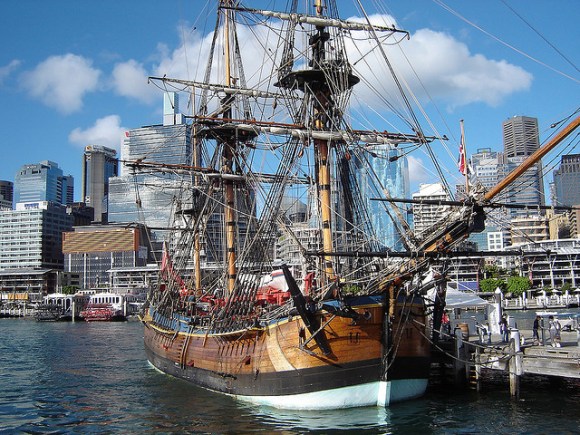
HMB Endeavour
CC Image Courtesy of Alex Bikfalvi on Flickr

Launched in 1993, HMB Endeavour is a faithful recreation of the bark used by Lieutenant James Cook on his expedition to Australia and New Zealand from 1768 – 1771. Cook and his crew explored various parts of Australia and New Zealand, gave Botany Bay its name and even ran aground on the Great Barrier Reef. Returning home a hero, Cook led two more expeditions of discovery before his death at the hands of natives in the Hawaiian Islands. The Endeavour continued in his majesty’s service as a troop transport before being sold into private hands. Renamed Lord Sandwich the bark was eventually scuttled as a blockship off Providence, Rhode Island during the American Revolution.

Having sailed over 170,000 nautical miles and visited 29 countries, the bark now calls the Australian National Maritime Museum home. Located in Sydney, the Australian National Maritime Museum has more than a half dozen museum ships including the patrol vessel HMAS Advance, submarine HMAS Onslow, destroyer HMAS Vampire, and barque James Craig. The bark is open for tours and more information can be found here.

operation albion

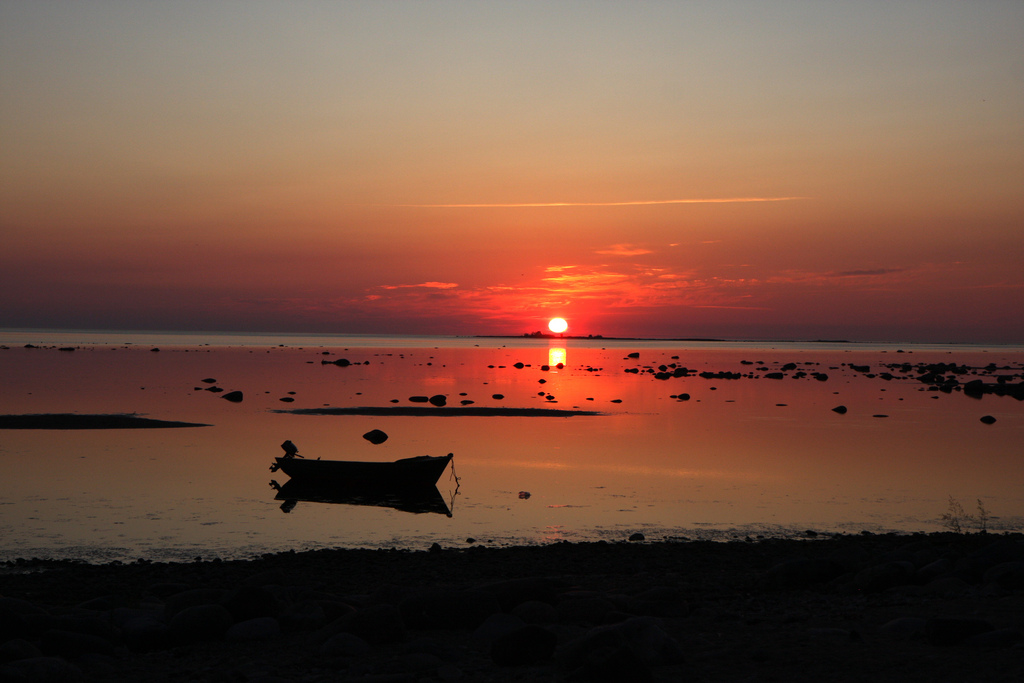
Sunset over Saaremaa Island, Estonia
CC Image Courtesy of Luke Saagi

In late 1917, the German High Command was desperate to knock Russia out of World War I and devote more resources to the Western Front. Despite upheaval at all levels of society and especially within the military, Russia had remained a belligerent after the Russian Revolution in February 1917. The Russian military had essentially ceased to be an effective fighting force and yet the Provisional Government under Alexander Kerensky insisted on continuing the fight against Germany and Austria-Hungary. Thus the Germans devised a plan to invade a trio of islands in what is now Estonia. The operation would achieve two significant objectives and potentially force Russia to withdraw from the war. First, the Russian Baltic Fleet would be all but neutered by German control of the islands and, more importantly, the Russian capital of St. Petersburg would be threatened with invasion.

Dubbed Operation Albion, the plan called for a combined arms operation in which infantry and cyclist troops would land on October 12, 1917 on Saaremaa Island and isolate the garrison. Meanwhile, a naval task force would provide fire support and deal with any attempted intervention by the Russian Navy. Both land and sea forces would be supported by seaplanes which flew reconnaissance and bombing missions.

The Russians had formidable coastal batteries and garrisons on Saaremaa and nearby Muhn Island, however, a combination of poor morale and bold action by the German forces negated any Russian advantages. Russian morale was so low that some coastal batteries refused to engage the German ships in the hope that non-resistance would spare their batteries hostile fire. Russian forces were also hampered by poor communication and a lack of initiative by some commanders.

The German landings were achieved without serious opposition and cyclist troops quickly pushed to divide the Russian forces by occupying a dam which connected Saaremaa and Muhn. The cyclists reached their objectives and wreaked havoc on the Russian forces as they attempted to withdraw across the dam. Russian naval forces and 3 Royal Navy submarines attempted to intervene, however, their efforts were unsuccessful and resulted in the loss of the pre-dreadnought Slava, the destroyer Grom and a few smaller vessels. Apart from damage from mines, the Germans lost no capital ships during the operation.

battleship sinking

Pre-Dreadnought Slava Sinking
Photo: Wikimedia Commons

After little more than a week, the Germans had secured the three islands – Saaremaa, Muhu and Hiiumaa and captured 20,000 Russian troops. Most significantly, though, the Germans had successfully launched a combined air-land-sea operation and were now poised to invade St. Petersburg. Less than 6 weeks after the action, the Russians sued for peace and German troops were freed from the Eastern Front to launch a last ditch effort to win on the Western Front.

The operation also had a minor World War II connection. Lieutenant Ernst Lindemann, later the captain of the ill-fated Nazi battleship Bismarck, served in the operation as a wireless officer aboard the battleship SMS Bayern. In 1944, the Soviets would launch their own Operation Albion, this time to wrest control of the islands from Nazi forces garrisoned there.

british warship

Mary Rose Museum & HMS Victory
CC Image Courtesy of Ian Stannard on Flickr

This week marks the 30th anniversary of the recovery of the 16th century English warship Mary Rose which sank on July 19, 1545 with nearly 500 officers and crew. Historians believe the ship was constructed around 1510 in Portsmouth and displaced 500 tons when it first entered service. The ship underwent two refits and during the second refit in 1536 the Mary Rose was strengthened and her displacement increased to 700 tons.

Mary Rose served the English Navy in wars against France and Scotland and it was during the Battle of Solent against a fleet of 200 French vessels that the Mary Rose was lost. Accounts differ as to the exact cause of the Mary Rose’s loss – the French believed they had sunk her while English accounts indicate that the ship most likely foundered due to poor seamanship by her crew.

Salvage efforts were launched immediately utilizing an age old technique used for recovery efforts the world over. Using two hulks and various winches, the salvors would straddle the ship with the two hulks, flood them, secure cables around the Mary Rose and then re-float the hulks. This process would be repeated until the ship reached water shallow enough where repairs could be made and the Mary Rose herself be re-floated. The salvors were unsuccessful in raising the ship and it remained hidden until 1965 when it was re-discovered by British diver Alexander McKee. The ship was finally recovered in 1982 and has been painstakingly preserved beneath a glassed-in drydock in Portsmouth. A permanent museum display is under construction and will be opened in early 2013. The museum is open to visitors during the transition period and visitors can also view Admiral Nelson’s flagship HMS Victory (not to be confused with Admiral Balchin’s HMS Victory) at the dockyard. More information can be found on the Mary Rose’s website.

 
british destroyer

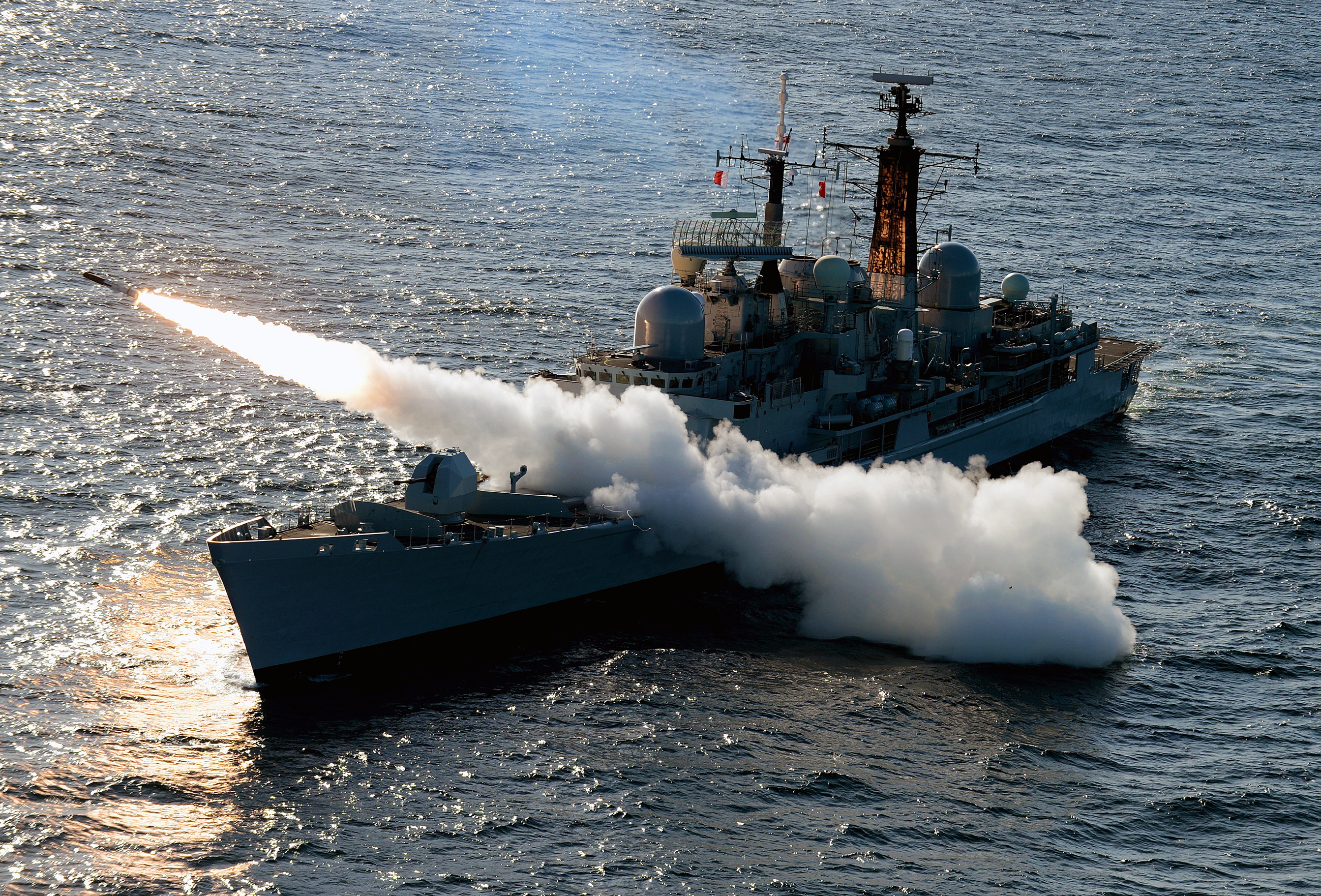
HMS Edinburgh Firing Sea Dart Missiles
© UK MOD/Crown Copyright 2012

Today the Royal Navy retired the HMS York, its second to last Type 42 destroyer. Its last Type 42, HMS Edinburgh, sailed on its final deployment earlier this week and will be retired upon its return. The Type 42 destroyer class has served the Royal Navy since the 1970s and two were lost in the Falklands War. York and Edinburgh will soon be replaced by new Type 45 destroyers which are among the most powerful and sophisticated anti-aircraft vessels in the world.

During her long career, York sailed 750,000 miles in defense of British interests and saw service in Iraq (2003), Lebanon (2006) and most recently Libya (2011). Her sister ship Edinburgh also served in the 2003 Iraq conflict and has deployed on numerous anti-terrorism and narcotics interdiction missions around the globe. Both ships are currently for sale on the UK MoD’s disposal site and their sale will be used as a diplomatic tool to further relations with another nation(s). Another notable warship sale occurred earlier this year when the US Navy sold for scrap the Sea Shadow, a copy of which appeared in the James Bond film Tomorrow Never Dies.

The last vessel to bear the Edinburgh name was a Town-class cruiser lost in World War 2 in the Arctic Sea. The ship fell prey to Nazi sea and air forces while escorting a convoy from Murmansk, Russia to Great Britain. Aboard the vessel was 465 bars of gold bullion weighing 4.5 tons. Several salvage efforts were launched but it wasn’t until September 1981 that the first bar of gold was recovered. Over the course of two dive seasons, 460 of the 465 bars were successfully recovered. The recovery operations were performed under a contract similar to that between the UK government and Odyssey Marine for the Gairsoppa and Mantola recoveries in 2012.