Archives For November 30, 1999

german battleship

Scharnhorst fires on HMS Glorious
Photo: US Navy

The Nazi battleship Scharnhorst lived a charmed life from the early days of World War II until Christmas 1943. The ship was among the most powerful of the Kriegsmarine’s most powerful surface units and, until the launch of the Bismarck and the Tirpitz, she and her sister ship Gneisenau were the pride of the Kriegsmarine. Often operating as a pair, Scharnhorst and Gneisenau wreaked havoc on the Royal Navy. In the opening days of World War II, the ships sank the armed British merchant cruiser HMS Rawalpindi and later sank the aircraft carrier HMS Glorious (see photo above) during the 1940 invasion of Norway.

The sister ships also broke out into the North Atlantic and sent several Allied merchantmen to the bottom of the sea. After the loss of the Bismarck, the decision was made to withdraw Nazi surface ships from the French coast. In early February 1942, the ships, along with the heavy cruiser Prinz Eugen, made a daring dash up the length of the English Channel. The Scharnhorst was then re-deployed to the northern waters of Norway in order to threaten Allied convoys supplying the Soviet Union.

On Christmas Day 1943, the Scharnhorst along with several destroyer escorts set sail from Norway to intercept an Allied convoy. Unbeknownst to the Kriegsmarine, the Royal Navy had intercepted and decoded the Scharnhorst’s orders and therefore laid a trap for the ship. Three Royal Navy cruisers screened the convoy from Scharnhorst while a squadron led by the battleship Duke of York raced to cut off the Nazi force from safety in Norwegian waters. After a fruitless pursuit of the convoy, the Scharnhorst cut off contact and began to return to base on December 26. In a three hour battle, the Scharnhorst was battered by the Royal Navy squadron and finally sank with only 36 survivors out of a crew of 1,968.

The wreck of the Scharnhorst was discovered in 2000 by the Norwegian Navy and further investigation revealed the extent of the damage inflicted by the Royal Navy. A total of 2,195 shells were fired at the ship along with 55 torpedoes. Eleven of the torpedoes found their mark and the torpedo and shell damage was extensive. The entire bow section of the ship was blown off the ship, most likely the result of an explosion in a forward magazine. Go here for a gallery of images from the Norwegian Navy’s investigation as well as period photos of the Scharnhorst.

Graf Spee sinking

Sinking of the Graf Spee

At the outset of World War II, the Nazi Kriegsmarine didn’t just deploy their merchant raiders and U-boats, but also tasked capital ships with the destruction of Allied shipping. One such ship was the Graf Spee, a pocket battleship constructed during the 1930s before Nazi Germany renounced the provisions of the Versailles Treaty. Germany’s pocket battleships were designed as a re-incarnation of the World War I battlecruiser concept – better armed than heavy cruisers and faster than battleships. The strategic concept was that each ship could operate independently against Allied merchant shipping and choose fight or flight when faced with the threat of engaging a warship.

The Graf Spee was named for Admiral Graf von Spee who had defeated a British squadron at the Battle of Coronel (November 1, 1914) only to have his squadron destroyed by a superior British force a month later at the Battle of the Falklands. Admiral von Spee was lauded by both sides of the conflict as a brilliant tactician and consummate naval officer and gentleman. After his death at the Battle of the Falklands, Admiral von Spee was quickly enshrined in the then small pantheon of Germany’s naval heroes. In addition to the Graf Spee, Germany built two other pocket battleships – the Deutschland and Admiral Scheer – both of which ended the war as floating artillery batteries and were destroyed in the waning weeks of the war.

Commanded by Captain Hans Langsdorff, the Graf Spee found herself in the South Atlantic at the outbreak of the war. Captain Langsdorff and his crew quickly got to work dispatching Allied shipping and sank 50,000 tons of British shipping before being engaged on December 13, 1939 by a trio of British cruisers – Achilles, Ajax, and Exeter. In the subsequent battle, dubbed the Battle of the River Plate, the Graf Spee seriously damaged the Exeter but was herself damaged and Captain Langsdorff sought shelter to perform repairs in Montevideo, Uruguay. Fearing a superior British force had gathered outside Montevideo, Captain Langsdorff and a skeleton crew sailed the Graf Spee into the river estuary on December 18 and scuttled the ship to prevent her from falling into Allied hands. Captain Langsdorff then committed suicide and the crew were interned in Uruguary.

The destruction of the Graf Spee and her limited contributions to the war effort enraged Adolf Hitler who instructed the commander of the Kriegsmarine, Admiral Raeder, to issue an order stating, “The German warship and her crew are to fight with all their strength to the last shell; until they win or go down with their flag flying.” For the Allies, the victory provided a healthy morale boost after the loss of Poland earlier in the year.

soviet submarine baltic sea

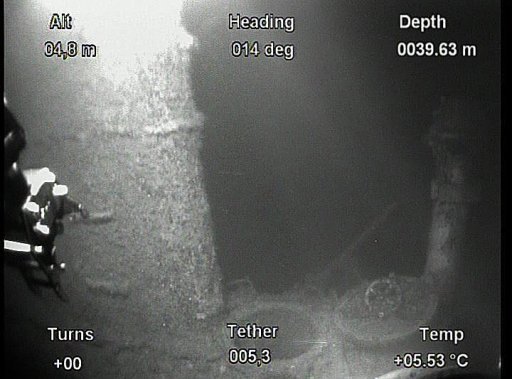
Wreckage of Soviet WWII Submarine S-6
Photo: Försvarsmakten

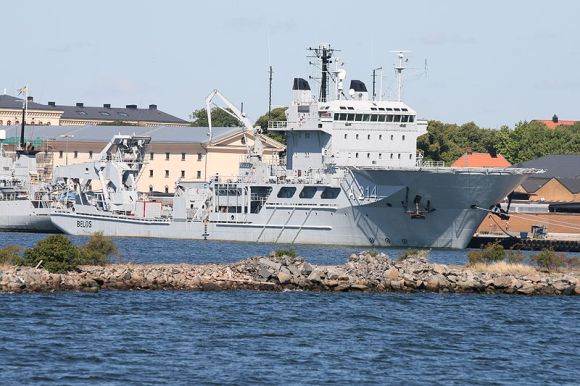
Earlier this summer civilian divers reported discovering what they believed to be a sunken submarine in 130 feet of water near Sweden’s island of Oland in the Baltic Sea. The Swedish Navy returned to the site with its submarine salvage ship HSWMS Belos to further inspect the wreck and determine its identity. Swedish news site The Local reports that the Swedish military believes the vessel is the Soviet submarine S-6 which never returned from its September 1941 patrol. Cyrillic text and a Soviet hammer and sickle are visible on the wreck providing evidence that the wreck is indeed a Soviet sub.

The Swedish military further believes that while cruising on the surface of the Baltic the sub struck a Nazi mine and was blown to pieces. This hypothesis flows from the fact that a hatch (seen above) was open on the vessel and it was found in multiple pieces on the sea floor. The large size of the debris field rules out the possibility the sub struck a mine below the surface and that the crew were able to make an attempt at escape. Thus it is most likely the sub was cruising on the surface, possibly re-charging its batteries at night, with hatches open to circulate air within the boat when it struck the mine.

submarine salvage ship

HSWMS Belos
Photo: Wikimedia

French Navy World War II

Aerial View of the Vichy French Fleet Scuttled in Toulon

Despite the overwhelming success of Nazi Germany’s Blitzkrieg assault on France in May 1940, Adolf Hitler chose not to occupy the entirety of the country. Along with a small zone occupied by Italy, a significant slice of southern France was allowed to remain nominally free. Dubbed Vichy France and headed by Marshall Petain, the “country” effectively functioned as a satellite state of Nazi Germany. In November 1942, Adolf Hitler ordered the occupation of Vichy France after the Allies landed in Vichy French North Africa.

One of the highest value targets in the Vichy French zone was the Vichy French fleet stationed in Toulon. Consisting of 3 battleships, 7 cruisers, 18 destroyers and 21 submarines, the addition of the Vichy French fleet to Italy’s Regia Marina or Germany’s Kriegsmarine could have had a significant effect on the balance of power in the Mediterranean theater. Aiming to deprive the Allies of the Vichy French fleet, Hitler ordered Operation Lila as a part of the larger takeover of Vichy France. Lila was intended to capture the Vichy French fleet at their anchorage in Toulon and turn the ships over to the Regia Marina.

At the same time Nazi forces were setting in motion Operation Lila, Vichy French forces were planning to either flee to North Africa or, in the event they couldn’t escape, scuttle their ships at anchor. Unfortunately for the Vichy French and for the greater Allied war effort, only a handful of submarines and a single surface vessel were able to escape the clutches of the advancing Nazi war machine. Instead, the majority of the fleet was scuttled in Toulon and rendered combat ineffective to the Nazis and Italians. In total, 77 ships were scuttled including all of the French capital ships and, while 30+ small vessels were captured, Operation Lila was essentially a complete failure for the Axis.

HMAS Sydney

CC Image courtesy of Horatio Kookaburra on Flickr

German naval strategy during World War II was similar to that employed in World War I – strangle the United Kingdom by sinking or disrupting its merchant shipping. In addition to the ubiquitous U-boat, the Kriegsmarine utilized surface warships and camouflaged merchant vessels to target Allied shipping in all theaters of the war. One such camouflaged merchant vessel was the HSK Kormoran. Formerly the merchantman Steiermark, the ship was converted in 1940 to carry mines and hidden armaments as well as two float planes. Departing Germany in December 1940, Kormoran captured or sunk 11 merchant ships as it cruised through the Atlantic and Indian Oceans.

The Kormoran’s luck ran out, though, when it happened upon the Australian cruiser HMAS Sydney on November 19, 1941. Sydney was returning to port from escorting a troopship and decided to investigate what appeared to be a suspicious vessel. The two ships exchanged signals until the Kormoran, posing as the Dutch ship Straat Malaka, failed to identify itself by the Straat Malaka’s secondary secret signal. Realizing he could no longer keep up the ruse, Kormoran’s captain ordered the Dutch ensign struck, raised the German naval ensign and opened fire. The two ships engaged in their deadly duel for about an hour at which point the heavily damaged Sydney, struck by hundreds of rounds of 5.9 inch shells as well as several torpedoes, drifted off to the southwest.

The Sydney disappeared with its entire crew complement of 645 officers and sailors. The Kormoran, irreparably damaged by Sydney’s broadsides, was ordered scuttled by her captain and the crew took to the lifeboats. Only 317 of the Kormoran’s 400 man crew were rescued. While Sydney’s sinking of the Kormoran was a pyrrhic victory for her crew, it helped eliminate the threat of continued predation on Allied merchant shipping and the lives of Sydney’s crew were not lost in vain. On March 12, 2008, searchers from the Finding Sydney Foundation located the wreck of the Kormoran in 2,500 meters of water. Five days later, the wreck of the Sydney was finally located approximately 11 miles from the Kormoran. Today, a new HMAS Sydney proudly serves the Royal Australian Navy and its replacement will be christened with the same name when it enters service in 2017.

operation albion

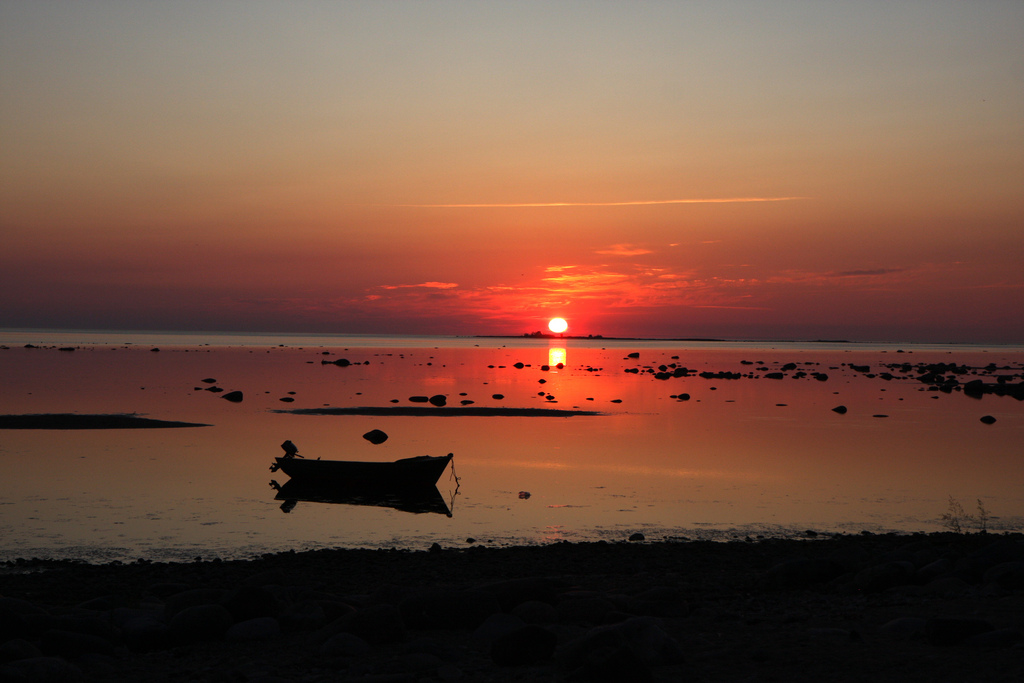
Sunset over Saaremaa Island, Estonia
CC Image Courtesy of Luke Saagi

In late 1917, the German High Command was desperate to knock Russia out of World War I and devote more resources to the Western Front. Despite upheaval at all levels of society and especially within the military, Russia had remained a belligerent after the Russian Revolution in February 1917. The Russian military had essentially ceased to be an effective fighting force and yet the Provisional Government under Alexander Kerensky insisted on continuing the fight against Germany and Austria-Hungary. Thus the Germans devised a plan to invade a trio of islands in what is now Estonia. The operation would achieve two significant objectives and potentially force Russia to withdraw from the war. First, the Russian Baltic Fleet would be all but neutered by German control of the islands and, more importantly, the Russian capital of St. Petersburg would be threatened with invasion.

Dubbed Operation Albion, the plan called for a combined arms operation in which infantry and cyclist troops would land on October 12, 1917 on Saaremaa Island and isolate the garrison. Meanwhile, a naval task force would provide fire support and deal with any attempted intervention by the Russian Navy. Both land and sea forces would be supported by seaplanes which flew reconnaissance and bombing missions.

The Russians had formidable coastal batteries and garrisons on Saaremaa and nearby Muhn Island, however, a combination of poor morale and bold action by the German forces negated any Russian advantages. Russian morale was so low that some coastal batteries refused to engage the German ships in the hope that non-resistance would spare their batteries hostile fire. Russian forces were also hampered by poor communication and a lack of initiative by some commanders.

The German landings were achieved without serious opposition and cyclist troops quickly pushed to divide the Russian forces by occupying a dam which connected Saaremaa and Muhn. The cyclists reached their objectives and wreaked havoc on the Russian forces as they attempted to withdraw across the dam. Russian naval forces and 3 Royal Navy submarines attempted to intervene, however, their efforts were unsuccessful and resulted in the loss of the pre-dreadnought Slava, the destroyer Grom and a few smaller vessels. Apart from damage from mines, the Germans lost no capital ships during the operation.

battleship sinking

Pre-Dreadnought Slava Sinking
Photo: Wikimedia Commons

After little more than a week, the Germans had secured the three islands – Saaremaa, Muhu and Hiiumaa and captured 20,000 Russian troops. Most significantly, though, the Germans had successfully launched a combined air-land-sea operation and were now poised to invade St. Petersburg. Less than 6 weeks after the action, the Russians sued for peace and German troops were freed from the Eastern Front to launch a last ditch effort to win on the Western Front.

The operation also had a minor World War II connection. Lieutenant Ernst Lindemann, later the captain of the ill-fated Nazi battleship Bismarck, served in the operation as a wireless officer aboard the battleship SMS Bayern. In 1944, the Soviets would launch their own Operation Albion, this time to wrest control of the islands from Nazi forces garrisoned there.

Coast Guard Cutter Ingham

CC Photo Courtesy of Kay Gaensler on Flickr

During a career spanning more than 50 years, the USCGC Ingham kept the shores of the United States safe for mariners in both war and peace. Commissioned in 1936, the cutter protected the Bering Sea and the fisheries of the Grand Banks until ordered to participate in neutrality patrols upon the outbreak of World War 2. After America’s entry to the war, Ingham helped convoy hundreds of Allied ships across the Atlantic. On December 15, 1942, during routine convoy operations, the Ingham detected and sank the German U-boat U-626. In late July 1944, the Ingham underwent alterations in the Charleston Navy Yard to prepare it to serve as a combined operations and headquarters and ship in the Pacific Theater. Ingham served briefly as a headquarters ship for General Douglas MacArthur prior to his landing in the Philippines.

Following World War 2, the ship returned to peacetime service and her missions included maritime rescue and oceanographic surveying. Ingham was called upon once again to serve in wartime during the Vietnam War. During the war she and her crew became the only Coast Guard cutter to earn 2 Presidential Unit Citations for her naval gunfire support and replenishment missions. Ingham responded to yet another crisis when Cuban dictator Fidel Castro allowed thousands of dissidents to flee his autocratic regime in what became known as the Mariel Boatlift. The Ingham rescued several boaters and towed half a dozen vessels to freedom in the United States. At the time of her decommissioning, the ship was the oldest and most decorated Coast Guard cutter in service. The ship now resides in Key West, Florida as a memorial to the 581 Coast Guardsmen killed in action during World War 2 and the Vietnam War. The ship is open for tours Monday thru Saturdays and more information can be found on their website.

One of the most unusual clashes in naval history occurred on September 14, 1914 when two former passenger liners fought one another off the coast of Brazil’s Trinidada Island. At the outbreak of World War 1, both the British and German navies put into effect plans calling for the arming of certain ships as auxiliary cruisers to act as wartime supplements to their naval forces. Two such ships were the SS Cap Trafalgar and RMS Carmania.

The SS Cap Trafalgar had been built in 1913 and operated between Hamburg, Germany and South American ports. Following the declaration of war, her civilian crew was replaced by officers and seaman of the German Imperial Navy and she was armed with 2 4.1in. guns. Thus she became SMS Cap Trafalgar and was charged with hunting down and sinking Allied shipping in the South Atlantic. SMS Cap Trafalgar’s opponent, RMS Carmania, was a British mail liner built in 1905 for the Cunard line’s Liverpool to New York route. Similar to SMS Cap TrafalgarRMS Carmania was commandeered by the British Admiralty and became HMS Carmania on August 8, 1914 when she was armed with 8 4.7 in. guns. Unlike Germany’s auxiliary cruisers, Britain utilized its cruisers to protect merchantmen or assist in the hunt for Germany’s merchant raiders.

The two ships were destined to come across one another after each were given orders to proceed to Trindade Island – the Germans were to rendezvous with colliers and the British suspected the island was being used by the Germans as a supply point. Caught with two colliers in broad daylight, the Cap Trafalgar at first fled from the pursuit of the Carmania, however, the Germans reversed course and turned to engage the Carmania. After a brisk 70 minute battle, with both ships ablaze and holed below the waterline the Cap Trafalgar capsized and sank with the loss of 51 officers and crew. While the Cap Trafalgar had been sunk, it had inflicted serious damage on the Carmania and she required extensive repairs at Gibraltar’s dry dock. The Carmania finished out the war in British service and was eventually scrapped in 1932. Even though it involved two of the largest, fastest and most expensive ships in the world, the engagement was of little strategic consequence and is now merely a strange footnote in naval history.

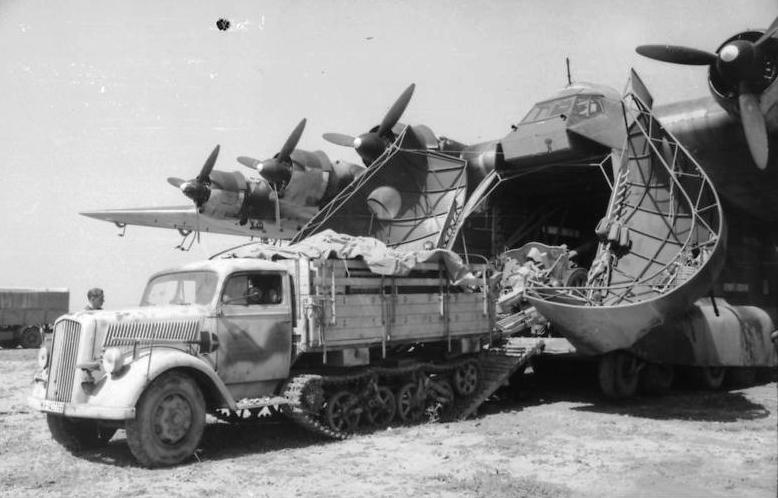
Me-323

Messerschmitt 323 Gigant Disgorging Cargo

A year of researching obscure World War 2 era archival materials has paid off for Italian diver Cristina Freghieri and her team of divers. Although looking for a different wreck, the group discovered the intact remains of a Messerschmitt 323 Gigant downed by a Royal Air Force Bristol Beaufighter on July 26, 1943. The wreck was discovered nearly intact approximately 8 miles off Italy’s Maddalena Islands. Only ~200 Me 323 Gigants were produced during World War 2 and none survive today, thus there is a distinct possibility that the plane will be recovered and restored. Earlier this year the German Navy recovered the remains of a Ju 88 from the Baltic Sea with plans to restore and display the plane at the German Historical Museum’s Air Force Museum.

The Me 323 Gigant was developed from a glider design the Luftwaffe had commissioned in October 1940. The plane could accommodate up to 100 assault troops or 10-12 tons of cargo (by comparison a C-130 can lift 22.5 tons) in the form of field artillery and its halftrack, two trucks or even the ubiquitous 88mm flak gun. By the time they were deployed in late 1942, the Luftwaffe had begun to lose air superiority and the Gigant often fell prey to Allied fighters due to its slow speed. Due to its low volume of production and Allied air superiority, the Gigant never lived up to its full potential.

89 years ago today, air power advocate General Billy Mitchell sank the battleships USS New Jersey and USS Virginia in his third demonstration of the potential of air power in naval warfare. General Mitchell proved that only a handful of bombers and airmen could render impotent 2 former crown jewels of the US Navy.

Two years earlier, in July of 1921, General Mitchell had successfully sunk the former German dreadnought SMS Ostfriesland and vindicated his theory that precision bombing could sink naval vessels. General Mitchell followed up several months later with further tests on the USS Alabama. While tactical bombing had been performed on both sea and land during World War I, no naval vessel had yet fallen prey to air power until Mitchell’s successful tests off the Virginia coast.

After World War I, General Mitchell returned to the US convinced that air power could fundamentally change the way naval warfare was waged. Facing opponents both within the military and in the halls of Congress, Mitchell’s tests on the Alabama, New Jersey, Ostfriesland and Virginia helped pave the way for the age of the aircraft carrier and the obsolescence of the big-gun battleship. General Mitchell was later court-martialed for statements he made about the competence of certain Army commanders. Although Mitchell passed away prior to World War II, his foresight proved prescient as numerous battleships succumbed to air power during the war, most notably HMS Prince of Wales & HMS Renown and the Japanese super-battleship Yamato. The North American B-25 Mitchell bomber was named for General Mitchell – 16 of which would later be launched from the USS Hornet in the Doolittle Raid against the Japanese home islands in 1942.