Archives For November 30, 1999

clipper shipWhen America First Met China provides readers with a fast paced and highly readable account of America’s first commercial encounters with China. Author Eric Jay Dolin traces the origins of America’s trade with China in the years following the end of the American Revolution through the tumultuous period of the Opium Wars and concludes with the role of Chinese laborers in tying the nation together with the Transcontinental Railroad.

Throughout the book, Dolin introduces the various American, British and Chinese personalities who made the early China trade one of the most colorful periods in maritime history. Men such as Robert Morris, Samuel Shaw, Dr. Peter Parker (no relation to Spiderman), Amasa Delano (a distant relative of President Franklin Delano Roosevelt), Charles Elliot, Lin Zexu, and Howqua all come to life through Dolin’s writing. Many of the men, while not household names today, made lasting contributions to American trade, prestige and foreign relations. For instance, a gift from one of the personalities involved in the early China trade, Stephen Girard, helped establish Girard College in Philadelphia – a school for white male orphans which has since become a full scholarship grade 1 – 12 school for children of low-income single parent families.

Additionally, the products involved in the China trade – tea, fur, silk, opium, sandalwood and beche-de-mer are all described in detail. The reader is given a thorough understanding of the economics and production techniques of each commodity without being driven to boredom. Having previously written about both whaling and the fur trade, Dolin is experienced in describing the details of 19th century industries.

Overall, Dolin does an excellent job of detailing the origins of America’s commercial trade with China and its ebb and flow through the post-Civil War Reconstruction years. The numerous illustrations of period engravings, sketches and paintings help the reader better grasp the locations, ships and products involved in the China trade. When America First Met China is accessible to readers with any level of knowledge about maritime or Chinese history and is worth the read.

Coast Guard Cutter Ingham

CC Photo Courtesy of Kay Gaensler on Flickr

During a career spanning more than 50 years, the USCGC Ingham kept the shores of the United States safe for mariners in both war and peace. Commissioned in 1936, the cutter protected the Bering Sea and the fisheries of the Grand Banks until ordered to participate in neutrality patrols upon the outbreak of World War 2. After America’s entry to the war, Ingham helped convoy hundreds of Allied ships across the Atlantic. On December 15, 1942, during routine convoy operations, the Ingham detected and sank the German U-boat U-626. In late July 1944, the Ingham underwent alterations in the Charleston Navy Yard to prepare it to serve as a combined operations and headquarters and ship in the Pacific Theater. Ingham served briefly as a headquarters ship for General Douglas MacArthur prior to his landing in the Philippines.

Following World War 2, the ship returned to peacetime service and her missions included maritime rescue and oceanographic surveying. Ingham was called upon once again to serve in wartime during the Vietnam War. During the war she and her crew became the only Coast Guard cutter to earn 2 Presidential Unit Citations for her naval gunfire support and replenishment missions. Ingham responded to yet another crisis when Cuban dictator Fidel Castro allowed thousands of dissidents to flee his autocratic regime in what became known as the Mariel Boatlift. The Ingham rescued several boaters and towed half a dozen vessels to freedom in the United States. At the time of her decommissioning, the ship was the oldest and most decorated Coast Guard cutter in service. The ship now resides in Key West, Florida as a memorial to the 581 Coast Guardsmen killed in action during World War 2 and the Vietnam War. The ship is open for tours Monday thru Saturdays and more information can be found on their website.

research vessel

Photo: Woods Hole Oceanographic Institute

The US Navy has announced that their newest Auxiliary General Oceanographic Research (AGOR) class of vessels will be named after naval aviator and astronaut Neil Armstrong who passed away last month. The class will be composed of two vessels and construction on the lead ship, R/V Neil Armstrong, began in August. Neil Armstrong is set to enter service in summer 2015.

The Neil Armstrong class of vessels will displace 3,200 tons, stretch 238 feet in length and have a cruising range of 11,500 nautical miles at 12 knots. Neil Armstrong’s 1,800 square feet of dry, wet and computer labs will give its 24 embarked scientists plenty of space to conduct research and exploration operations throughout the globe. In addition to its lab and staging spaces, the Neil Armstrong will be able to launch and recover various ROVs and mini-submersibles with its stern and main cranes. Among the innovations included in the ship’s design is a hull optimized to divert bubbles from the sonar area for enhanced sonar performance.

The ships are funded by the Office of Naval Research, but will be operated by non-profit oceanographic institutes. The yet unnamed second vessel of the class (AGOR 28) will be operated by the Scripps Institution of Oceanography in San Diego, California. Neil Armstrong will be based at the Woods Hole Institute of Robert Ballard fame and conduct most of her operations in the Atlantic.

New Jersey shipwreck

CC Image Courtesy of messycupcakes on Flickr

Step aside Snooki and Pauly D – Florida diver Allan Garner may be set to become the Jersey Shore’s latest celebrity. Garner has filed an admiralty arrest claim on the wreck of the SS Ella Warley. The ship sank in 1863 after colliding with the SS North Star off the New Jersey coast. The North Star, owned by Commodore Vanderbilt, survived the collision and made it safely to New York City. The reason for the collision was disputed, although there were allegations of the Ella Warley’s captain and some of her officers being drunk at the time. Concerning the accusation of drunkenness, the New York Times editorialized, “we believe [it] has not the slightest foundation in truth.” Six crew members of the Ella Warley perished while the North Star suffered no casualties.

Built in 1848 as the SS Isabel, the Ella Warley displaced 1,115 tons and carried cargo and passengers between Charleston and Havana. Following the outbreak of hostilities in 1861, the Ella Warley ran the blockade several times between Charleston and Nassau until it was captured by the USS Santiago de Cuba.

At the time of its sinking the ship was laden with a cargo worth $175,000 and a safe containing $5,000 belonging to Adams Express Company. In addition, a passenger had $8,000 in gold aboard. While the cargo, which according to contemporary accounts consisted of hay, leather, provisions, dry goods and “express matter,” is most likely worthless, the safe’s contents and gold are quite valuable. Assuming the safe’s $5,000 was in gold, then there is the possibility of ~687 ounces of gold lying on the seabed floor amidst the wreckage. At today’s prices, this would mean the wreck is worth more than $1.2 million.

If no one objects to Garner’s claim by Thursday, then the US District Court for the District of New Jersey will award full ownership of the wreck and its contents to Garner. Successors in interest to the insurance company which paid out any claims for cargoes lost on the wreck, Adams Express Company and descendants of the passenger who lost $8,000 in gold are potential claimants and could be awarded a percentage of any recovery. Considering the wreck has been known among New Jersey’s diving community for 20 years, the likelihood is quite high that Garner has found something worth arresting.

Update: The $1.2 million value is for melt value and not the value of the gold if it were in specie form. If the gold were recovered in specie form, then the wreck could be worth upwards 20x of melt value as shipwreck specie commands a significant premium in the collector market.

Bonhomme Richard

Battle of Flamborough Head
Photo: US Navy, Painting by Thomas Mitchell

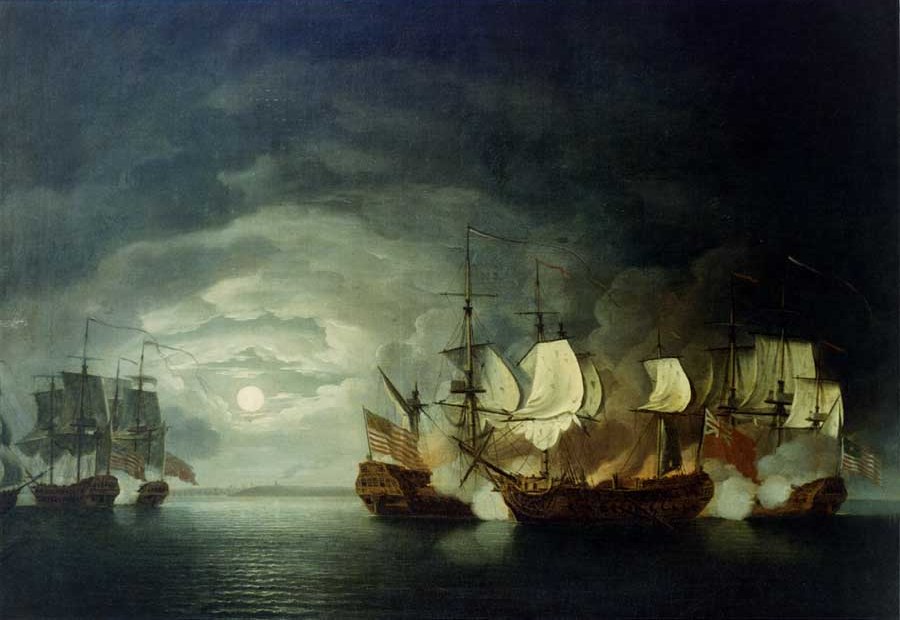
One of the most famous battles in the US Navy’s history occurred 233 years ago today on September 23, 1779. Captain John Paul Jones and his converted East Indiaman USS Bonhomme Richard along with USS Alliance attacked a British convoy protected by HMS Serapis and Countess of Scarborough. In what became known as the Battle of Flamborough Head, Jones and his crew engaged the Serapis in a ship-to-ship duel. Captain Pearson of the Serapis demanded Jones’ surrender and in reply he uttered the now famous words, “I have not yet begun to fight.”

Though outgunned, Jones’ superior  fighting skills carried the day and the Serapis eventually struck its colors. Despite having defeated the British forces (Countess of Scarborough struck her colors as well), the Bonhomme Richard sank the next morning and Jones transferred his flag to the Serapis. Jones’ victory was not the last in which an American naval force engaged British forces while penning a famous phrase

The wreck of the Bonhomme Richard is considered one of the crown jewels of shipwrecks and has been the subject of several discovery expeditions. Unfortunately none have been able to locate the wreck and its final resting place off Flamborough Head remains a mystery. John Paul Jones is considered the father of the American Navy and his words “I wish to have no connection with any ship that does not sail fast for I intend to go in harm’s way” are just as famous in naval circles as “I have not yet begun to fight.” Sadly, Jones never held a significant sea command in the US Navy after the Battle of Flamborough Head and died an Admiral in the Russian Navy.

jolly roger

CC Image Pirated From Scott Vandehey on Flickr

To recognize International Talk Like a Pirate Day, here are a few piratical items of note…

Captain Morgan, the Diageo owned rum distiller, funded excavations at the site of the real Admiral Morgan’s shipwreck this summer. No word if any rum has been found aboard the wreck or if the salvage crew were cited for operating an ROV under the influence.

Excavations continue on both Captain Sam Bellamy’s Whydah and Blackbeard’s Queen Anne’s Revenge. Artifacts from both wrecks can be viewed at their respective museums in Provincetown, Massachusetts and Beaufort, North Carolina.

According to the Maritime Executive, there were 17 pirate attacks just last month. This month, pirates even fired upon an Italian naval helicopter. A map of pirate attacks in 2012 can be viewed here.

Last year, 35 people lost their lives while being held hostage by Somali pirates. As of August 30, there were 11 vessels and 188 hostages being held by Somali pirates. In addition to the human costs of piracy, experts estimate that the financial costs of piracy was around $6.6 – 6.9 billion in 2011 alone.

Piracy along the coast of Somalia has become such a problem that one of the primary reasons for the 2007 creation of the US’s Africa Command (AFRICOM) was the fighting of piracy. It’s rumored that the servicemen of AFRICOM will star in Disney’s upcoming film Pirates of the Caribbean: On Somali Tides.

civil war navy

Pulitzer Prize winning author James M. McPherson’s latest book, War on the Waters, is a concise naval history of the American Civil War. Most authors and historians focus on the great generals (Lee, Jackson, Grant, Sherman, etc.) or the great battles (Antietam, Chancellorsville, Gettysburg, Shiloh etc.) and often ignore the vital role the navies played in the conflict both on the rivers of the western Confederacy and the high seas. Entire books have been written on various aspects of the naval war – riverine warfare in the west, blockade running, Confederate merchant raiders, foreign intrigue in Europe and the innovations that made their debut in the conflict. McPherson neatly summarizes each of these topics and arranges them in easily digestible chapters that proceed in chronological order.

McPherson’s organization and writing style allow both the uninitiated reader and the Civil War buff to understand the ebb and flow of the conflict and the various personalities, events and inventions that influenced the war. Perhaps most importantly, McPherson accompanies his chapters with strategic or tactical level maps that enable the reader to understand the events which occur in the chapter. McPherson understands the unwritten rule that the inclusion of a relevant map is worth multiple pages of text in helping a reader establish an awareness of the events being described. Along with the maps, various etchings and photos accompany each chapter and neither maps nor illustrations are confined to a few pages in the center or the beginning of the book. This allows the reader to visually grasp the crux of each chapter and makes both the maps and the illustrations more relevant to the narrative being told.

Overall, War on the Waters is a fantastic single volume history of the Civil War’s naval history. McPherson hits all of the highlights of the Civil War – CSS Virginia vs. USS Monitor, blockade running, William B. Cushing’s daring raid on the CSS Albemarle, and the first successful attack by a submarine – in only 225 pages. War on the Waters is a welcome addition to the naval literature of the Civil War and will be enjoyed by anyone interested in American history, naval history or the Civil War.

submarine

Photo: US Navy

One wouldn’t expect to find a museum ship in Oklahoma, much less an American World War 2 submarine, but the USS Batfish has made its final resting place in Muskogee, Oklahoma just southeast of Tulsa. The Batfish, a Balao class submarine, was commissioned on August 21, 1943 and made 7 war patrols during the course of World War 2. She is officially credited with sinking 6 Japanese ships, however, her ship’s crew claimed 15 ships sunk and such discrepancies are not uncommon. Among those 6 ships were 3 Japanese submarinesgranting Batfish entry into the exclusive fraternity of submarines that have sent other submarines to the bottom. The Batfish and her crew earned a Presidential Unit Citation, 10 Bronze Stars, 4 Silver Stars and a Navy Cross for their actions in World War 2.

Following World War 2, the Batfish served as a training vessel in the Pacific Fleet and was decommissioned in 1969. In 1973, after much political wrangling by various parties, the Batfish made her final voyage up the Arkansas River to Muskogee where she now continues her service, this time as a museum and memorial to the valiant submariners who perished defending liberty and freedom in World War 2. The ship is open to visitors from March to November. 

Oliver Hazard Perry

CC Image courtesy of Archives de la Ville de Montreal on Flickr

Today marks the 199th anniversary of the Battle of Lake Erie fought between American and British forces for control of the Great Lakes region on September 10, 1813. After British forces captured Detroit, MI, American military planners decided to build a small fleet near Presque Isle to wrest back control of Lake Erie and allow the recapture of Detroit. A force of 9 ships were quickly hewn from local forests and Master Commandant Oliver Hazard Perry sent to take command of the force.

On the morning of September 10, 1813, 6 ships under the command of Royal Navy Commander Robert Heriot Barclay moved to sweep the American force from the lake. While outnumbered 6 to 9, the Royal Navy squadron possessed more cannons (63) than the Americans (54) and the British cannons had a longer range than the Americans which had primarily equipped their ship with close-range carronades.

In a tribute to Captain James Lawrence who had lost his life aboard the USS Chesapeake earlier that year, Perry’s battle flag stated “Don’t Give Up the Ship.” At the outset of the battle, Barclay’s squadron had the advantage over the American vessels as possession of the weather gauge allowed his ships to outmaneuver the Americans and use their longer range fire power to pound the Americans. The British used their advantage to batter Perry’s flagship USS Lawrence into a hulking wreck, but undeterred, Perry transferred his flag from the Lawrence to the USS Niagara where he continued the action. Perry’s fleet had not let the British escape unscathed, though, as Commander Barclay and several of his officers had been wounded, putting command of the ships in the hands of less experienced officers. The British attempted to wear-to in order to bring their opposite broadsides to bear on Perry’s bruised fleet, but miscommunication and poor seamanship caused two of the British vessels to collide. Perry then split the British column, a maneuver even more deadly than “crossing the T,” allowing his ships to pour fire from both broadsides into the British squadron. This effective maneuver by Perry and his squadron devastated the British ships and one by one the squadron surrendered, giving Perry and his squadron the greatest American naval victory of the War of 1812.

Perry’s victory at the Battle of Lake Erie opened the door for an American invasion of Canada and the recapture of Detroit. It also was the first time an entire British squadron had surrendered in battle. Oliver Hazard Perry became an overnight American hero and his notification of victory, “We have met the enemy and they are ours,” has been forever written in American naval history. More than half a dozen ships, including a class of modern-day frigates, have been named in his honor and the latest ship to bear his name is currently under construction in Perry’s home state of Rhode Island.

Morro Castle Fire

Photo: Wikimedia Commons

78 years ago today, a devastating fire destroyed the passenger liner SS Morro Castle off the coast of New Jersey. Operating between Havana and New York City, the liner had been built in 1930, but her builders failed to incorporate the latest safety features into her design. The fire began in a storage room around 3am and quickly spread throughout the ship. The ship’s highly flammable materials, de-activation of the trip wires for the ship’s fire doors and poor structural design allowed the Morro Castle to be engulfed in flames in just minutes. 135 passengers and crew perished in the disaster and the Morro Castle was beached and later sold for scrap. 

Partly because the Morro Castle burned so close to shore (and was a beach front attraction for several weeks before being towed to the breaker’s yard), the disaster served as the catalyst for more stringent maritime safety laws in the form of the Merchant Marine Act of 1936. It also influenced an entire generation of naval architects, including William Francis Gibbs the designer of the SS United Statesto introduce multiple safety innovations in the next generation of passenger liners. Earlier this year, New Jersey authors Gretchen Coyle and Deborah Whitcraft published Inferno At Sea documenting the Morro Castle disaster. The authors interviewed survivors and archival materials to produce the most recent account of the maritime tragedy.