Archives For November 30, 1999

Me-323

Messerschmitt 323 Gigant Disgorging Cargo

A year of researching obscure World War 2 era archival materials has paid off for Italian diver Cristina Freghieri and her team of divers. Although looking for a different wreck, the group discovered the intact remains of a Messerschmitt 323 Gigant downed by a Royal Air Force Bristol Beaufighter on July 26, 1943. The wreck was discovered nearly intact approximately 8 miles off Italy’s Maddalena Islands. Only ~200 Me 323 Gigants were produced during World War 2 and none survive today, thus there is a distinct possibility that the plane will be recovered and restored. Earlier this year the German Navy recovered the remains of a Ju 88 from the Baltic Sea with plans to restore and display the plane at the German Historical Museum’s Air Force Museum.

The Me 323 Gigant was developed from a glider design the Luftwaffe had commissioned in October 1940. The plane could accommodate up to 100 assault troops or 10-12 tons of cargo (by comparison a C-130 can lift 22.5 tons) in the form of field artillery and its halftrack, two trucks or even the ubiquitous 88mm flak gun. By the time they were deployed in late 1942, the Luftwaffe had begun to lose air superiority and the Gigant often fell prey to Allied fighters due to its slow speed. Due to its low volume of production and Allied air superiority, the Gigant never lived up to its full potential.

russian nuclear powered icebreaker

Icebreaker off Antarctica
CC Image Courtesy of Matt Geske on Flickr

Russia recently commissioned the building of the world’s largest nuclear powered icebreaker in an effort to increase traffic in the Northern Sea Route and better compete for resources in the Arctic. Global warming (anthropogenic or not) has made use of the Northern Sea Route a viable possibility in the past few years and the Barents Observer is reporting that a record amount of cargo may transit the route this year. The current record is 820,789 tons of cargo and 749,706 tons have already made their way through the shipping lane in 2012. Russia hopes to increase trade at its northern ports as the Northern Sea Route stays open longer and longer each season and through the artificial extension of the shipping season via use of its yet to be named icebreaker.

The new icebreaker will be 558 feet long and 102 feet wide, making the vessel 46 feet longer and 12 feet wider than any other icebreaker in Russia’s fleet. The ship’s enormous size will enable it to break up thicker sheets of ice than other ships. In addition to being vastly larger than anything currently in the Russian icebreaking fleet, the ship will have on-board ballast tanks allowing it to raise and lower its draft from 28 to 35 feet. Thus the ship will be able to sail up previously inaccessible Siberian rivers. Powering the icebreaker will be dual nuclear reactors producing 60 megawatts of power which make it capable of towing ships displacing up to 70,000 tons through Arctic waters. While the selection of nuclear reactors as a power source for civilian ships may seem strange, Russia’s first nuclear powered icebreaker, Lenin, first sailed in 1959 and the country currently operates around a dozen nuclear powered icebreakers. As a sidenote, the US experimented with nuclear powered civilian vessels beginning with the launch of the NS Savannah in 1959, but ceased operating her in 1972 due to cost inefficiencies.

While the icebreaker is chiefly intended for improving the commercial flow of goods in the Arctic, the ship’s strategic value can not be ignored. Russia, Norway, Denmark, Canada and the US have all laid claim to parts of the region in order to secure access to the oil and gas believed to be located beneath the seabed. Just as China views its deep water oil rigs as “strategic weapons,” Russia’s possession of the most capable icebreaker in the world will have serious implications in who exercises control of the region.

Shi Lang

Former Soviet Carrier Varyag
Photo: Information Dissemination

China’s first aircraft carrier is finally getting an official name.  Blogger Andrew S. Erickson, an expert in Chinese naval affairs, is reporting that an official state media outlet has stated that the ship’s name will be Liaoning, in honor of the province where the ship was recently re-built. The ship’s name has been the source of much speculation with it often being referred to as Shi Lang in Western news reports. While many might scoff at the hubbub surrounding the naming of the carrier, its name will carry some significance regarding Chinese attitudes towards other countries in the region. Shi Lang was a Qing general who subdued Taiwan through a seaborne invasion and the naming of the ship after him would have had sinister overtones for Chinese-Taiwanese relations. Another name choice reportedly debated within government circles was Diaoyu Dao which is an island group controlled by Japan, but disputed by both China and Taiwan. Either of those names would have indicated a bellicose attitude towards Japan and/or Taiwan.

Liaoning was originally launched as the Varyag in 1988 by the Soviet Union and remained unfinished at the time of the collapse of the Soviet Union. China purchased the Varyag from the Ukraine in 1998 and the ship sat derelict for several years until the decision was made to rebuild the carrier to fulfill its original role. Re-building of the ship was completed earlier last year and she has undergone multiple sea trials since. Naval experts have differed as to whether China intends to use the carrier for belligerent purposes or merely as a training vessel. It takes years to hone the skills necessary to effectively conduct the air-sea ballet that is carrier operations and it is most likely that the Liaoning will serve merely to train the crew and officers of the follow-on carriers China intends to build. The Chinese have even built a mock-up of the ship on dry land to get a head-start on training its newest generation of naval aviators.

Viking Longboat

The Viking by C. Graham. 1893.

In 1892, Norwegian Magnus Andersen embarked on an ambitious project – building a full-size replica of the Gokstad Viking ship that had been discovered 12 years earlier in a burial mound near Gokstad, Norway. As if replicating a nearly 80 foot wooden ship wasn’t enough, Andersen then sailed the ship from Norway to New York City up the Hudson River to the Erie Canal through the Great Lakes and finally to Chicago for the World’s Columbian Exposition. Andersen’s exploits made waves both literally and figuratively at the Exposition and later as he sailed to New Orleans and back to Chicago.

The ship is now housed in Geneva, IL just outside Chicago and is considered one of Illinois’ most endangered historical landmarks. Friends of the Viking Ship have stepped up to preserve the ship and are currently resolving legal ownership issues so they can raise money to permanently house the ship in a climate controlled facility. The ship is open to the public from 1 – 4pm this Saturday (September 15, 2012) as well as October 20, 2012. For more information, see the Friends of the Viking Ship website.

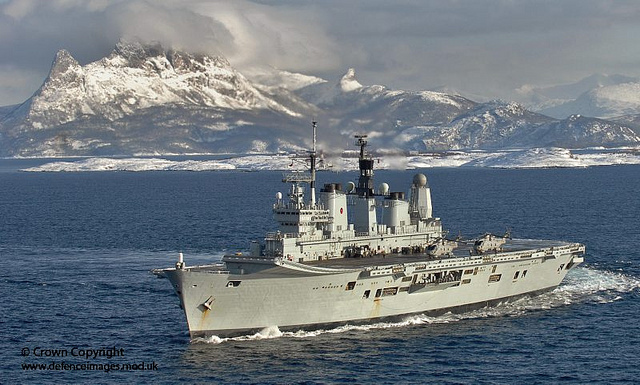
British aircraft carrier

HMS Ark Royal off Norway in 2008
Photo: MOD

The Telegraph is reporting that the HMS Ark Royal, the Royal Navy’s only remaining aircraft carrier, is finally being sold for scrap. The ship was originally to remain in service until 2016 or 2017 when it would have been replaced by HMS Queen Elizabeth, the first of the Queen Elizabeth class aircraft carriers. Budgetary issues, though, caused the Ministry of Defence to rethink their time table and remove the ship from service early. The Ark Royal was decommissioned in March of 2011 and an internal debate within the UK government about its final disposal has caused delays in the decision. Among the various scenarios considered for the Ark Royal’s ultimate fate were it being sunk as a wreck site for divers, converted to use as a London heliport, converted into a Hong Kong casino, refitted for hotel use (much like the former Soviet carrier Kiev) or sold for scrap. Ultimately the Ministry of Defence chose to scrap the vessel for £3 million.

The Ark Royal was laid down in 1978 and commissioned in 1985. She was the third and final ship of the Invincible class carriers and was designed to operate short take-off and vertical landing (STOVL) aircraft and helicopters from her flight deck. Her sister ship HMS Invincible saw service in the Falklands War and was sold for scrap earlier last year. Her other sister ship HMS Illustrious served in the Balkans conflict of the 1990s and has since joined HMS Ocean as a helicopter carrier. Ark Royal was the fifth Royal Navy ship to carry the name with previous ships having fought against the Spanish Armada, the German High Seas Fleet, the Nazi Kriegsmarine (lost to a u-boat in 1941) and in post-World War 2 service. The current Ark Royal provided air cover for operations in the Balkans in 1993 – 1994 and in the invasion of Iraq in 2003.

Following the retirement of the the Ark Royal in March 2011, the UK Ministry of Defence sold its remaining Harrier STOVL jets to the US Marine Corps to be used for spare parts. This decision has left the Royal Navy with only 1 fixed wing aircraft until the entry of the F-35 into service. While the Ministry of Defence is much better prepared to resist an invasion of the Falklands than it was in the 1980s, the loss of its seaborne fixed-wing aircraft capability until 2016 has left the UK increasingly reliant on allies (such as the French in their agreement to jointly operate the Charles de Gaulle) in the shaping of its foreign policy. Gone are the days when an enlightened British citizenry could call for the outlawing of the slave trade and the Royal Navy unilaterally enforce the prohibition. This further erosion of British autonomy has most assuredly set Lord Nelson and Winston Churchill to spinning in their graves.

Blackbeard

Edward Teach, aka Blackbeard
Photo: Wiki Commons

An archaeological team from the North Carolina Underwater Archaeology Branch will spend eight weeks excavating the Queen Anne’s Revenge, the flagship of famous pirate Blackbeard. The vessel was discovered in 1996 near Beaufort, NC and several excavations have been conducted by the state’s Underwater Archaeology Branch over the past few years. Numerous cannons, the ship’s anchor and approximately 16,000 artifacts have been recovered thus far. A permanent exhibit at the Beaufort branch of NC’s Maritime Museum opened in June 2011 to display the artifacts and educate visitors about the life of a pirate. Blackbeard’s name has become synonymous with 18th century piracy even though his career lasted a mere two years before he was killed in 1718 during a fight with Royal Navy forces near Ocracoke, North Carolina. The Queen Anne’s Revenge is only the second pirate ship to be discovered and excavated, with the other being the Whydah off the Massachusetts coast.

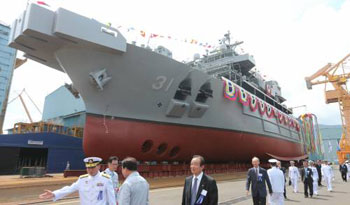
Korean Rescue Ship

Photo: Naval Open Source INTelligence

Yesterday, South Korea launched the Tongyeong, its first domestic manufactured rescue and salvage ship. The Tongyeong was laid down in October of 2010 and will join the ROK Navy next year after final fitting out and trials are completed. The ship is intended to broaden the ROK Navy’s salvage and rescue capabilities which are currently served by two former US Navy Vessels.  Both vessels are nearing the end of their service lives and the ROK Navy will now be able to respond in half the time to disasters in far-reaching islands.

The Tongyeong displaces 3,500 tons and is capable of 21 knots. Armed with an ROV, side-scan sonar, a dynamic position system and various winches, the Tongyeong can search on and below the seas for wrecked vessels and is capable of towing vessels displacing up to 15,000 tons. The ship has onboard medical facilities for treating survivors at sea and can medevac patients via its helipad. With South Korean shipyards now some of the largest in the world, it is only fitting that the ROK Navy can benefit from domestically produced ships and not rely on second-hand ships for rescuing stranded mariners.

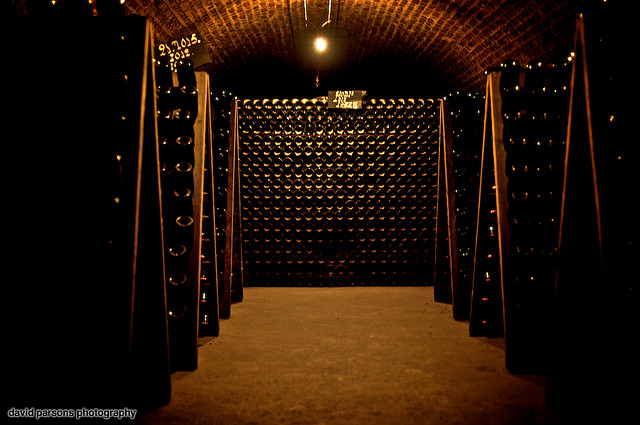
Finland Shipwreck Champagne

CC Image courtesy of David Parsons on Flickr

According to the German publication Deutsche Welle, another 8 bottles from a 168 bottle collection of champagne are set to go under the auctioneers hammer. The champagne was discovered two years ago by diver and (ironically enough) brewery owner Christian Ekström. Ekström was exploring a wrecked schooner off the coast of the Åland Islands when he came upon the bottles at the site. Researchers believe the schooner sank in the 1840s making Ekström’s find the oldest champagne ever found. Now, two years after the discovery, 10 of the bottles have been sold at auction with one, a Veuve Clicquot, selling for a record breaking $26,700. Authorities on the Åland Islands plan to hold auctions of the champagne over the next few years as a method of bringing tourists to the area.

Ekström’s find isn’t the first fermented treasure trove found in the Baltic as there have been both beer and other champagne caches discovered in recent years. The discovery and re-creation of Antarctic explorer Sir Ernest Shackleton’s whiskey, though, is still perhap the most noteworthy alcoholic find of the past few years.

Merchant Navy Flag

UK Merchant Navy Ensign
CC Image courtesy of L2F1 on Flickr

Today the United Kingdom, along with Australia, Canada and New Zealand, remembers the sacrifices of their merchant marine from World War One to the present day. The Merchant Navy has served in WWI, WWI, Korea, the Suez Crisis, the Falklands War, and Gulf Wars I & II. More than 14,500 seamen lost their lives in World War I and another 30,000 perished during World War II. September 3rd was chosen as the date to honor the Merchant Navy because September 3, 1939 marked the first loss of British shipping in World War 2 – the SS Athenia. Two shipwrecks, SS Storaa and M/V Atlantic Conveyor, have subsequently been designated protected places under the UK Protection of Military Remains Act. Storaa was lost in World War One to a German u-boat while Atlantic Conveyor is the most recent Merchant Navy loss, having been sunk while supporting British efforts to free the Falkland Islands from their Argentinian invaders.

USNS Spearhead

Joint High Speed Vessel Concept Rendering

Despite Hurricane Isaac disrupting Austal’s Mobile, AL shipyard operations for two days, the USNS Spearhead has now completed its performance and acceptance trials for the US Navy. Successful completion of the trials means the Navy should soon be accepting the first of 9 Joint High Speed Vessels (JHSV) into service. The second ship in its class, USNS Vigilant, is set to be christened September 15th.

The JHSVs were designed to act as fast transports for deploying US servicemen throughout the world in support of combat and humanitarian missions. Austal, the winner of the Navy contract for design and construction of the vessels, drew upon its experience building civilian catamaran ferries to produce the ship. The JHSV can embark 312 troops in airline style seating and has on-board berthing for 150 plus 41 crew. Its rear loading ramp can accommodate vehicles up to the size of an M1A Abrams tank and can operate a single helicopter off of its landing pad. The JHSVs are designed to operate in austere conditions and can disembark their troops and cargo without advanced port facilities. A single JHSV can move a Marine or Army company with all of their equipment or an entire battalion if operating solely as a troop transport. Additionally, the vessel can transport troops and equipment 25% cheaper than an airlift operation and around 50% faster than current seaborne options.