Archives For November 30, 1999

Last week, researchers announced the discovery of the famous polar exploration vessel SS Terra Nova in waters off the southern coast of Greenland. SS Terra Nova was discovered during routine tests of mapping equipment aboard the Schmidt Ocean Institute’s R/V Falcor. The ship is lying in less than 160M of water, but its exact location has not been disclosed by Schmidt Ocean Institute.

Lost in 1943 after a collision with an ice pack, the SS Terra Nova was built in 1884 to withstand the rigors of operating as a whaler and sealer in polar regions. Following a ten year commercial career, the ship served the Jackson-Harmsworth Arctic Expedition from 1894 – 1897. Terra Nova is most famous, though, for its role in Captain Robert Scott’s doomed Terra Nova Expedition (1910 – 1912).  Captain Scott and his team of British explorers sought to become the first humans to reach the South Pole; however they were beaten by a Norwegian team led by Roald Amundsen. Amundsen’s party reached the South Pole on December 14, 1911, beating Scott by approximately 30 days. Scott’s team perished on their return trek and their bodies were not discovered until nearly 8 months later. In death, Scott was mythologized throughout his native Britain and has been the subject of numerous books and articles. Historians continue to debate his legacy – historian Roland Huntford’s The Last Place on Earth is a stinging critique of Captain Scott while polar explorer Sir Ranulph Fienne’s Captain Scott defends Scott and the choices he made during the expedition.

Photo: Shipspotting.com

The lure of easy money has long driven salvors and their financial backers to chase rumors of buried treasure. Unfortunately for many, the vast amounts of money necessary to find a ship, much less recover it, has often resulted in bankruptcy. For others, though, the successful location and excavation of a ship garnered them nothing more than worthless trinkets.  One of the greatest and costliest failures in shipwreck hunting history is the search for the Japanese WWII transport Awa Maru.

Guaranteed safe passage by the US government, the Awa Maru sailed for Tokyo from Singapore with more than 2,000 Japanese civilians and medical supplies in late March 1945. Although the ship was marked with a red cross and instructions given to US forces to grant the Awa Maru safe passage, a tragic miscommunication resulted in the torpedoing of the ship by the USS Queenfish on April 1, 1945.  Of the 2,004 souls on board, only one survived. The US submarine commander was removed from command and court-martialled. Rumors immediately began to run rampant that the ship was carrying millions of dollars in precious metals and artwork.

In the late 1970s, the People’s Republic of China began hunting for the wreck and successfully located it. Over the course of 3 dive seasons, Chinese salvors made 10,000 dives and and cleared 10,000 cubic meters of mud from the site.  In addition, the Chinese spent $20 million on the Dalihao, a specialized salvage barge, to perform work on the site. The Chinese eventually declared defeat after only finding human remains and personal effects which were sent to Japan. A declassified 1981 US government document revealed that the treasure was never aboard the Awa Maru, that it had been shipped via another vessel and that the Chinese expended millions of yuan and thousands of man-hours chasing after a treasure that had never existed. In defense of the Chinese efforts, though, noted shipwreck treasure expert Nigel Pickford listed the Awa Maru in his 1995 book The Atlas of Shipwrecks & Treasure as a significant treasure ship lost during World War Two.

Photo: Nick Messinger

A century old mystery may soon be solved in the frigid depths off Alaska’s coast. The SS Islander, a 240 foot liner operated by the Canadian Pacific Navigation Company, sank on August 15, 1901 while en route from Skagway, Alaska to Vancouver, British Columbia. Approximately 40 people perished in the sinking including the highest government official of the Yukon Territory. The steamer was purportedly carrying 6 tons of gold which led to a series of salvage efforts beginning only weeks after the ship’s sinking. Not until 1934, though, were any successful attempts made due to hazardous working conditions and primitive salvage equipment. The 1934 expedition used a process similar to that employed on the Swedish Vasa shipwreck to raise a 175 foot section of the ship and beach it on shore. The tremendous efforts expended to float the ship are documented in Sunken Klondike Gold written by the expedition’s official photographer, Leonard Delano. Unfortunately for the salvors, only $75,000 in gold dust and nuggets was found – not even enough to cover the expedition’s costs. Either the 6 tons of gold was never aboard or it had been stored in the Mail and Storage Room in the bow of the ship which wasn’t recovered.

Eight decades later another group, Ocean Mar, Inc., has returned to (hopefully) complete the salvage of the ship. Ocean Mar began its efforts in the early 1990s, but were stymied by legal wranglings with another salvage company – Yukon Recovery LLC. A federal court finally resolved the dispute in June of 2012 and the state of Alaska issued Ocean Mar, Inc. a work permit for the site this week, nearly 111 years to the day since the ship’s sinking. The permit extends through December 31 and the Alaska State Museum will serve as a repository for salvaged artifacts. If recovered, the melt value of the gold alone would be worth more than $300,000,000.00 in 2012 dollars. Ocean Mar has a salvage agreement in place with Salvage Association of London whereby Ocean Mar would pay Salvage Association 25% of any recovery in order to pay off any insurers’ claims.

Photo: Charles McCain

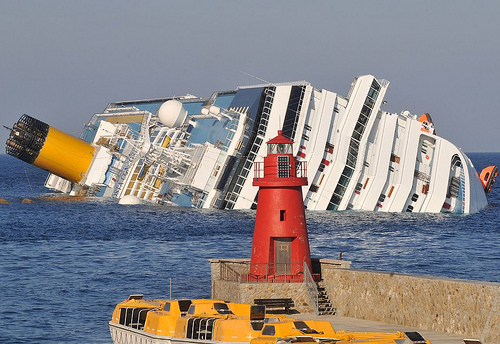
Earlier this week, Titan Salvage and its Italian partner Micoperi presented updated salvage plans for the stricken cruise ship Costa Concordia to the Italian goverment. Titan/Micoperi’s initial plan called for removal of the ship in January 2013, but delays in subcontractor deliveries has pushed the completion date to spring of 2013.

Immediately after the wreck on January 13, 2012, all fuel oil was pumped out of the ship’s bunkers and a bidding process initiated for salvage proposals. Titan/Micoperi was awarded the salvage contract and began planning for the removal of the ship from the coast off the Italian island of Giglio.  Titan has salvaged some of the world’s most difficult wrecks and has now completed initial environmental and site assessment for the Concordia salvage. The wreck initially hurt the general tourism industry on Giglio, but “disaster tourism” has spurred an increase in day trippers ferrying to the island to gawk at the wreck.

As this year’s recovery season winds down, noted exploration company Odyssey Marine is wrapping up two deep water recoveries (the SS Gairsoppa and SS Mantola) and currently on hold with the excavation of HMS Victory.  The 2012 season marked several firsts for Odyssey – the completion of a shipwreck salvage under government contract, the validation of their deepwater recovery methods and the beginnings of legitimacy for their role in “academic” archaeology with their efforts on the HMS Victory. What lies ahead for Odyssey is a question of much debate.  Below are five of the most discussed targets for Odyssey along with pros and cons for each.

1.  Merchant Royal – widely believed to be the target of Odyssey’s “Atlas” search, the Merchant Royal went down in a storm off Great Britain in 1641 with a cargo of gold and silver valued around ~1 billion in current dollars. This is the Holy Grail of shipwrecks and would be an incredible find both for the monetary and publicity windfall. Apart from the difficulty involved in locating the wreck, there are no significant cons to recovering the Merchant Royal.

2.  Prins Frederik – sunk in 1890 after a collision with the Marpessa in the Bay of Biscay, this Dutch mail steamer carried 400,000 silver rijksdaalders in its bullion room. Disputes over the actual location of the ship (and thus who was to blame for the collision) have created a wide search area and significantly affect the depth of water it could be located in – 500 feet if where the captain of the Prins Frederik claimed or 6,000 feet if where the captain of the Marpessa claimed. A British company claimed to have found the wreck in shallow water in 1994 which could generate legal issues for Odyssey if it is indeed the Prins Frederik. Odyssey could also face legal claims from insurers who paid out on claims or the Dutch government as the cargo was for payment of colonial forces in Indonesia. The Prins Frederik would be an excellent target for an arrangement similar to the Gairsoppa and Mantola where the Dutch government receives a portion of the proceeds after expenses.

3.  I-52 – re-discovered in 1995 by Paul Tidwell, the I-52 was sunk by American naval forces in 1944 while en route from Japan to Nazi Germany. The I-52 was carrying 2.2 tons of gold and now sits in 17,000 feet of water. While Odyssey’s deepwater recovery methods would enable recovery of the wreck, apart from a multi-party agreement on salvage rights between Tidwell, the Japanese government and Odyssey no recovery is possible. Tidwell has also stated he is pursuing recovery of the sub and it is doubtful Odyssey would be brought in on the deal.

4.  Port Nicholson – a British freighter loaded with $3 billion in platinum, the Port Nicholson was torpedoed off the coast of Massachusetts in 1942 and was located in 2008 by Sub Sea Research.  Sub Sea Research gained title to the ship in 2009 and planned recovery in 2012. No word has emerged on whether or not the group has been successful in their salvage and there are doubts as to whether the platinum even exists onboard.  If Sub Sea is unable to recover the wreck due to a lack of expertise or funding, then a collaboration with Odyssey would benefit both parties and be the most valuable recovery yet, surpassing even Odyssey’s Black Swan recovery (and subsequent loss).

5.  Bonhomme Richard – John Paul Jones’ famous flagship went down after his epic battle with HMS Serapis. The past few years have seen renewed efforts to find the ship, but any recovery would be limited by the doctrine of sovereign immunity. Because the Bonhomme Richard was an American warship it cannot be salvaged without the permission of the US government. An arrangement with the US government similar to that of the HMS Victory one is a possibility, but doubtful because the upside isn’t nearly as high as it is for other wrecks.

There are dozens of other wrecks Odyssey could be pursuing – the company claims to have dozens of high value shipwreck targets in its proprietary database. Based on Odyssey’s stated business model of pursuing high value targets with easily ascertainable legal ownership and inaccessible to normal salvors, Odyssey will most likely pursue deepwater commodity shipwrecks where the cargo can be quickly monetized and not the storied Spanish Galleons of treasure hunting lore.

Disclosure: I am an Odyssey Marine shareholder.

Baltic Sea UFO

August 16, 2012 — 1 Comment

Diver Peter Lindberg recently sat down with Red Ice Radio to discuss the “Baltic UFO” that was reported in several major media outlets earlier this summer (see here and here). At the beginning of this year’s recovery season, Ocean X, a Swedish salvage company, began further investigations of an underwater anomaly it discovered last year.  Some outlets questioned the veracity of Ocean X’s claims, allegations which Lindberg addressed in his interview.

Lindberg explained that he believes the most likely explanation is that the odd rock formation is an underwater volcano or, if artificial, a relic of the Ice Age.  He asserts that he never claimed for it to be a UFO and further research has ruled out it having been constructed during either world war. Much of the UFO speculation arose from Ocean X’s constant reports of interference at the dive site with its electronic equipment. Lindberg stated that while electronics and water don’t mix and equipment problems are common on dives, he’s never seen this level of interference.

His team just completed operations necessary to create a computerized 3D image of the object and have taken samples from loose rock around and atop it.  Ocean X is working with Stockholm University to process the data and samples and hopes to return to the site with a geologist and the tools to take a core sample. The team also used a frequency meter to determine whether or not the object was emitting radio frequencies and are awaiting final results.

While some may question whether or not Ocean X is using their “find” to garner publicity, Lindberg’s previous success in recovering the $8 million “Jonkoping Champagne” from the depths of the Baltic Sea definitively established his maritime exploration and salvage bona fides.

For the full interview, go to Red Ice Radio.