Archives For November 30, 1999

HMS Hood

CC Image courtesy of Patrick McDonald on Flickr

An expedition led by Microsoft co-founder Paul Allen aboard his mega-yacht Octopus has been forced to abandon their efforts to recover the ship’s bell of the Royal Navy battlecruiser HMS Hood. Allen and his team have been operating out of Reykjavik, Iceland for the last two weeks, but a combination of weather and mechanical issues with their ROV have caused the team to end its efforts on the Hood this recovery season. Named for Admiral Samuel Hood, the Hood was the second ship to bear his name. The ship entered service in 1920 and is best known for its role in the hunt for the German battleship Bismarck.

HMS Hood and the battleship HMS Prince of Wales intercepted the Bismarck on May 24, 1941 as the Bismarck and heavy cruiser Prinz Eugen attempted to break out into the North Atlantic in hunt of British merchantmen. In a running battle lasting less than 20 minutes, the Bismarck sank the Hood and damaged the Prince of Wales. The Hood took with it 1,415 of her 1,418 man crew. The engagement became known as the Battle of the Denmark Straits and was merely the opening act of a massive 3 day manhunt culminating in the sinking of the Bismarck on May 27th. The Prince of Wales went on to serve in the Pacific Theater where it, along with the battleship HMS Repulse, was sunk by a Japanese air attack. Prinz Eugen survived the war and was later used as a target ship by the US Navy for atomic bomb tests.

Merchant Navy Flag

UK Merchant Navy Ensign
CC Image courtesy of L2F1 on Flickr

Today the United Kingdom, along with Australia, Canada and New Zealand, remembers the sacrifices of their merchant marine from World War One to the present day. The Merchant Navy has served in WWI, WWI, Korea, the Suez Crisis, the Falklands War, and Gulf Wars I & II. More than 14,500 seamen lost their lives in World War I and another 30,000 perished during World War II. September 3rd was chosen as the date to honor the Merchant Navy because September 3, 1939 marked the first loss of British shipping in World War 2 – the SS Athenia. Two shipwrecks, SS Storaa and M/V Atlantic Conveyor, have subsequently been designated protected places under the UK Protection of Military Remains Act. Storaa was lost in World War One to a German u-boat while Atlantic Conveyor is the most recent Merchant Navy loss, having been sunk while supporting British efforts to free the Falkland Islands from their Argentinian invaders.

HMS Ajax

HMS Ajax
CC Image courtesy of Charles McCain on Flickr

Only two days after the Nazi invasion of Poland on September 1, Great Britain declared war on Germany and dispatched the Royal Navy to clear the seas of Germany’s merchant fleet and warships. Within hours of the commencement of hostilities, the light cruiser HMS Ajax encountered the German merchantman Olinda off the coast of Uruguay and promptly destroyed the ship with gunfire. Shortly thereafter, Ajax found and sank another Nazi freighter, the Carl Fritzen. Ajax continued to serve on the South American Station until February 1940 when it returned to the UK for a refit. While on station, Ajax along with HMS Exeter and HMS Achilles accounted for the destruction of several more German merchant ships. Additionally, Ajax, Exeter and Achilles engaged the German pocket battleship Graf Spee which was scuttled by her crew after the Battle of the River Plate. Thus began a nearly six year struggle between the Royal Navy and the Kriegsmarine, Regia Marina, the Imperial Japanese Navy and even the Vichy French Navy.

Russian submarine

CC Image courtesy of The Bellona Foundation on Flickr

Nine years ago today the Russian Navy lost the nuclear powered submarine K-159 when it foundered in the Barents Sea . The sub had recently been slated for scrapping and was en route to a date with the breakers yard. Commissioned in 1963, the K-159 served in the Soviet Northern Fleet (the same fleet as Tom Clancy’s Red October) and suffered a reactor accident in 1965. Reports vary on the extent of repairs to the reactor, but the ship returned to active service and was retired in 1989. The K-159 lay derelict in a Russian naval yard for fourteen years with minimal maintenance until the decision was made to scrap the ship in 2003. Due to extensive rusting of the ship’s outer hull, pontoons were secured to the K-159 to provide additional flotation.

Manned with a 10 man skeleton crew, the sub was taken under tow to a Russian scrapyard. While under tow, a storm ripped away the K-159’s pontoons and the sub began to take on water. Within a few hours the K-159 dipped below the waves of the Barents Sea and came to rest in 781 feet of water. In addition to killing 9 of her crew members, the sub took with it 1,760 pounds of radioactive spent fuel. Plans for salvage have continually been postponed, however the Scottish salvage company Adus located the sub and published sonar scan images of it resting on the sea floor in 2010. The Dutch salvage company Smit & Mammoet (the same firm which salvaged the Russian sub Kursk) submitted a salvage proposal in 2011, but salvage work has yet to begin. While the wreck generated initial concerns of radioactive contamination of the Barents Sea, to date there has been no documented increase in radiation levels in the area.

Peter Stevens

Reporter Peter Stevens’ latest book, Fatal Dive, is an engaging and easy to read work about the disappearance of the US sub USS Grunion off the coast of Alaska during World War II. Launched only a few weeks after the Japanese attack on Pearl Harbor, the Grunion’s first combat deployment was against Japanese shipping in the Aleutian Islands. Commanded by Lieutenant Commander Jim Abele, Grunion and her 70 man crew successfully sank 2 Japanese sub-chasers, survived a depth charge attack by a Japanese destroyer and then disappeared with all hands after crippling the Japanese merchantman Kano Maru. Apart from Western Union telegrams declaring the crew members Missing In Action, the relatives of the crew were largely kept in the dark as to the causes of the sub’s loss.

Stevens’ straightforward writing style and the book’s relatively short-length of 175 pages (plus a 60 page appendix containing short bios of each crew member) make it a quick, but thoroughly enjoyable read. Fatal Dive chronicles the life of Lt. Commander Abele, the Grunion’s first combat cruise and subsequent loss, and the dramatic story of her discovery by Lt. Commander Abele’s sons 65 years later. Stevens’ avoids getting bogged down in historical minutiae and instead focuses on the characters in the story from both sides of the conflict. His writing effectively conveys the sense of excitement and danger faced by the Abele brothers and their crew as they work to locate the ship in the treacherous waters of the Bering Sea. Stevens concludes the book with a discussion of the causes of the ship’s sinking and why the US Navy subsequently chose to torpedo any explanation of her loss. Fatal Dive is a great choice for a quick weekend read for any history or mystery buff.

Wilhelm Gustloff

Photo: German Federal Archive

The worst maritime disaster in recorded human history occurred in the closing days of World War II and is little known in popular history. The torpedoing of the M/V Wilhelm Gustloff claimed ~9,000 lives including as many as 4,000 children. By comparison the RMS Titanic disaster cost 1,517 lives. In the waning days of World War II, the once vaunted German Wehrmacht was pressed into ever shrinking pockets of territory by advancing Soviet armies. Admiral Karl Donitz, desperate to evacuate 2 million German personnel and civilians from isolated pockets of German territory on the Baltic Coast, initiated Operation Hannibal – an evacuation almost six times the size of Dunkirk.

Among the ships used in the evacuation was the Wilhelm Gustloff, a former luxury liner built in 1938 to provide holiday excursions as part of Hitler’s “Strength Through Joy” program. Confiscated by the Kriegsmarine at the outbreak of hostilities in September, 1939, the ship served as a hospital ship and floating barracks. The Wilhelm Gustloff departed Gotenhafen on January 30, 1945 with more than 10,000 refugees and military personnel. Less than 9 hours after leaving Gotenhafen, the ship was spotted by the Soviet submarine S-13 which loosed a four torpedo salvo. Three of the four torpedoes (the fourth jammed in the tube) found their mark and within 70 minutes the Wilhelm Gustloff lay 150 feet beneath the Baltic Sea. More than 9,000 souls perished in the sinking, but for propaganda reasons the Nazi regime kept news of the sinking from spreading within the crumbling Third Reich. For numerous reasons, most importantly the overshadowing of the tragedy by the ending of the war and the exposure of Nazi death camps, the disaster is not a pop culture icon like the sinking of the RMS Titanic or the RMS Lusitania.

Some historians have speculated that the looted Amber Room might have been aboard and the Soviets allegedly launched an expedition to the wreck site during the Cold War. Evidence pointing to the Amber Room being aboard is circumstantial at best. The last known sighting of the room was in nearby Konigsberg Castle just days before the ship sailed. The room had been packaged into 27 crates and eyewitnesses report the moving of similar sized crates from trucks to the ship prior to its departure. In the most thorough analysis of the fate of the Amber Room to date, authors Catherine Scott-Clark and Adrian Levy posit that the Amber Room was destroyed on land sometime during the frantic evacuations from East Prussia and has been forever lost.
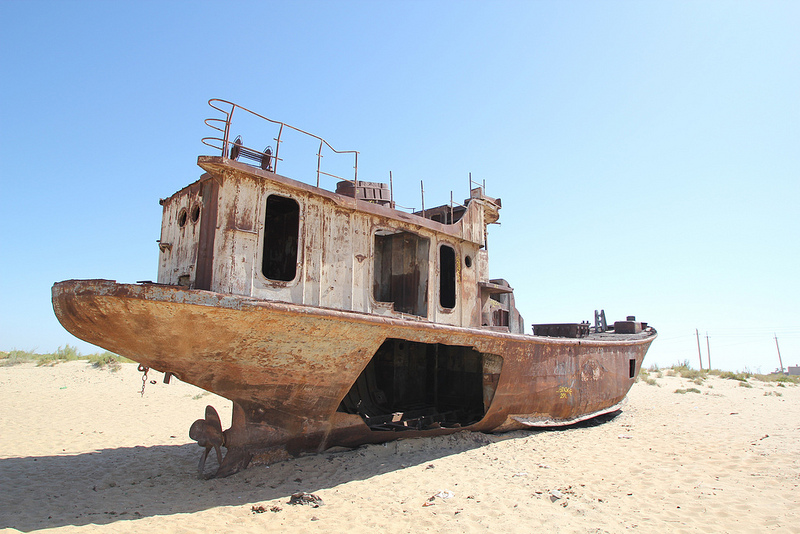
Aral Sea Ship

CC Image courtesy of farflungistan on Flickr

The 2005 movie Sahara centered around the disappearance of a Confederate ironclad at the end of the Civil War. Matthew McConnaughey’s character, Dirk Pitt, is endlessly jibed for thinking the ship could have ended up in the African desert. Although Dirk is eventually proved correct when the ship is discovered in the desert, he would have faced much less derision had he been looking for a ship in the deserts of Uzbekistan.

The Aral Sea, located between Uzbekistan and Kazakhstan, was once one of the largest lakes in the world. Beginning in 1918, though, Soviet central planners decided that cotton exports from the region were of vital importance and trumped all other considerations. Beginning in the 1930s, numerous irrigation canals were constructed to divert water from the rivers feeding the Aral Sea to cotton fields throughout the region. This decision devastated the ecosystem of the region, though, and the Aral Sea began to shrink in the 1960s as the irrigation canals robbed the Aral Sea of the inflows necessary to maintain its water levels. The sea had declined so much by 1987 that it split into two separate entities – the North Aral Sea located mainly in Kazakhstan and the South Aral Sea in Uzbekistan. The reduction in freshwater inflows spiked the salinity of the sea, devastating the fishing industry. Additionally, the continued receding of water levels left dozens of vessels high and dry in what has now become a desert.

Fortunately for residents of Kazakhstan, Kazakh authorities have worked to refill the North Aral Sea and it is now growing. Uzbekistan, though, has chosen to continue to divert inflows to irrigation which has resulted in further desertification of the area.

Richard Montgomery

The remains of SS Richard Montgomery
CC Image courtesy of tomylees on Flickr

Today marks the 68th anniversary of the abandonment and beginnings of salvage on the SS Richard Montgomery. The ship ran aground near an approach channel to the Thames River on August 20, 1944 and salvage operations began on August 23rd after it was determined the ship could not be saved. Named after Revolutionary War General Richard Montgomery, the SS Richard Montgomery was a Liberty Ship carrying a cargo of ammunition from the United States to the UK. Liberty Ships were designed by William Francis Gibbs to be cheap, mass-produced cargo haulers for the Allied powers during World War Two. Over 2,500 were built and only two survive today, carrying on service as museum ships – SS Jeremiah O’Brien and SS John W. Brown.

Salvage operations were unable to remove all of its deadly cargo and according to a survey performed in 2010 by the UK Maritime and Coastguard Agency, the wreck has 1,500 tons of high explosives still aboard. Due to the presence of so many tons of TNT, the ship remains a serious hazard to navigation and is closely monitored with yearly surveys by UK authorities. A detonation of the ship’s cargo could occur from natural deterioration, a collision with another vessel or even an act of terrorism and would result in an explosion 1/12th the size of the atomic bombs dropped on Hiroshima and Nagasaki. The BBC reported in 2004 that UK authorities believe an explosion could cause a 1,000 x 10,000 foot column of debris and water as well as a 16 foot high wave that would swamp low lying coastal areas.

In death, the SS Richard Montgomery has taken on a pop culture life of its own and has been featured in numerous novels and tv shows. It was even the centerpiece of the fictionalized plot of a 1970s novel wherein terrorists attempted to use speedboats to detonate the ship’s explosives and wreak havoc on the English coast.

Shackleton’s Whiskey

August 22, 2012 — 1 Comment
Shackleton's Whisky

CC Image courtesy of sandwichgirl on Flickr

Two years ago, three bottles of whisky were recovered from the base camp Sir Ernest Shackleton used during his British Antarctic Expedition (1907 – 1909). Shackleton and his team approached to within ~100 miles of the South Pole and turned back after Shackelton decided it would be too risky to continue. Two years later Captain Robert Scott’s Terra Nova expedition would return to successfully reach the South Pole (although they were beaten by a month by Norwegian Roald Amundsen), but perished on the return journey. Shackleton had been on Captain Scott’s Discovery Expedition in 1904 and later returned to the South Pole as commander of the Imperial Trans-Antarctic Expedition (1914 – 1917). The Imperial Trans-Antarctic Expedition is most famous for the loss of the ship Endurance and the subsequent account of the travails of the crew.

Fast-forward to 2010 and the recovery of the three bottles of whisky by the Antarctic History Trust. Although the whisky was not frozen due to its alcohol content, the bottles were slowly thawed in a New Zealand conservation lab. In 2011, they were then turned over to Whyte & Mackay, the distillery that succeeded the originally producer of the whisky. Using a painstaking process chronicled here and here, scientists at Whyte & Mackay discerned the whisky’s recipe and the distillery has released a limited run of 50,000 bottles of the whisky for sale.

SS United States

Launched in 1951, the trans-Atlantic passenger liner SS United States was a triumph of American engineering. Designed for speed, safety, comfort and easy wartime conversion to a troopship, the ship incorporated numerous innovations in its construction. During her maiden voyage, she captured the speed record known as the Blue Riband for both the eastern and western crossings of the Atlantic. Commercially operated from 1952 to 1969, the SS United States carried thousands of passengers between Europe and New York City in speed and style. Among her passengers were such notables as John Wayne, Bob Hope, Salvador Dali and the Duke and Duchess of Windsor.  Historian Steven Ujifusa’s recently published A Man and His Ship is a history of the SS United States and her designer, William Francis Gibbs. In his book, Ujifusa masterfully weaves together the biography of William Francis Gibbs, his quest to design the ultimate passenger liner and the construction and life of the SS United States.

Neatly divided into two parts, Ujifusa opens the book with William Francis Gibbs’ life prior to the construction of the SS United States. Gibbs had no formal training as a naval architect and yet he went on to a wildly successful career in naval architecture after designing and pitching a ship in collaboration with his younger brother. Ujifusa lays out Gibbs story in a manner compelling to any reader interested in what drives individuals to the pinnacle of success in their field. The second half of the book focuses on Gibbs’ crowning achievement – the design, construction, life and record-breaking performance of  the SS United States. Ujifusa writes with a style easily accessible to a layperson and doesn’t require a knowledge of the minutiae of naval architecture.

Ujifusa concludes with the recent history of the ship including an unsuccessful attempt by Norwegian Cruise Lines to utilize the ship as a cruise liner and the current plan by the SS United States Conservancy to convert the ship to a floating hotel/conference center in Philadelphia or New York City. In sum, A Man and His Ship is a page turning tome celebrating the ingenuity, self-motivation and indomitability of the American spirit.