Archives For November 30, 1999

jolly roger

CC Image Pirated From Scott Vandehey on Flickr

To recognize International Talk Like a Pirate Day, here are a few piratical items of note…

Captain Morgan, the Diageo owned rum distiller, funded excavations at the site of the real Admiral Morgan’s shipwreck this summer. No word if any rum has been found aboard the wreck or if the salvage crew were cited for operating an ROV under the influence.

Excavations continue on both Captain Sam Bellamy’s Whydah and Blackbeard’s Queen Anne’s Revenge. Artifacts from both wrecks can be viewed at their respective museums in Provincetown, Massachusetts and Beaufort, North Carolina.

According to the Maritime Executive, there were 17 pirate attacks just last month. This month, pirates even fired upon an Italian naval helicopter. A map of pirate attacks in 2012 can be viewed here.

Last year, 35 people lost their lives while being held hostage by Somali pirates. As of August 30, there were 11 vessels and 188 hostages being held by Somali pirates. In addition to the human costs of piracy, experts estimate that the financial costs of piracy was around $6.6 – 6.9 billion in 2011 alone.

Piracy along the coast of Somalia has become such a problem that one of the primary reasons for the 2007 creation of the US’s Africa Command (AFRICOM) was the fighting of piracy. It’s rumored that the servicemen of AFRICOM will star in Disney’s upcoming film Pirates of the Caribbean: On Somali Tides.

submarine

Photo: US Navy

One wouldn’t expect to find a museum ship in Oklahoma, much less an American World War 2 submarine, but the USS Batfish has made its final resting place in Muskogee, Oklahoma just southeast of Tulsa. The Batfish, a Balao class submarine, was commissioned on August 21, 1943 and made 7 war patrols during the course of World War 2. She is officially credited with sinking 6 Japanese ships, however, her ship’s crew claimed 15 ships sunk and such discrepancies are not uncommon. Among those 6 ships were 3 Japanese submarinesgranting Batfish entry into the exclusive fraternity of submarines that have sent other submarines to the bottom. The Batfish and her crew earned a Presidential Unit Citation, 10 Bronze Stars, 4 Silver Stars and a Navy Cross for their actions in World War 2.

Following World War 2, the Batfish served as a training vessel in the Pacific Fleet and was decommissioned in 1969. In 1973, after much political wrangling by various parties, the Batfish made her final voyage up the Arkansas River to Muskogee where she now continues her service, this time as a museum and memorial to the valiant submariners who perished defending liberty and freedom in World War 2. The ship is open to visitors from March to November. 

Merchant submarine

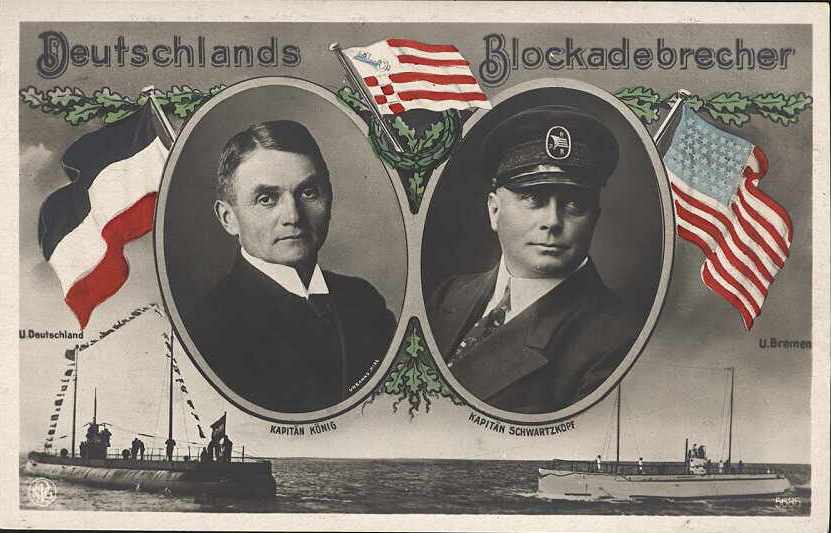
German Merchant Submarines Deutschland & Bremen
Photo: Kevin Heath

During World War I, the Royal Navy blockaded Germany’s North Sea ports and cut off all imports into the country. Desperate for imports of rubber, tin, nickel and other resources unavailable within their borders, the German merchant marine took a page from Jules Verne’s 20,000 Leagues Under the Sea and developed blockade running merchant submarines. The subs were built for the North German Lloyd Line and were designed to maximize cargo carrying capacity – unusual for vessels normally viewed as tools of war and not of trade.

The first sub, Deutschland, made her maiden voyage in June of 1916 and arrived in Baltimore, Maryland a month later carrying dyes, gemstones and pharmaceuticals. Deutschland had successfully threaded the needle of the Royal Navy blockade without even being detected. Returning with a load of valuable nickel, tin and rubber, the Deutschland’s maiden voyage not only paid for itself, but it netted a massive profit for her North German Lloyd Line owners.

The Deutschland made one more voyage to the United States before deteriorating relations between the US and Germany precluded further trade. Deutschland was later converted to u-boat use by the Imperial German Navy, sank 42 vessels and was turned over to the Royal Navy after the Armistice. The Deutschland’s sister ship, Bremen, sailed for the US in September of 1916, however, she never arrived and was presumed lost at sea. One of Bremen’s oil stained life preservers was discovered near Cape Elizabeth, Maine indicating the ship may have made its way as far the American coast. The ship’s disappearance, though, remains a mystery. Various reports indicate she might have been depth charged or mined by Royal Navy vessels, but perhaps Bremen felt drawn to her Jules Verne origins and fell prey, like Captain Nemo and the Nautilus, to the Moskstraumen.

One of the most unusual clashes in naval history occurred on September 14, 1914 when two former passenger liners fought one another off the coast of Brazil’s Trinidada Island. At the outbreak of World War 1, both the British and German navies put into effect plans calling for the arming of certain ships as auxiliary cruisers to act as wartime supplements to their naval forces. Two such ships were the SS Cap Trafalgar and RMS Carmania.

The SS Cap Trafalgar had been built in 1913 and operated between Hamburg, Germany and South American ports. Following the declaration of war, her civilian crew was replaced by officers and seaman of the German Imperial Navy and she was armed with 2 4.1in. guns. Thus she became SMS Cap Trafalgar and was charged with hunting down and sinking Allied shipping in the South Atlantic. SMS Cap Trafalgar’s opponent, RMS Carmania, was a British mail liner built in 1905 for the Cunard line’s Liverpool to New York route. Similar to SMS Cap TrafalgarRMS Carmania was commandeered by the British Admiralty and became HMS Carmania on August 8, 1914 when she was armed with 8 4.7 in. guns. Unlike Germany’s auxiliary cruisers, Britain utilized its cruisers to protect merchantmen or assist in the hunt for Germany’s merchant raiders.

The two ships were destined to come across one another after each were given orders to proceed to Trindade Island – the Germans were to rendezvous with colliers and the British suspected the island was being used by the Germans as a supply point. Caught with two colliers in broad daylight, the Cap Trafalgar at first fled from the pursuit of the Carmania, however, the Germans reversed course and turned to engage the Carmania. After a brisk 70 minute battle, with both ships ablaze and holed below the waterline the Cap Trafalgar capsized and sank with the loss of 51 officers and crew. While the Cap Trafalgar had been sunk, it had inflicted serious damage on the Carmania and she required extensive repairs at Gibraltar’s dry dock. The Carmania finished out the war in British service and was eventually scrapped in 1932. Even though it involved two of the largest, fastest and most expensive ships in the world, the engagement was of little strategic consequence and is now merely a strange footnote in naval history.

Me-323

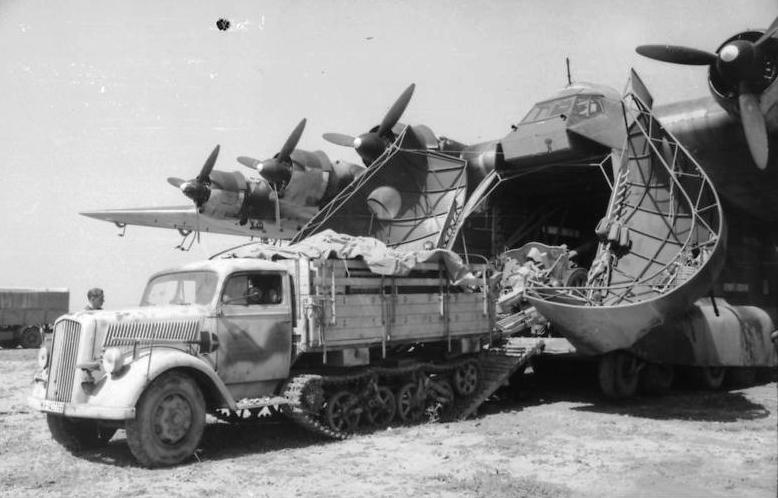
Messerschmitt 323 Gigant Disgorging Cargo

A year of researching obscure World War 2 era archival materials has paid off for Italian diver Cristina Freghieri and her team of divers. Although looking for a different wreck, the group discovered the intact remains of a Messerschmitt 323 Gigant downed by a Royal Air Force Bristol Beaufighter on July 26, 1943. The wreck was discovered nearly intact approximately 8 miles off Italy’s Maddalena Islands. Only ~200 Me 323 Gigants were produced during World War 2 and none survive today, thus there is a distinct possibility that the plane will be recovered and restored. Earlier this year the German Navy recovered the remains of a Ju 88 from the Baltic Sea with plans to restore and display the plane at the German Historical Museum’s Air Force Museum.

The Me 323 Gigant was developed from a glider design the Luftwaffe had commissioned in October 1940. The plane could accommodate up to 100 assault troops or 10-12 tons of cargo (by comparison a C-130 can lift 22.5 tons) in the form of field artillery and its halftrack, two trucks or even the ubiquitous 88mm flak gun. By the time they were deployed in late 1942, the Luftwaffe had begun to lose air superiority and the Gigant often fell prey to Allied fighters due to its slow speed. Due to its low volume of production and Allied air superiority, the Gigant never lived up to its full potential.

Winter War

Photo: Wikimedia Commons

In November of 1939, Soviet forces invaded Finland with the intention of bringing additional territory into the communist fold. Even though the Soviet forces vastly outnumbered the Finns, Finnish troops put up a heroic resistance and the conflict was resolved 4 months later with the loss of ~11% of Finland’s pre-war territory. Thus when Nazi Germany launched its invasion of the Soviet Union on June 22, 1941 the Finns were quick to lend their support to the Nazis in an effort to regain their lost territory.

Flowing from this cooperation was the use of Finnish naval forces to screen against Soviet naval forces while German ground forces advanced through the Baltic states. In one such operation, Operation Nordwind, one of Finland’s two capital ships, the Ilmarinen, struck a mine and sank with 271 casualties. The loss of the Ilmarinen on September 13, 1941 was devastating to the tiny Finnish Navy. For a force consisting of only 3,800 officers and sailors, the loss represented  7% of Finnish naval forces. By comparison, less than .8% of the US Navy perished in the attack on Pearl Harbor.

The Ilmarinen had been built in the 1930s as a coastal defence ship for the purpose of defending the numerous islands and islets of Finland’s Baltic coastline. Video of the ship in 1938 can be seen here (the Ilmarinen is the first ship shown in the video). The ship saw service in the Winter War defending the Finnish coast against the Soviet invaders and later shelled Soviet forces after the beginning of the German invasion.

Even though the Finns initially sided with the Nazis, they fought not for ideology, but for self-preservation. In September 1944, the Finns established a separate peace with the Soviets and engaged the Nazis in open combat in the Lapland region until the Nazis withdrew to Norway in April 1945.

British aircraft carrier

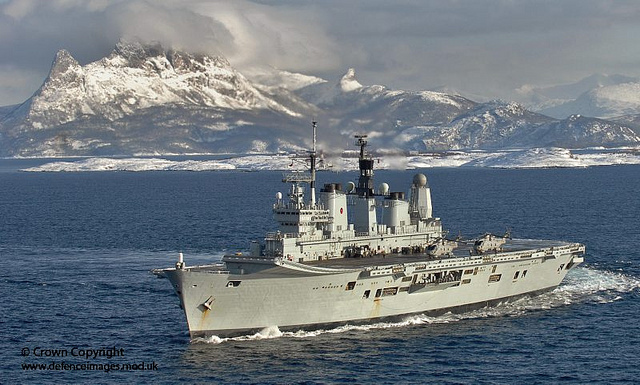
HMS Ark Royal off Norway in 2008
Photo: MOD

The Telegraph is reporting that the HMS Ark Royal, the Royal Navy’s only remaining aircraft carrier, is finally being sold for scrap. The ship was originally to remain in service until 2016 or 2017 when it would have been replaced by HMS Queen Elizabeth, the first of the Queen Elizabeth class aircraft carriers. Budgetary issues, though, caused the Ministry of Defence to rethink their time table and remove the ship from service early. The Ark Royal was decommissioned in March of 2011 and an internal debate within the UK government about its final disposal has caused delays in the decision. Among the various scenarios considered for the Ark Royal’s ultimate fate were it being sunk as a wreck site for divers, converted to use as a London heliport, converted into a Hong Kong casino, refitted for hotel use (much like the former Soviet carrier Kiev) or sold for scrap. Ultimately the Ministry of Defence chose to scrap the vessel for £3 million.

The Ark Royal was laid down in 1978 and commissioned in 1985. She was the third and final ship of the Invincible class carriers and was designed to operate short take-off and vertical landing (STOVL) aircraft and helicopters from her flight deck. Her sister ship HMS Invincible saw service in the Falklands War and was sold for scrap earlier last year. Her other sister ship HMS Illustrious served in the Balkans conflict of the 1990s and has since joined HMS Ocean as a helicopter carrier. Ark Royal was the fifth Royal Navy ship to carry the name with previous ships having fought against the Spanish Armada, the German High Seas Fleet, the Nazi Kriegsmarine (lost to a u-boat in 1941) and in post-World War 2 service. The current Ark Royal provided air cover for operations in the Balkans in 1993 – 1994 and in the invasion of Iraq in 2003.

Following the retirement of the the Ark Royal in March 2011, the UK Ministry of Defence sold its remaining Harrier STOVL jets to the US Marine Corps to be used for spare parts. This decision has left the Royal Navy with only 1 fixed wing aircraft until the entry of the F-35 into service. While the Ministry of Defence is much better prepared to resist an invasion of the Falklands than it was in the 1980s, the loss of its seaborne fixed-wing aircraft capability until 2016 has left the UK increasingly reliant on allies (such as the French in their agreement to jointly operate the Charles de Gaulle) in the shaping of its foreign policy. Gone are the days when an enlightened British citizenry could call for the outlawing of the slave trade and the Royal Navy unilaterally enforce the prohibition. This further erosion of British autonomy has most assuredly set Lord Nelson and Winston Churchill to spinning in their graves.

Morro Castle Fire

Photo: Wikimedia Commons

78 years ago today, a devastating fire destroyed the passenger liner SS Morro Castle off the coast of New Jersey. Operating between Havana and New York City, the liner had been built in 1930, but her builders failed to incorporate the latest safety features into her design. The fire began in a storage room around 3am and quickly spread throughout the ship. The ship’s highly flammable materials, de-activation of the trip wires for the ship’s fire doors and poor structural design allowed the Morro Castle to be engulfed in flames in just minutes. 135 passengers and crew perished in the disaster and the Morro Castle was beached and later sold for scrap. 

Partly because the Morro Castle burned so close to shore (and was a beach front attraction for several weeks before being towed to the breaker’s yard), the disaster served as the catalyst for more stringent maritime safety laws in the form of the Merchant Marine Act of 1936. It also influenced an entire generation of naval architects, including William Francis Gibbs the designer of the SS United Statesto introduce multiple safety innovations in the next generation of passenger liners. Earlier this year, New Jersey authors Gretchen Coyle and Deborah Whitcraft published Inferno At Sea documenting the Morro Castle disaster. The authors interviewed survivors and archival materials to produce the most recent account of the maritime tragedy.
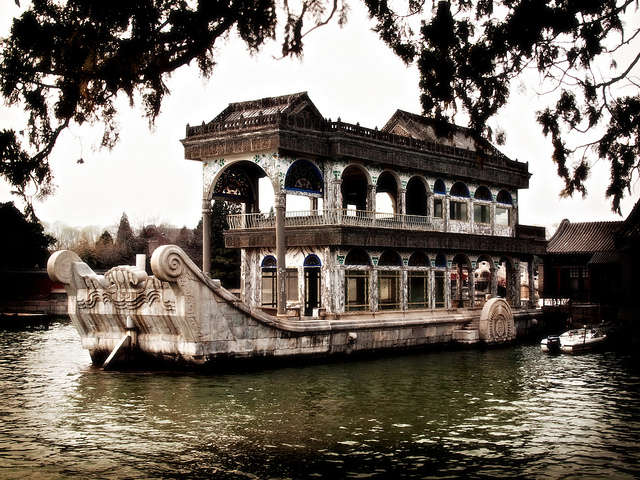
Ci Xi Marble Boat

CC Image courtesy of Kevin Poh on Flickr

Today marks the 111th anniversary of the end of the Boxer Rebellion. Inspired by anti-imperialist sentiment and religious mysticism, the Boxers were a nationalist Chinese group which rose up against Westerners across China in late 1899. Thousands of Chinese Christian converts, Western missionaries and other Western ex-pats were slaughtered in the ensuing violence. The Rebellion culminated in a 55 day siege of the foreign embassies in Peking which was finally lifted when 20,000 troops from Austria-Hungary, Germany, Great Britain, France, Italy, Japan, Russia and the US fought their way into Peking.

In a strange twist, the Boxer Rebellion owes much to the marble edifice pictured above – the Marble Boat on the grounds of the Summer Palace in Peking. Originally built in 1755, the structure was renovated in 1893 by order of the Empress Dowager Ci Xi with funds intended for modernizing the Chinese navy. Instead of funding the construction of a modern navy that could have kept Western forces at bay and prevented the further divvying up of China between competing Western nations, the Chinese built a ship useful only for delighting courtesans and guests of the Empress.

89 years ago today, air power advocate General Billy Mitchell sank the battleships USS New Jersey and USS Virginia in his third demonstration of the potential of air power in naval warfare. General Mitchell proved that only a handful of bombers and airmen could render impotent 2 former crown jewels of the US Navy.

Two years earlier, in July of 1921, General Mitchell had successfully sunk the former German dreadnought SMS Ostfriesland and vindicated his theory that precision bombing could sink naval vessels. General Mitchell followed up several months later with further tests on the USS Alabama. While tactical bombing had been performed on both sea and land during World War I, no naval vessel had yet fallen prey to air power until Mitchell’s successful tests off the Virginia coast.

After World War I, General Mitchell returned to the US convinced that air power could fundamentally change the way naval warfare was waged. Facing opponents both within the military and in the halls of Congress, Mitchell’s tests on the Alabama, New Jersey, Ostfriesland and Virginia helped pave the way for the age of the aircraft carrier and the obsolescence of the big-gun battleship. General Mitchell was later court-martialed for statements he made about the competence of certain Army commanders. Although Mitchell passed away prior to World War II, his foresight proved prescient as numerous battleships succumbed to air power during the war, most notably HMS Prince of Wales & HMS Renown and the Japanese super-battleship Yamato. The North American B-25 Mitchell bomber was named for General Mitchell – 16 of which would later be launched from the USS Hornet in the Doolittle Raid against the Japanese home islands in 1942.