Archives For November 30, 1999

jolly roger

CC Image Pirated From Scott Vandehey on Flickr

To recognize International Talk Like a Pirate Day, here are a few piratical items of note…

Captain Morgan, the Diageo owned rum distiller, funded excavations at the site of the real Admiral Morgan’s shipwreck this summer. No word if any rum has been found aboard the wreck or if the salvage crew were cited for operating an ROV under the influence.

Excavations continue on both Captain Sam Bellamy’s Whydah and Blackbeard’s Queen Anne’s Revenge. Artifacts from both wrecks can be viewed at their respective museums in Provincetown, Massachusetts and Beaufort, North Carolina.

According to the Maritime Executive, there were 17 pirate attacks just last month. This month, pirates even fired upon an Italian naval helicopter. A map of pirate attacks in 2012 can be viewed here.

Last year, 35 people lost their lives while being held hostage by Somali pirates. As of August 30, there were 11 vessels and 188 hostages being held by Somali pirates. In addition to the human costs of piracy, experts estimate that the financial costs of piracy was around $6.6 – 6.9 billion in 2011 alone.

Piracy along the coast of Somalia has become such a problem that one of the primary reasons for the 2007 creation of the US’s Africa Command (AFRICOM) was the fighting of piracy. It’s rumored that the servicemen of AFRICOM will star in Disney’s upcoming film Pirates of the Caribbean: On Somali Tides.

civil war navy

Pulitzer Prize winning author James M. McPherson’s latest book, War on the Waters, is a concise naval history of the American Civil War. Most authors and historians focus on the great generals (Lee, Jackson, Grant, Sherman, etc.) or the great battles (Antietam, Chancellorsville, Gettysburg, Shiloh etc.) and often ignore the vital role the navies played in the conflict both on the rivers of the western Confederacy and the high seas. Entire books have been written on various aspects of the naval war – riverine warfare in the west, blockade running, Confederate merchant raiders, foreign intrigue in Europe and the innovations that made their debut in the conflict. McPherson neatly summarizes each of these topics and arranges them in easily digestible chapters that proceed in chronological order.

McPherson’s organization and writing style allow both the uninitiated reader and the Civil War buff to understand the ebb and flow of the conflict and the various personalities, events and inventions that influenced the war. Perhaps most importantly, McPherson accompanies his chapters with strategic or tactical level maps that enable the reader to understand the events which occur in the chapter. McPherson understands the unwritten rule that the inclusion of a relevant map is worth multiple pages of text in helping a reader establish an awareness of the events being described. Along with the maps, various etchings and photos accompany each chapter and neither maps nor illustrations are confined to a few pages in the center or the beginning of the book. This allows the reader to visually grasp the crux of each chapter and makes both the maps and the illustrations more relevant to the narrative being told.

Overall, War on the Waters is a fantastic single volume history of the Civil War’s naval history. McPherson hits all of the highlights of the Civil War – CSS Virginia vs. USS Monitor, blockade running, William B. Cushing’s daring raid on the CSS Albemarle, and the first successful attack by a submarine – in only 225 pages. War on the Waters is a welcome addition to the naval literature of the Civil War and will be enjoyed by anyone interested in American history, naval history or the Civil War.

Oliver Hazard Perry

CC Image courtesy of Archives de la Ville de Montreal on Flickr

Today marks the 199th anniversary of the Battle of Lake Erie fought between American and British forces for control of the Great Lakes region on September 10, 1813. After British forces captured Detroit, MI, American military planners decided to build a small fleet near Presque Isle to wrest back control of Lake Erie and allow the recapture of Detroit. A force of 9 ships were quickly hewn from local forests and Master Commandant Oliver Hazard Perry sent to take command of the force.

On the morning of September 10, 1813, 6 ships under the command of Royal Navy Commander Robert Heriot Barclay moved to sweep the American force from the lake. While outnumbered 6 to 9, the Royal Navy squadron possessed more cannons (63) than the Americans (54) and the British cannons had a longer range than the Americans which had primarily equipped their ship with close-range carronades.

In a tribute to Captain James Lawrence who had lost his life aboard the USS Chesapeake earlier that year, Perry’s battle flag stated “Don’t Give Up the Ship.” At the outset of the battle, Barclay’s squadron had the advantage over the American vessels as possession of the weather gauge allowed his ships to outmaneuver the Americans and use their longer range fire power to pound the Americans. The British used their advantage to batter Perry’s flagship USS Lawrence into a hulking wreck, but undeterred, Perry transferred his flag from the Lawrence to the USS Niagara where he continued the action. Perry’s fleet had not let the British escape unscathed, though, as Commander Barclay and several of his officers had been wounded, putting command of the ships in the hands of less experienced officers. The British attempted to wear-to in order to bring their opposite broadsides to bear on Perry’s bruised fleet, but miscommunication and poor seamanship caused two of the British vessels to collide. Perry then split the British column, a maneuver even more deadly than “crossing the T,” allowing his ships to pour fire from both broadsides into the British squadron. This effective maneuver by Perry and his squadron devastated the British ships and one by one the squadron surrendered, giving Perry and his squadron the greatest American naval victory of the War of 1812.

Perry’s victory at the Battle of Lake Erie opened the door for an American invasion of Canada and the recapture of Detroit. It also was the first time an entire British squadron had surrendered in battle. Oliver Hazard Perry became an overnight American hero and his notification of victory, “We have met the enemy and they are ours,” has been forever written in American naval history. More than half a dozen ships, including a class of modern-day frigates, have been named in his honor and the latest ship to bear his name is currently under construction in Perry’s home state of Rhode Island.

Viking Longboat

The Viking by C. Graham. 1893.

In 1892, Norwegian Magnus Andersen embarked on an ambitious project – building a full-size replica of the Gokstad Viking ship that had been discovered 12 years earlier in a burial mound near Gokstad, Norway. As if replicating a nearly 80 foot wooden ship wasn’t enough, Andersen then sailed the ship from Norway to New York City up the Hudson River to the Erie Canal through the Great Lakes and finally to Chicago for the World’s Columbian Exposition. Andersen’s exploits made waves both literally and figuratively at the Exposition and later as he sailed to New Orleans and back to Chicago.

The ship is now housed in Geneva, IL just outside Chicago and is considered one of Illinois’ most endangered historical landmarks. Friends of the Viking Ship have stepped up to preserve the ship and are currently resolving legal ownership issues so they can raise money to permanently house the ship in a climate controlled facility. The ship is open to the public from 1 – 4pm this Saturday (September 15, 2012) as well as October 20, 2012. For more information, see the Friends of the Viking Ship website.

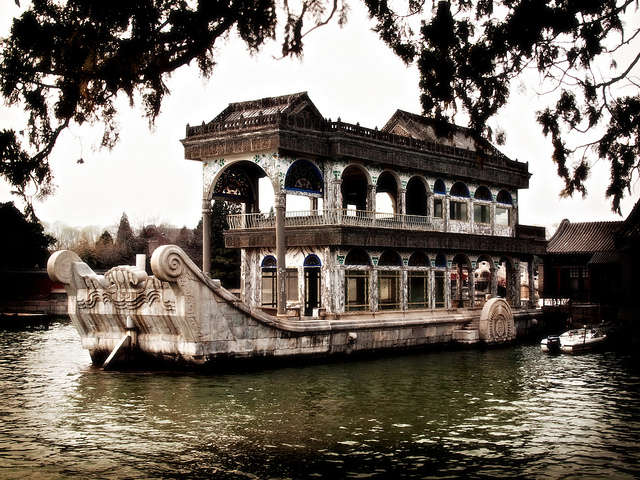
Ci Xi Marble Boat

CC Image courtesy of Kevin Poh on Flickr

Today marks the 111th anniversary of the end of the Boxer Rebellion. Inspired by anti-imperialist sentiment and religious mysticism, the Boxers were a nationalist Chinese group which rose up against Westerners across China in late 1899. Thousands of Chinese Christian converts, Western missionaries and other Western ex-pats were slaughtered in the ensuing violence. The Rebellion culminated in a 55 day siege of the foreign embassies in Peking which was finally lifted when 20,000 troops from Austria-Hungary, Germany, Great Britain, France, Italy, Japan, Russia and the US fought their way into Peking.

In a strange twist, the Boxer Rebellion owes much to the marble edifice pictured above – the Marble Boat on the grounds of the Summer Palace in Peking. Originally built in 1755, the structure was renovated in 1893 by order of the Empress Dowager Ci Xi with funds intended for modernizing the Chinese navy. Instead of funding the construction of a modern navy that could have kept Western forces at bay and prevented the further divvying up of China between competing Western nations, the Chinese built a ship useful only for delighting courtesans and guests of the Empress.

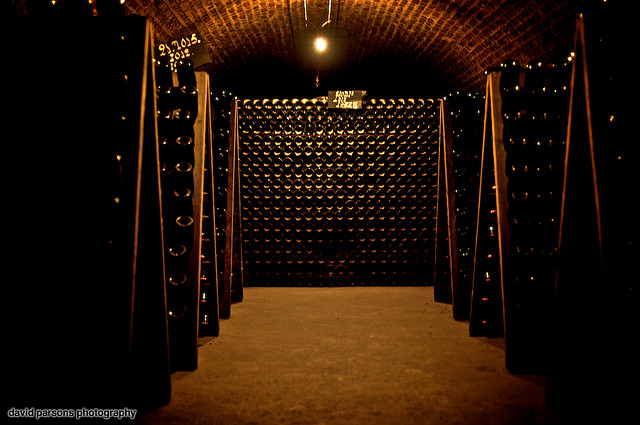
Finland Shipwreck Champagne

CC Image courtesy of David Parsons on Flickr

According to the German publication Deutsche Welle, another 8 bottles from a 168 bottle collection of champagne are set to go under the auctioneers hammer. The champagne was discovered two years ago by diver and (ironically enough) brewery owner Christian Ekström. Ekström was exploring a wrecked schooner off the coast of the Åland Islands when he came upon the bottles at the site. Researchers believe the schooner sank in the 1840s making Ekström’s find the oldest champagne ever found. Now, two years after the discovery, 10 of the bottles have been sold at auction with one, a Veuve Clicquot, selling for a record breaking $26,700. Authorities on the Åland Islands plan to hold auctions of the champagne over the next few years as a method of bringing tourists to the area.

Ekström’s find isn’t the first fermented treasure trove found in the Baltic as there have been both beer and other champagne caches discovered in recent years. The discovery and re-creation of Antarctic explorer Sir Ernest Shackleton’s whiskey, though, is still perhap the most noteworthy alcoholic find of the past few years.

Charleston, SC Civil War

The Attack on Fort Sumter, Currier & Ives

Archaeologists from the University of South Carolina just completed a 4 year long survey of Charleston, South Carolina’s Civil War naval battlefield. While many associate Charleston with the attack on Fort Sumter or the CSS Hunley, the city was the scene of multiple naval engagements and an important port for Confederate blockade runners. The archaeological team created a map of wrecks, gun emplacements and harbor obstructions in 2010 and has spent the last 2 years surveying some of those sites.

Among the sites are the wrecks of several Union ironclads that were sunk in action with Confederate land batteries or by “torpedoes” – early versions of what are mines in today’s naval parlance. The archaeologists also sought the wrecks of the “Stone Fleets” – a fleet of approximately 30 ex-whaling ships and merchant vessels purchased by the US Navy, stripped of all valuable implements, loaded with stone and then sunk as block ships in the approach channels to Charleston Harbor. Because the ships were wooden hulled and had been stripped of most of their metal fittings, the USC team had to rely on side scan sonar, further complicating the task of locating the ships. The remains of Confederate blockade runners were also surveyed by the team, including a set of three wrecks that are now buried beneath dry land due to the shifting sands of the beach. The survey will be helpful not only to historians, but also to the US Army Corps of Engineers and other planning entities for the avoidance of wrecks and other obstructions in the harbor.

Last week, researchers announced the discovery of the famous polar exploration vessel SS Terra Nova in waters off the southern coast of Greenland. SS Terra Nova was discovered during routine tests of mapping equipment aboard the Schmidt Ocean Institute’s R/V Falcor. The ship is lying in less than 160M of water, but its exact location has not been disclosed by Schmidt Ocean Institute.

Lost in 1943 after a collision with an ice pack, the SS Terra Nova was built in 1884 to withstand the rigors of operating as a whaler and sealer in polar regions. Following a ten year commercial career, the ship served the Jackson-Harmsworth Arctic Expedition from 1894 – 1897. Terra Nova is most famous, though, for its role in Captain Robert Scott’s doomed Terra Nova Expedition (1910 – 1912).  Captain Scott and his team of British explorers sought to become the first humans to reach the South Pole; however they were beaten by a Norwegian team led by Roald Amundsen. Amundsen’s party reached the South Pole on December 14, 1911, beating Scott by approximately 30 days. Scott’s team perished on their return trek and their bodies were not discovered until nearly 8 months later. In death, Scott was mythologized throughout his native Britain and has been the subject of numerous books and articles. Historians continue to debate his legacy – historian Roland Huntford’s The Last Place on Earth is a stinging critique of Captain Scott while polar explorer Sir Ranulph Fienne’s Captain Scott defends Scott and the choices he made during the expedition.

As this year’s recovery season winds down, noted exploration company Odyssey Marine is wrapping up two deep water recoveries (the SS Gairsoppa and SS Mantola) and currently on hold with the excavation of HMS Victory.  The 2012 season marked several firsts for Odyssey – the completion of a shipwreck salvage under government contract, the validation of their deepwater recovery methods and the beginnings of legitimacy for their role in “academic” archaeology with their efforts on the HMS Victory. What lies ahead for Odyssey is a question of much debate.  Below are five of the most discussed targets for Odyssey along with pros and cons for each.

1.  Merchant Royal – widely believed to be the target of Odyssey’s “Atlas” search, the Merchant Royal went down in a storm off Great Britain in 1641 with a cargo of gold and silver valued around ~1 billion in current dollars. This is the Holy Grail of shipwrecks and would be an incredible find both for the monetary and publicity windfall. Apart from the difficulty involved in locating the wreck, there are no significant cons to recovering the Merchant Royal.

2.  Prins Frederik – sunk in 1890 after a collision with the Marpessa in the Bay of Biscay, this Dutch mail steamer carried 400,000 silver rijksdaalders in its bullion room. Disputes over the actual location of the ship (and thus who was to blame for the collision) have created a wide search area and significantly affect the depth of water it could be located in – 500 feet if where the captain of the Prins Frederik claimed or 6,000 feet if where the captain of the Marpessa claimed. A British company claimed to have found the wreck in shallow water in 1994 which could generate legal issues for Odyssey if it is indeed the Prins Frederik. Odyssey could also face legal claims from insurers who paid out on claims or the Dutch government as the cargo was for payment of colonial forces in Indonesia. The Prins Frederik would be an excellent target for an arrangement similar to the Gairsoppa and Mantola where the Dutch government receives a portion of the proceeds after expenses.

3.  I-52 – re-discovered in 1995 by Paul Tidwell, the I-52 was sunk by American naval forces in 1944 while en route from Japan to Nazi Germany. The I-52 was carrying 2.2 tons of gold and now sits in 17,000 feet of water. While Odyssey’s deepwater recovery methods would enable recovery of the wreck, apart from a multi-party agreement on salvage rights between Tidwell, the Japanese government and Odyssey no recovery is possible. Tidwell has also stated he is pursuing recovery of the sub and it is doubtful Odyssey would be brought in on the deal.

4.  Port Nicholson – a British freighter loaded with $3 billion in platinum, the Port Nicholson was torpedoed off the coast of Massachusetts in 1942 and was located in 2008 by Sub Sea Research.  Sub Sea Research gained title to the ship in 2009 and planned recovery in 2012. No word has emerged on whether or not the group has been successful in their salvage and there are doubts as to whether the platinum even exists onboard.  If Sub Sea is unable to recover the wreck due to a lack of expertise or funding, then a collaboration with Odyssey would benefit both parties and be the most valuable recovery yet, surpassing even Odyssey’s Black Swan recovery (and subsequent loss).

5.  Bonhomme Richard – John Paul Jones’ famous flagship went down after his epic battle with HMS Serapis. The past few years have seen renewed efforts to find the ship, but any recovery would be limited by the doctrine of sovereign immunity. Because the Bonhomme Richard was an American warship it cannot be salvaged without the permission of the US government. An arrangement with the US government similar to that of the HMS Victory one is a possibility, but doubtful because the upside isn’t nearly as high as it is for other wrecks.

There are dozens of other wrecks Odyssey could be pursuing – the company claims to have dozens of high value shipwreck targets in its proprietary database. Based on Odyssey’s stated business model of pursuing high value targets with easily ascertainable legal ownership and inaccessible to normal salvors, Odyssey will most likely pursue deepwater commodity shipwrecks where the cargo can be quickly monetized and not the storied Spanish Galleons of treasure hunting lore.

Disclosure: I am an Odyssey Marine shareholder.

“When I was a boy, there was but one permanent ambition among my comrades in our village on the west bank of the Mississippi River. That was, to be a steamboatman.”

Chapter 4, Life on the Mississippi by Mark Twain

Mark Twain mined his rich experiences as a riverboat pilot to craft some of America’s finest novels. Recently, drought in the US Midwest has helped bring to the surface a piece of Twain’s beloved riverboat culture. In 1884 the Missouri River claimed yet another victim in the form of the 283 foot steamboat Montana, the largest stern-wheel steamboat to ever ply the Missouri’s waters.  Low water levels, though, have exposed a ~180 foot section of the boat’s hull.

Professors and students from East Carolina University’s Maritime Archaeology program previously conducted extensive excavations on the site and published their findings in The Steamboat Montana and the Opening of the American West.